Overview
Ling-3.0-flash-VL is the native multimodal model in Ant Group's Ling family. inclusionAI uploaded the weights to Hugging Face on 4 September 2026 under the MIT license, and describes it as built upon Ling-3.0-flash: it inherits that model's language, reasoning and long-context behaviour and extends it with image and video understanding. It carries 124 billion total parameters with only 5.5 billion activated per token, accepts image and video inputs, and supports a context window of up to 256K tokens.
The framing in the model card is that vision is not just another input. inclusionAI says the model brings visual information into the complete process of understanding, reasoning, acting and verification — advancing beyond image and video perception to solving real-world tasks through vision. The card groups the benchmark results into three capability dimensions: Understand (object counting, complex layouts, charts and document content), Reason (calculation, multi-step reasoning and external verification grounded in visual evidence), and Act (reading web and software interfaces, then turning what it sees into sequences of actions).
Architecturally, a ViT visual encoder extracts features from images and videos while a two-layer MLP projector aligns those features with text representations. VideoRoPE encodes both spatial position and temporal order, which is what supports event localisation, long-video question answering and video clip editing. The backbone is 42 layers alternating KDA and Gated MLA at a 5:1 ratio for efficient long-context processing across text, images, video and extended agent task histories, and the sparse MoE routing keeps the served cost near a 5.5B activation while retaining 124B of total capacity.
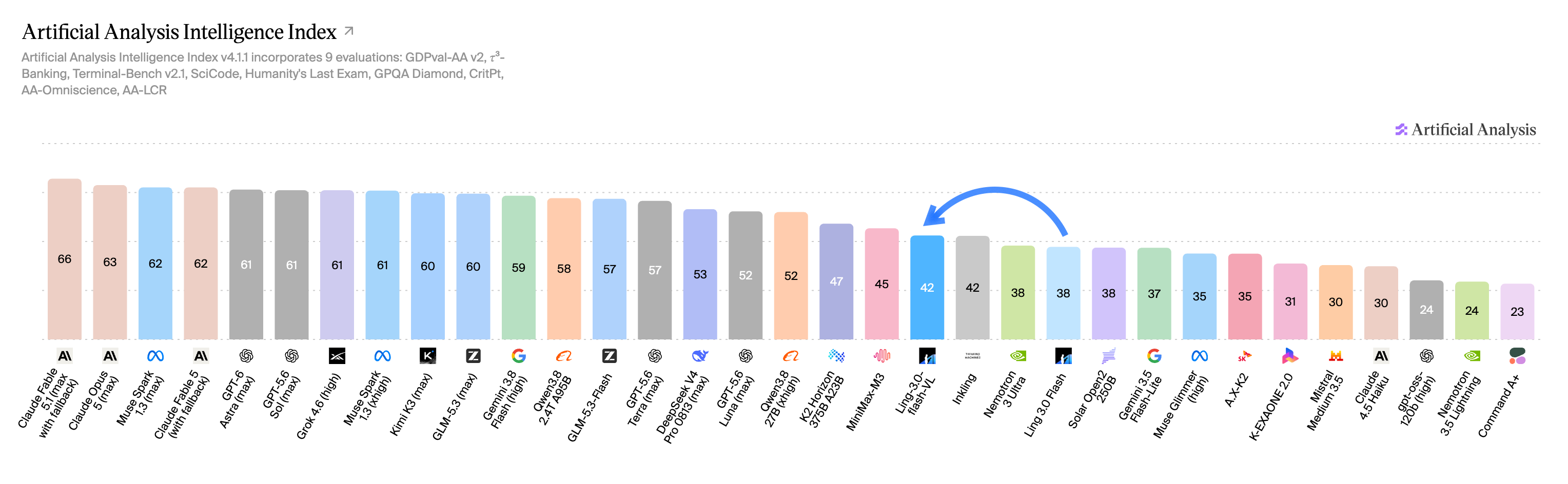
On the Artificial Analysis Intelligence Index v4.1.1 the model scores 42, four points above Ling-3.0-flash's 38 — inclusionAI's read is that adding visual capability improved overall intelligence rather than trading against it. Serving is documented for both SGLang and vLLM. SGLang runs from the published `lmsysorg/sglang:dev-Ling-3.0-flash-VL` image with a 256K context via YaRN on four 141GB-class GPUs (scaling to `--tp 8` on 80GB cards); vLLM runs through inclusionAI's own `vllm-ling-v3` fork with the `ling3` reasoning and tool-call parsers. Thinking mode is enabled by default in the chat template and can be disabled per request; inclusionAI recommends temperature 1.0, top-p 0.95 and top-k 20.
| Released | 2026-09-04 |
|---|---|
| License | MIT |
| Weights | Open weights |
| Parameters | 124B total · 5.5B activated per token (Mixture-of-Experts) |
| Context | 256K |
| Architecture | Sparse Mixture-of-Experts: a 42-layer hybrid backbone alternating KDA and Gated MLA layers at a 5:1 ratio, with a ViT visual encoder, a two-layer MLP projector and VideoRoPE |
| Modalities | Text, Vision, Video |
| Status | Generally available — open weights on Hugging Face |
Benchmarks
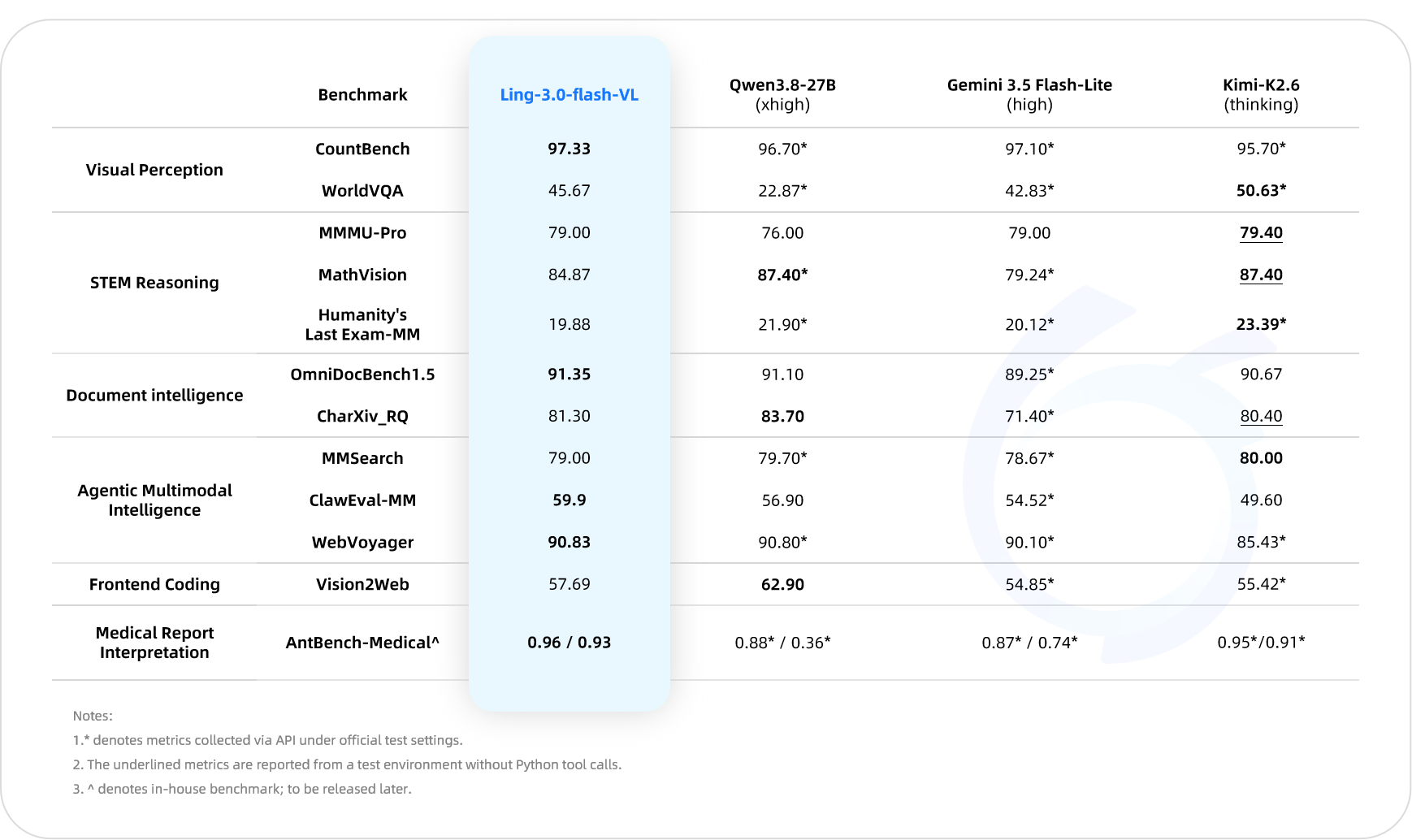
Ling-3.0-flash-VL against the peers inclusionAI named in its model card. Figures marked * in the source were collected via API under official test settings; AntBench-Medical is an in-house benchmark inclusionAI says will be released later.
| Benchmark | Ling-3.0-flash-VL | Qwen3.8-27B (xhigh) | Gemini 3.5 Flash-Lite (high) | Kimi-K2.6 (thinking) |
|---|---|---|---|---|
| CountBench | 97.33 | 96.7 | 97.1 | 95.7 |
| WorldVQA | 45.67 | 22.87 | 42.83 | 50.63 |
| MMMU-Pro | 79 | 76 | 79 | 79.4 |
| MathVision | 84.87 | 87.4 | 79.24 | 87.4 |
| Humanity's Last Exam-MM | 19.88 | 21.9 | 20.12 | 23.39 |
| OmniDocBench1.5 | 91.35 | 91.1 | 89.25 | 90.67 |
| CharXiv_RQ | 81.3 | 83.7 | 71.4 | 80.4 |
| MMSearch | 79 | 79.7 | 78.67 | 80 |
| ClawEval-MM | 59.9 | 56.9 | 54.52 | 49.6 |
| WebVoyager | 90.83 | 90.8 | 90.1 | 85.43 |
| Vision2Web | 57.69 | 62.9 | 54.85 | 55.42 |
| AntBench-Medical | 0.96 / 0.93 | 0.88 / 0.36 | 0.87 / 0.74 | 0.95 / 0.91 |
This model's scores
- Artificial Analysis Intelligence Index v4.1.142
- CountBench97.33%
- OmniDocBench1.591.35%
- WebVoyager90.83%
- MathVision84.87%
- CharXiv_RQ81.3%
- MMMU-Pro79%
- MMSearch79%
- ClawEval-MM59.9%
- Vision2Web57.69%
- WorldVQA45.67%
- Humanity's Last Exam-MM19.88%
Scores on a 0–100 scale (25-point gridlines); higher is better. Each benchmark links to its published source.
Strengths
- MIT-licensed open weights — downloadable, self-hostable, fine-tunable and usable commercially
- Native image AND video input, with VideoRoPE encoding temporal order for event localisation and long-video question answering
- Activates only 5.5B of 124B parameters per token, so multimodal capability does not carry a dense-model serving cost
- 256K context across text, images, video and long agent task histories
- Agentic multimodal results: 90.83 on WebVoyager and 59.9 on ClawEval-MM in inclusionAI's published comparison
- Documented SGLang and vLLM recipes, plus official FP8, INT4 and FP4 checkpoints for smaller deployments
Best for
- Computer-use and browser agents that read an interface visually and turn it into a sequence of actions
- Document intelligence over charts, complex layouts and scanned material where text-only extraction loses structure
- Long-video understanding: event localisation, question answering over long footage, and clip editing
- Self-hosted multimodal assistants at organisations that cannot send images or video to a hosted API
How to access
| Provider | Model ID |
|---|---|
| OpenRouter ↗ | inclusionai/ling-3.0-flash-vl |
FAQ
How does Ling-3.0-flash-VL differ from Ling-3.0-flash?
It is the native multimodal build of the same family. Ling-3.0-flash is text-only; Ling-3.0-flash-VL adds a ViT visual encoder, an MLP projector and VideoRoPE so it accepts image and video input. Activated parameters rise slightly, from 5.1B to 5.5B per token; total parameters (124B), the 256K context window and the MIT license are unchanged.
Is it open source?
The weights are published on Hugging Face and ModelScope under the MIT License, so you can download, self-host, fine-tune and use the model commercially. inclusionAI also publishes official FP8, INT4 and FP4 checkpoints.
How do I serve it?
Two documented paths. SGLang runs from the published lmsysorg/sglang:dev-Ling-3.0-flash-VL image; inclusionAI's recommended 256K-context recipe uses YaRN rope scaling on four 141GB-class GPUs (H20-3e / H200) or a 4-GPU Blackwell node, scaling to --tp 8 on 80GB cards. vLLM runs through inclusionAI's vllm-ling-v3 fork with --tool-call-parser ling3 and --reasoning-parser ling3.
Does adding vision cost it text performance?
inclusionAI reports the opposite. The model scores 42 on the Artificial Analysis Intelligence Index v4.1.1 against 38 for Ling-3.0-flash, and the model card's reading is that extending the model with visual capabilities further improves its overall intelligence performance.
Can it handle video, or only still images?
Both. Video input is passed in the same message shape as images using a video_url content block. VideoRoPE encodes spatial position and temporal order together, which is what supports event localisation, long-video question answering and video clip editing.
Is thinking mode on by default?
Yes — the chat template enables it by default. You can disable it per request with "chat_template_kwargs": {"enable_thinking": false}. inclusionAI recommends temperature 1.0, top-p 0.95 and top-k 20 per generation_config.json.