

Overview
Aion 1.0 Instruct is a small language model from the Applied Sciences Group in Microsoft's Windows & Devices division, built to run on the device rather than in the cloud. Microsoft's model card calls it the foundational small language model of the Windows ecosystem, aimed at everyday text and operating-system tasks such as summarization, rewriting, document question answering and chat. It succeeds Phi Silica, the previous Windows OS model, whose training data it extends.
Microsoft first shipped it as a developer preview in Edge Canary and Dev in June 2026, behind the browser's Prompt API and Writing Assistance APIs, which had run on the 4B Phi-4-mini; Microsoft said the smaller model reaches far more devices, including those with weaker GPUs and, through CPU inference, those with no GPU. The unquantized weights followed on Hugging Face on November 18, 2026 under the MIT license, alongside an ONNX WebGPU build; the model card says quantized versions come next, and that a further-optimized version paired with Microsoft's content-moderation model will become the Windows OS small language model by the end of January 2027.
The model has about 2.29 billion parameters across 28 layers, mixing 21 sliding-window attention layers with 7 full-attention layers to reach a 32,768-token context, enough for multi-page documents and long email threads on-device. It reads and writes English, German, Spanish, Portuguese, Italian, French, Chinese and Japanese, supports tool calling through its chat template, and has a December 2025 knowledge cutoff. Microsoft is explicit about the trade-offs of its size: it was not trained for world knowledge and can miss detail or struggle with complex multi-step reasoning.
| Released | 2026-11-18 |
|---|---|
| License | MIT |
| Weights | Open weights |
| Parameters | ~2.29B (dense) |
| Context | 32,768 tokens |
| Architecture | Dense decoder-only transformer: 28 layers, grouped-query attention (24 query / 8 key-value heads), hybrid attention with 21 sliding-window layers (window 2,048) and 7 full-attention layers, RoPE with YaRN scaling on the full-attention layers |
| Knowledge cutoff | 2025-12 |
| Modalities | Text |
| Status | Preview (open weights on Hugging Face; Windows release planned by end of January 2027) |
Benchmarks
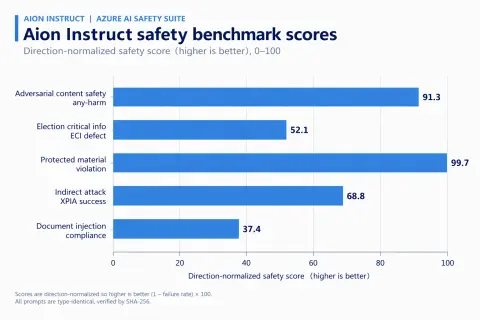
Scores on a 0–100 scale (25-point gridlines); higher is better. Each benchmark links to its published source.
Strengths
- Runs locally — Microsoft's Edge preview targets devices with less capable GPUs and, through CPU inference, devices without a GPU
- MIT-licensed open weights on Hugging Face, plus an ONNX WebGPU build for in-browser inference
- 32,768-token context from a hybrid of sliding-window and full-attention layers
- 83.9 on IFEval and 74.91 on GSM8K in Microsoft's lm-evaluation-harness runs
- Tool calling built into the chat template, and eight supported languages
Best for
- Reach for it to summarize, rewrite or answer questions over documents and email threads on a laptop without sending the text to a cloud model.
- Reach for it to prototype Windows and Edge on-device AI features ahead of its planned Windows release, or to fine-tune task adapters for it.
- Look elsewhere for world-knowledge questions, complex multi-step reasoning or high-stakes decisions — Microsoft's model card warns a model this small can miss fine details and is not trained to excel at world knowledge.
How to access
| Provider | Model ID |
|---|---|
| Hugging Face (weights) ↗ | microsoft/Aion-1.0-Instruct-2.3B |
| Hugging Face (ONNX WebGPU build) ↗ | microsoft/Aion-1.0-Instruct-2.3B-ONNX-WebGPU |
FAQ
What is Aion 1.0 Instruct?
A 2.3B-parameter small language model from Microsoft's Windows Applied Sciences Group, built to run on-device for summarization, rewriting, question answering and chat. It succeeds Phi Silica as the Windows OS small language model.
Is Aion 1.0 Instruct open-weight?
Yes. Microsoft published the unquantized bfloat16 weights on Hugging Face on November 18, 2026 under the MIT license, with an ONNX WebGPU build alongside; the model card says quantized versions will follow.
How large is its context window?
32,768 tokens, reached by combining 21 sliding-window attention layers with 7 full-attention layers that use YaRN scaling.
Which languages does it support?
English, German, Spanish, Portuguese, Italian, French, Chinese and Japanese. Microsoft notes that output quality may differ by language; multilingual data is about 6% of its training data.
When does it ship in Windows?
The model card says a further-optimized version, paired with Microsoft's content-moderation model, will become the Windows OS small language model by the end of January 2027.