
Overview
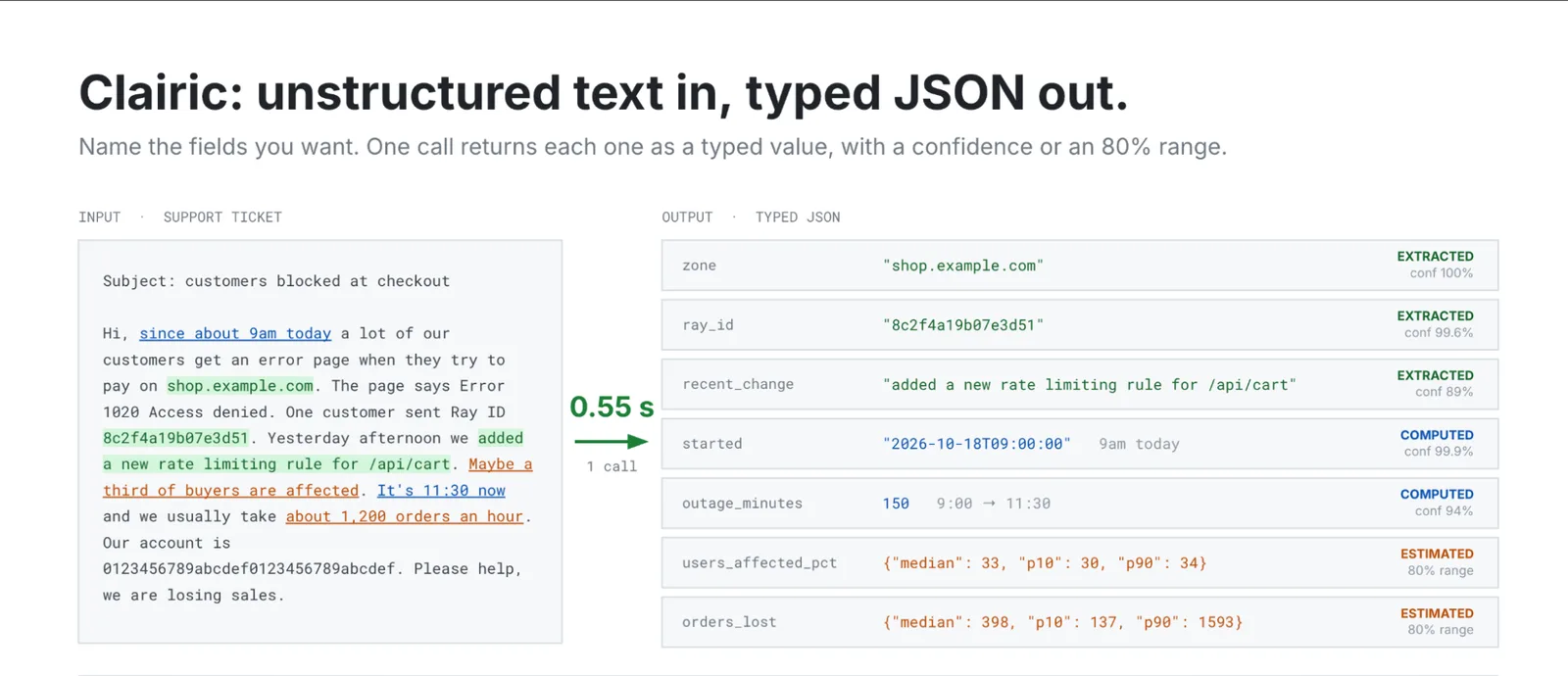
Clairic is an extraction model from Cloudflare's Workers AI team, announced in preview on October 19, 2026 as @cf/cloudflare/clairic. You pass it a piece of text (plus up to four images) and a list of named, typed fields — text, number, date, time, datetime, duration, list, estimate or forecast — and one call returns every field as a typed value. Each answer carries a confidence score, and estimates and forecasts come back as a median with an 80% interval (p10 to p90). A field it cannot determine comes back as null.
Cloudflare calls it a "System One" model: fast and precise, as opposed to a "System Two" model capable of deliberate reasoning such as GPT, Claude, Gemini or DeepSeek. It sits next to the decision models Jev and Cloudflare's own Clef, which answer typed questions; Clairic extracts, computes, estimates and forecasts values instead. It processes input tokens in a single forward pass and does not charge for output tokens. Cloudflare has not described the backbone or training, and says it intends to release the weights openly after more work.
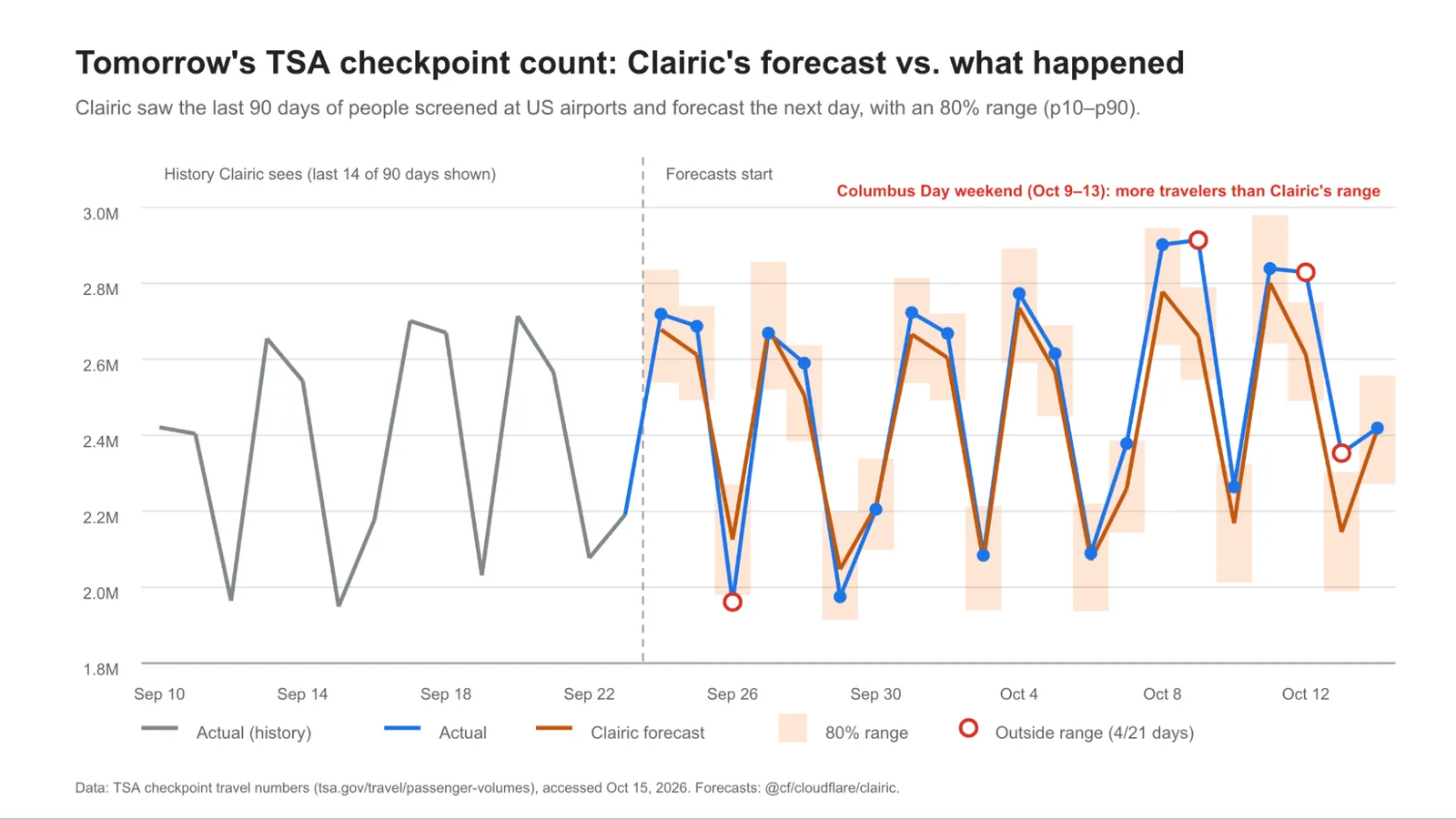
In the launch post, a claims-processing pipeline that chains Clairic (extract, 0.46 s), Clef (decide, 0.22 s) and GLM-5.3 (reply) ran end to end in 19.3 s against 61.7 s for the same three steps done by GLM-5.3 alone, and cost $6,032 against $11,740 per million claims. Asked to forecast the next day's US TSA checkpoint count from the previous 90 days, Clairic averaged a 3.3% error over 21 days, with 17 of the 21 actual counts inside its 80% range.
| Released | 2026-10-19 |
|---|---|
| License | Proprietary (Workers AI preview terms) |
| Weights | API only |
| Context | 65,536 tokens (Workers AI) |
| Modalities | Text, Vision |
| Status | Preview on Workers AI (announced October 19, 2026 as an early checkpoint); Cloudflare says open weights will follow. |
Pricing
| Input | $0.10 / 1M input tokens |
|---|
Workers AI preview price for @cf/cloudflare/clairic; Clairic does not charge for output tokens.
Strengths
- Typed output for text, number, date/time, duration, list, estimate and forecast fields in one call
- A confidence score on every answer, and a median plus 80% range for estimates and forecasts
- Reads text plus up to four images, such as receipts
- Sub-second extraction in Cloudflare's pipeline demo (0.46 s), billed on input tokens only at $0.10 per M
Best for
- Reach for it to pull IDs, dates, amounts and other named fields out of emails, tickets and receipts into JSON without parsing free text from a chat model.
- Reach for it when a value is not written down and you need an estimate with a range — a repair cost, a share of affected users — instead of a null or a guessed number.
- Reach for it as the first step of a pipeline, feeding typed fields to a decision model such as Clef and leaving only the open-ended reply to a large reasoning model.
- Reach for a System Two model such as GLM-5.3 instead when the task needs a written answer or multi-step reasoning rather than field values.
How to access
| Provider | Model ID |
|---|---|
| Cloudflare Workers AI ↗ | @cf/cloudflare/clairic |
FAQ
How is Clairic different from Clef?
Both are Cloudflare "System One" models on Workers AI. Clef is a decision model: it answers typed questions (yes/no, choice, score) with a probability per option. Clairic is an extraction model: it fills named, typed fields — text, numbers, dates, durations, lists, estimates and forecasts — from text and images, with a confidence score or an 80% range on each.
How much does Clairic cost?
Clairic costs $0.10 per million input tokens on Workers AI during the preview, and it does not charge for output tokens.
Are Clairic's weights open?
Not yet. At its October 19, 2026 preview Clairic is available only on Workers AI; Cloudflare says it intends to release the model with open weights after more work, without giving a date.
What are Clairic's input limits?
On Workers AI a request takes up to four embedded images (4 MiB each, 8 MiB in total) and the context window is 65,536 tokens. Remote image URLs are not accepted, and fields that do not fit in one 8,192-token pass are split across parallel passes.