
Overview
GPT-Rosalind is OpenAI's first domain-specific frontier reasoning model, purpose-built for life sciences research, drug discovery, and genomics. Named after Rosalind Franklin, it was introduced on April 16, 2026 and is available in research preview through OpenAI's trusted-access deployment structure to qualified enterprise customers in ChatGPT, Codex, and the API. Launch partners include Amgen, Moderna, the Allen Institute, and Thermo Fisher Scientific.
The model is tuned for multi-step scientific workflows over molecules, proteins, genes, pathways, and disease-relevant biology — covering evidence synthesis, hypothesis generation, experimental planning, genomics analysis, and interpretation of research data. In OpenAI's Codex evaluations, best-of-ten GPT-Rosalind submissions ranked above the 95th percentile of human experts on a prediction task and reached the 84th percentile on a sequence-generation task.
On June 3, 2026, OpenAI shipped expanded capabilities for GPT-Rosalind, combining GPT-5.5's agentic coding and tool-use with stronger drug-discovery domains such as medicinal chemistry and genomics. The updated model uses 31% fewer tokens than GPT-5.5 while improving accuracy on quantitative-biology workloads (21.6% vs 20.4% on GeneBench).
On September 8, 2026 the model left preview: OpenAI's API changelog lists `gpt-rosalind-research` as generally available through the trusted-access program for approved internal life sciences research, with standard pricing of $5 per 1M input tokens, $0.50 per 1M cached input tokens, and $25 per 1M output tokens. Access stays gated to eligible research organizations rather than open self-serve signup.
| Released | 2026-04-16 |
|---|---|
| License | Proprietary |
| Weights | API only |
| Modalities | Text |
| Status | Generally available (trusted-access program) |
Benchmarks
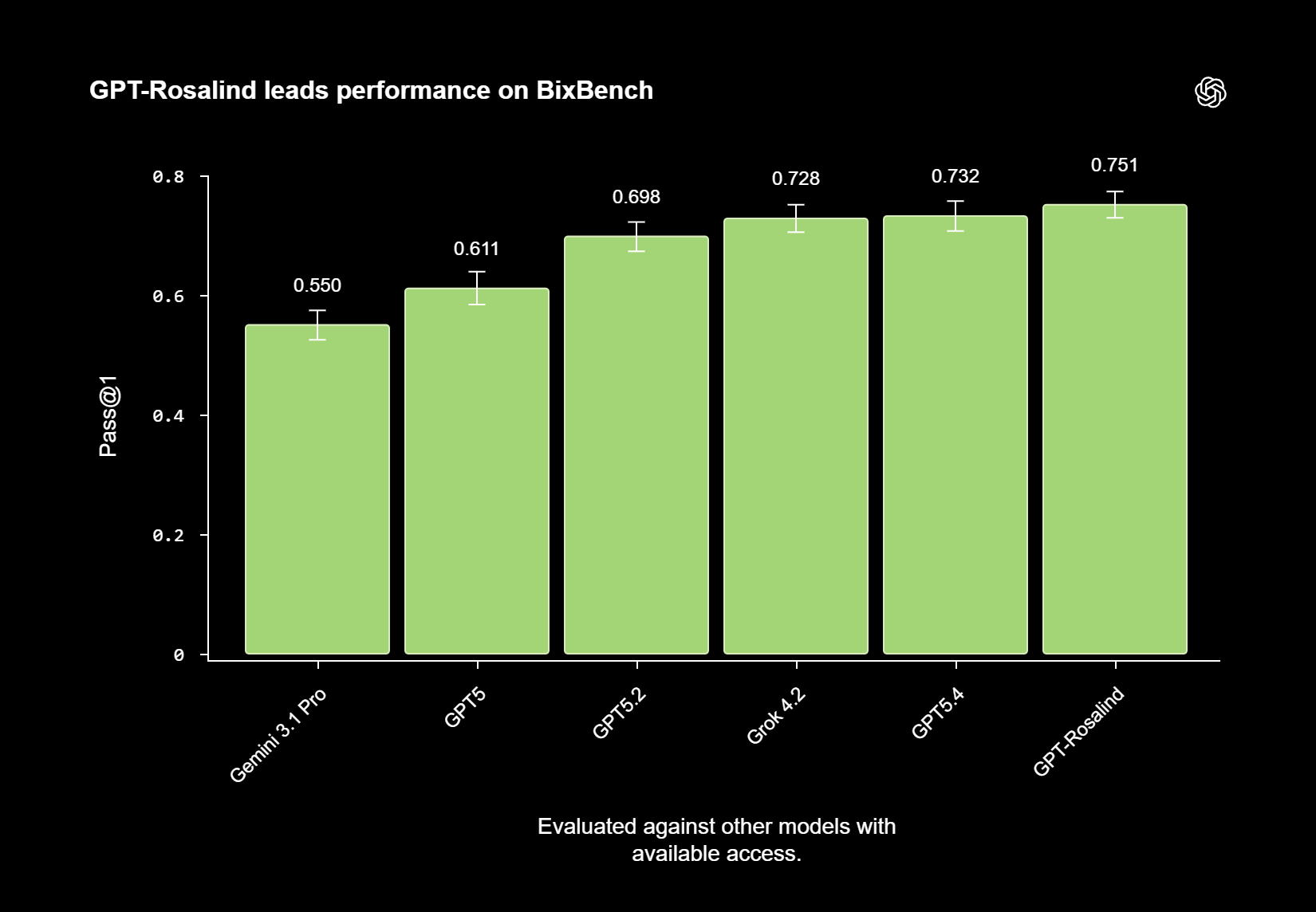
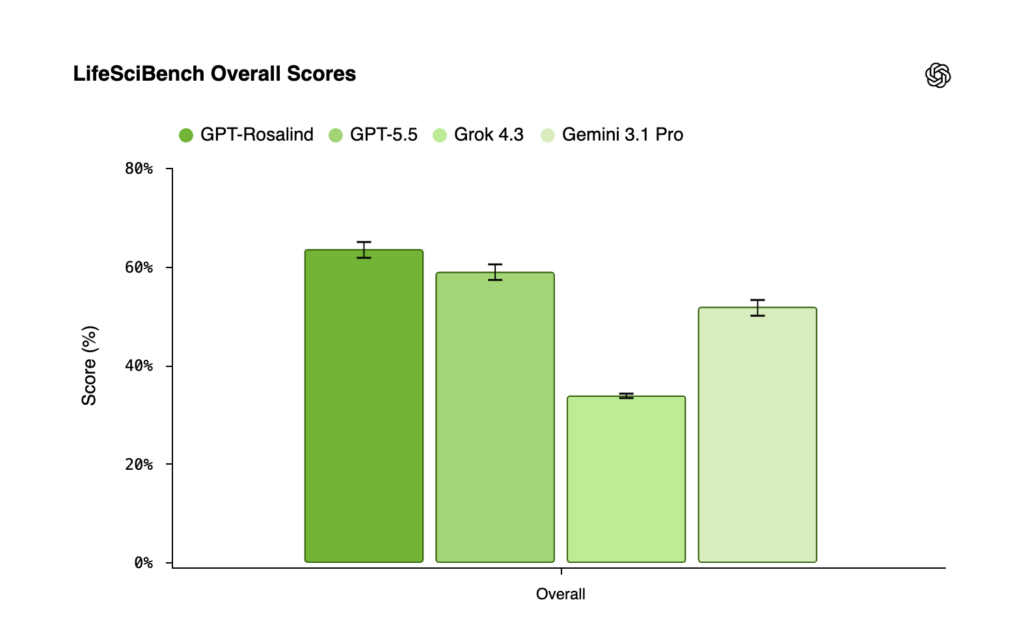
BixBench Pass@1 — GPT-Rosalind vs other models with available access (transcribed from OpenAI's published bar chart)
| Benchmark | GPT-Rosalind | GPT5.4 | Grok 4.2 | GPT5.2 | GPT5 | Gemini 3.1 Pro |
|---|---|---|---|---|---|---|
| BixBench | 0.751 Pass@1 | 0.732 Pass@1 | 0.728 Pass@1 | 0.698 Pass@1 | 0.611 Pass@1 | 0.55 Pass@1 |
This model's scores
- GeneBench (genomics & quantitative biology, accuracy)21.6%
- Codex prediction task (best-of-ten percentile vs human experts)95%ile
- Codex sequence-generation task (percentile vs human experts)84%ile
Scores on a 0–100 scale (25-point gridlines); higher is better. Each benchmark links to its published source.
Pricing
| Input | $5.00 / 1M tokens |
|---|---|
| Cached input | $0.50 / 1M tokens |
| Output | $25.00 / 1M tokens |
Standard pricing published with general availability on September 8, 2026; access remains gated to the trusted-access program.
Strengths
- Frontier reasoning tuned for biology, drug discovery, medicinal chemistry, and genomics
- Higher accuracy than GPT-5.5 on genomics/quantitative-biology tasks while using 31% fewer tokens (per OpenAI's June 2026 update)
- Top-tier results on OpenAI's Codex prediction and sequence-generation evaluations vs human experts
- Inherits GPT-5.5's agentic coding and tool-use abilities for scientific tool integration and Codex workflows
- Trusted-access deployment structure designed for legitimate research organizations with strong governance
Best for
- Reach for it for evidence synthesis and literature review across genomics, transcriptomics, proteomics, and clinical evidence.
- Reach for it for hypothesis generation, experimental planning, and wet-lab troubleshooting in drug-discovery workflows.
- Reach for it for medicinal-chemistry queries — turning molecules into useful drugs — and genomics or quantitative-biology analysis.
- Reach for it as an agentic lab assistant in Codex, connecting models to scientific tools and data sources via the trusted-access API.
How to access
| Provider | Model ID |
|---|---|
| OpenAI — trusted-access program ↗ | gpt-rosalind-research |
GPT-Rosalind in the news
- 2026-06-17MAJORLifeSciBench — OpenAI's 750-task benchmark for life-science research
- 2026-06-04NOTABLEOpenAI Updates GPT-Rosalind With GPT-5.5 Reasoning — New LifeSciBench Tops Internal Evals, Two Codex Life-Sciences Plugins Land, and Novo Nordisk Joins the Trusted-Access Roster
- 2026-05-29MAJOROpenAI Launches Rosalind Biodefense — Sponsored GPT-Rosalind Access for Trusted Pandemic-Prep Developers and US/Allied Governments, With Lawrence Livermore, Johns Hopkins APL, CEPI, Fourth Eon, and SecureDNA Onboard
- 2026-04-18NOTABLEAI NEWS recap — Claude Opus 4.7, Qwen 3.6, Happy Oyster, realtime 3D worlds, new Google TTS
- 2026-04-16MAJORGPT-Rosalind — OpenAI's first domain-specific frontier reasoning model, for life sciences
From the AI/TLDR release feed — every item is source-verified when it ships.
FAQ
What is GPT-Rosalind?
GPT-Rosalind is OpenAI's first domain-specific frontier reasoning model, purpose-built for life sciences research, drug discovery, genomics, and medicinal chemistry. It was introduced on April 16, 2026 and is named after Rosalind Franklin. It reached general availability on September 8, 2026 as the API model `gpt-rosalind-research`, offered to qualified research organizations through OpenAI's trusted-access program in ChatGPT, Codex, and the API.
Who can use GPT-Rosalind?
Access is gated. OpenAI offers GPT-Rosalind to eligible enterprise customers globally through its trusted-access deployment structure, designed for organizations conducting legitimate scientific research with clear public benefit and strong governance. Launch partners include Amgen, Moderna, the Allen Institute, and Thermo Fisher Scientific. Since general availability on September 8, 2026, approved organizations pay standard token pricing: $5 per 1M input tokens, $0.50 per 1M cached input tokens, and $25 per 1M output tokens.
How does GPT-Rosalind differ from GPT-5.5?
GPT-5.5 is OpenAI's general-purpose flagship; GPT-Rosalind is a narrower model tuned specifically for life sciences workflows. The June 3, 2026 update combines GPT-5.5's agentic coding and tool use with stronger reasoning over drug-discovery domains like medicinal chemistry and genomics, using 31% fewer tokens than GPT-5.5 while improving accuracy on GeneBench (21.6% vs 20.4%).
When was GPT-Rosalind released?
OpenAI introduced GPT-Rosalind on April 16, 2026 as a research-preview frontier reasoning model for life sciences, shipped expanded capabilities and broader scientific-workflow coverage on June 3, 2026, and moved the model to general availability as `gpt-rosalind-research` on September 8, 2026. Access stays limited to trusted-access partners throughout.