Overview
Kev is a family of small open decision models published by Jared Palmer, with the Kev-0.8B, Kev-4B, Kev-9B and Kev-27B weights released together on GitHub on September 20, 2026 under Apache-2.0. Instead of generating prose, a Kev request carries a piece of text (the state) plus typed questions — yes/no (noul), multiple-choice (choice) and rating (score) — and every answer comes back as a typed value with calibrated probabilities. The questions share the text but cannot read each other.
Kev follows the architecture described in the essay "Jev's Architecture Unmasked" and deliberately matches the API of TypeSafe's hosted Jev (System One), so TypeSafe's Python SDK works against a local Kev server unchanged. Kev-0.8B, 4B and 9B are LoRA adapters with a pointer head on Qwen3.5 base models and share one training recipe; Kev-27B starts from the post-trained Qwen3.8-27B. Each checkpoint ships with a temperature fitted on held-out data, so its probabilities are calibrated by default.
On the frozen out-of-domain suite (datasets and policy rules Kev never saw in training), Kev-27B scores 0.848 accuracy on the development split against 0.857 for Jev, and Kev-4B and Kev-9B land within four points. The README is explicit about the gaps: all sizes trail Jev on knowledge questions (MMLU: Kev-9B 0.74, Kev-27B 0.84, Jev 0.90), the smaller models trail on day-precision date arithmetic, and Jev ranks its answers better at a fixed error budget.
The repo includes a server (CUDA, ROCm or MLX on Apple Silicon), a one-command Modal deployment that scales to zero, a browser playground, and coding-agent skills that fine-tune a released checkpoint on your own labelled examples.
| Released | 2026-09-20 |
|---|---|
| License | Apache-2.0 |
| Weights | Open weights |
| Parameters | Four sizes: 0.8B, 4B, 9B and 27B |
| Context | 8,192 tokens for the state + 8,192 per question (server limit) |
| Architecture | LoRA (r=16) adapter plus a pointer head on Qwen3.5 base models (0.8B, 4B, 9B) and on the post-trained Qwen3.8-27B (27B) |
| Modalities | Text |
| Status | Generally available |
Benchmarks
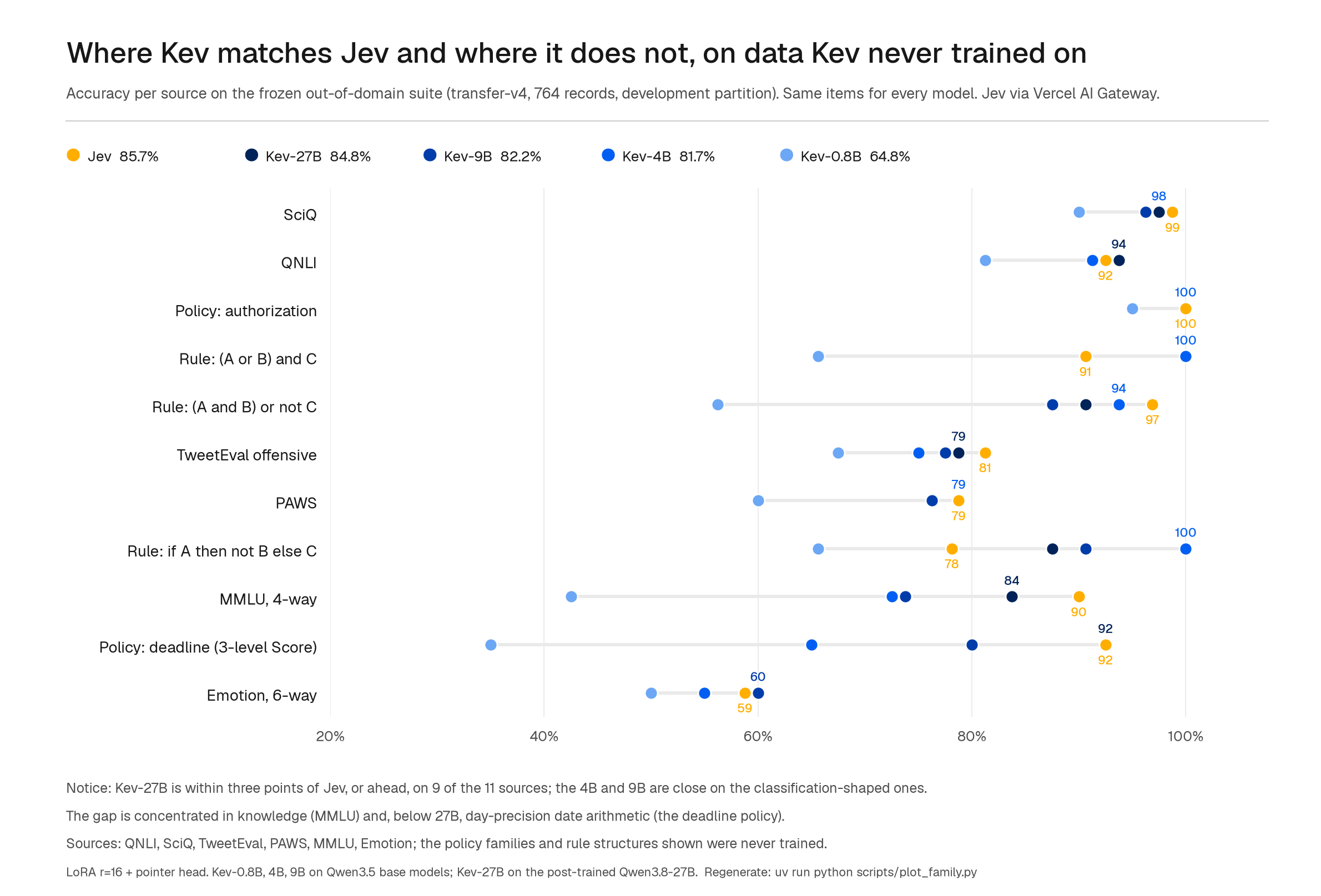
Kev sizes against TypeSafe's hosted Jev on the development split, as published in the Kev README (Brier: lower is better).
| Benchmark | Kev-0.8B | Kev-4B | Kev-9B | Kev-27B | Jev (hosted) |
|---|---|---|---|---|---|
| Accuracy: new sources (dev) | 0.648 | 0.817 | 0.822 | 0.848 | 0.857 |
| Accuracy: trained sources (dev) | 0.827 | 0.873 | 0.872 | 0.866 | 0.845 |
| Brier: new sources (dev, lower is better) | 0.481 | 0.269 | 0.286 | 0.236 | 0.211 |
| MMLU, 4-way | — | — | 0.74 | 0.84 | 0.9 |
This model's scores
- New-source accuracy, test split (Kev-27B)89.6%
- New-source accuracy, test split (Kev-9B)85.2%
- New-source accuracy, test split (Kev-4B)83.8%
- New-source accuracy, test split (Kev-0.8B)69.7%
Scores on a 0–100 scale (25-point gridlines); higher is better. Each benchmark links to its published source.
Strengths
- Kev-27B reaches 0.848 accuracy on never-seen sources against 0.857 for the hosted Jev, and 0.896 on the test split
- Calibrated probabilities by default: every checkpoint ships a fitted temperature
- Drop-in for Jev: the TypeSafe Python SDK talks to a Kev server unchanged
- Kev-4B answers six questions about a short text in 18.1 ms of model time on an H100, and Kev-0.8B runs on any Apple Silicon Mac
- Apache-2.0 weights with a documented fine-tuning loop; one epoch on 5,219 consumer-finance complaints took Kev-4B from 0.804 to 0.904 accuracy
Best for
- Reach for it when code needs to route, triage or score text — support tickets, emails, moderation — and must act only on confident answers.
- Reach for it when you already call Jev and want a self-hosted model behind the same API.
- Reach for it when you have labelled decisions from your own domain and want a small model fine-tuned and calibrated on them.
- Look elsewhere for knowledge-heavy questions, where Kev trails Jev and depends mostly on its Qwen base model.
How to access
| Provider | Model ID |
|---|---|
| Hugging Face (weights) ↗ | jaredpalmer/kev-4b |
| Hugging Face Space (demo) ↗ | — |
FAQ
What does Kev do differently from a chat model?
Kev never writes prose. You send a text (the state) and typed questions — yes/no, multiple-choice or a rating scale — and each answer comes back as a typed value with calibrated probabilities, so your code can act on confident answers and hand the rest to a person.
How does Kev compare with TypeSafe's Jev?
On the Kev README's out-of-domain suite, Kev-27B scores 0.848 accuracy on the development split against 0.857 for Jev, and Kev-4B and Kev-9B are within four points. Kev trails on knowledge questions (MMLU: Kev-27B 0.84, Jev 0.90) and Jev ranks its answers better at a 5% error budget. The author notes Jev's training data is unknown, so this is not a controlled comparison.
Which Kev size should I use?
The README recommends starting with Kev-4B, moving to Kev-9B on a bigger GPU, or Kev-27B on an 80 GB GPU for the most accuracy. Kev-0.8B runs on any Apple Silicon Mac when size matters more than accuracy.
Is Kev open source?
Yes. The code and all four checkpoints are Apache-2.0, published on Hugging Face and as a GitHub release with SHA-256 checksums.