
Overview
LFM2.5-24B-A2B is an open-weight reasoning model from Liquid AI, announced on the Liquid AI blog on October 13, 2026. It is a mixture of experts with 24.0B total parameters and 2.45B active per token (Liquid rounds this to about 2B, hence the A2B suffix), a 131,072-token context window and a 128,000-token vocabulary. Liquid describes it as the largest and final model in the LFM2.5 family, which runs from LFM2.5-230M up to this model, and it is a text-only model that always thinks before it answers: the chat template opens every assistant turn with a <think> tag.
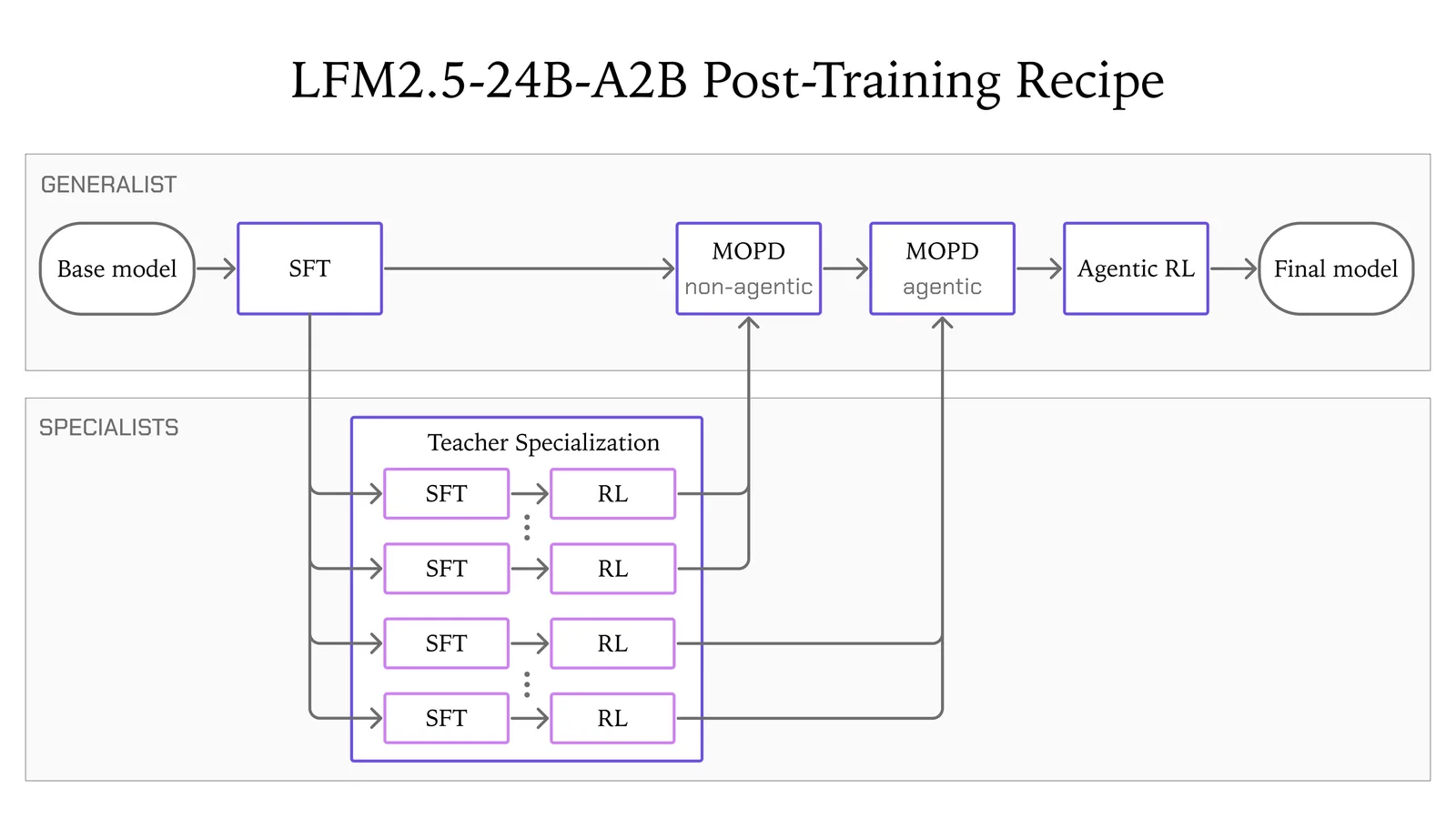
It keeps the architecture of LFM2-24B-A2B (February 2026) — 40 layers, 30 of them double-gated short-convolution blocks and 10 grouped-query attention blocks, with 64 experts per MoE block and top-4 routing — and changes two things: the context window grows from 32K to 131K tokens, and the vocabulary doubles from 65K to 128K through an in-place tokenizer expansion for better non-Latin tokenization. Pre-training grew from about 17T to about 33T tokens, followed by 2T tokens of mid-training at 32K context and 300B tokens of long-context data at 131K. Post-training runs supervised fine-tuning, teacher specialization, two on-policy distillation stages (one non-agentic, one agentic) and agentic reinforcement learning inside the OpenClaw, Hermes Agent, Pi and OpenCode harnesses, so the model learns their tools and system prompts.
On Liquid's own 16-benchmark comparison against Qwen3.6-35B-A3B, Gemma-4-26B-A4B-it and Nemotron-3.5-Lightning (30B-A3B), it leads on AutomationBench (27.69), BFCLv4 (65.01), ToolSandbox (80.71), LiveClaw (48.09, against 38.19 for Qwen3.6-35B-A3B) and τ³-Bench Banking, and on all three instruction-following tests: IFEval 96.75, IFBench 74.69 and Multi-IF 84.38. Liquid is explicit that larger models lead on knowledge-heavy and coding work: Qwen3.6-35B-A3B scores 83.69 on GPQA Diamond to its 74.42, and 66.20 on SWE-Bench Verified (OpenCode) to its 51.00. The model card advises against using it alone for knowledge-heavy tasks and recommends pairing it with retrieval or web search.
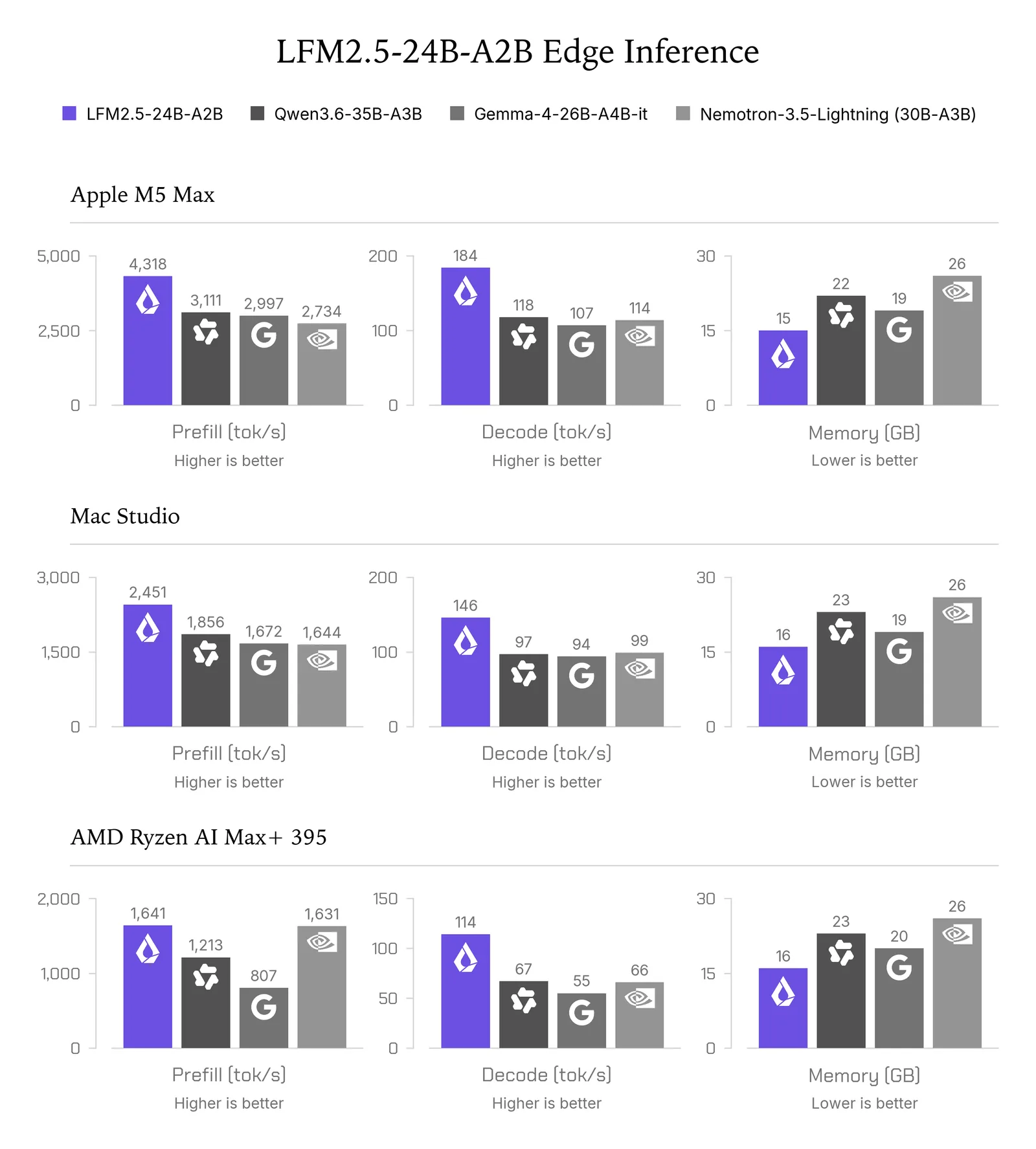
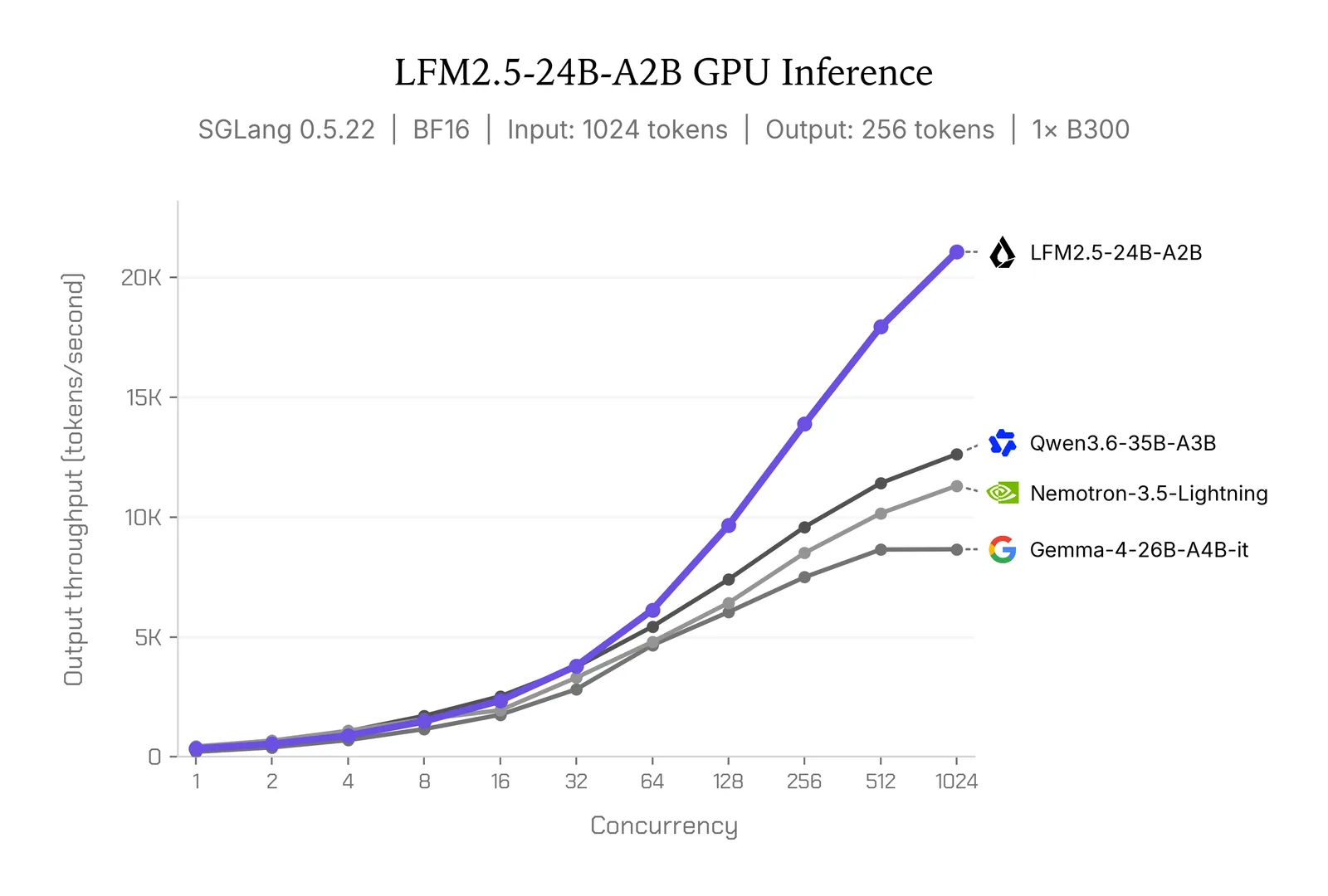
Speed is the headline. On Liquid's device benchmarks (llama.cpp, Q4_K_M, 4K-token input) it decodes 184 tokens/s on an Apple M5 Max and 114 tokens/s on an AMD Ryzen AI Max+ 395 — up to 1.7× faster than the next-best compared model — while using the least memory of the four (15–16 GB). On a single NVIDIA B300 with SGLang and BF16 weights it passes 21K output tokens/s at high concurrency. Weights ship on Hugging Face in BF16, FP8, GGUF, ONNX and MLX packings alongside a separate base model, with support in Transformers, vLLM, SGLang, llama.cpp, MLX and LM Studio; Liquid Console serves it by API at $0.10 per 1M input tokens and $1.00 per 1M output tokens. Use is governed by the LFM Open License v1.0, whose commercial-use rights stop at a company annual revenue threshold of $10 million.
| Released | 2026-10-13 |
|---|---|
| License | LFM Open License v1.0 |
| Weights | Open weights |
| Parameters | 24.0B total · 2.45B active |
| Context | 128K |
| Architecture | Hybrid mixture-of-experts: 40 layers (30 double-gated short-convolution blocks + 10 grouped-query attention blocks), 64 experts per MoE block with top-4 routing, 128K-token vocabulary |
| Modalities | Text |
| Status | Open weights on Hugging Face (BF16, FP8, GGUF, ONNX and MLX packings); API on Liquid Console |
Benchmarks
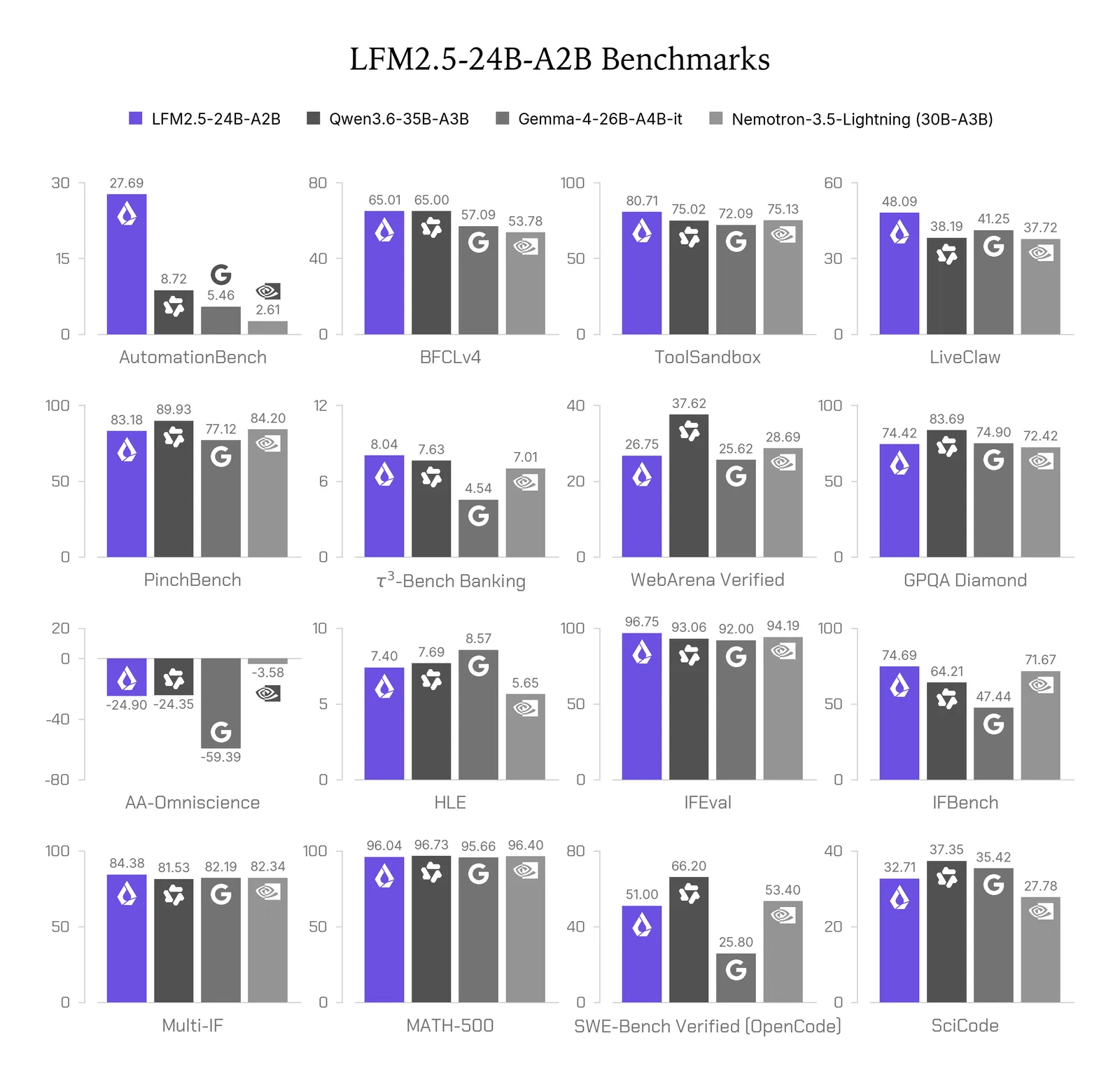
Liquid AI's published comparison: LFM2.5-24B-A2B against three MoE models on 16 benchmarks
| Benchmark | LFM2.5-24B-A2B | Qwen3.6-35B-A3B | Gemma-4-26B-A4B-it | Nemotron-3.5-Lightning (30B-A3B) |
|---|---|---|---|---|
| AutomationBench | 27.69 | 8.72 | 5.46 | 2.61 |
| BFCLv4 | 65.01 | 65 | 57.09 | 53.78 |
| ToolSandbox | 80.71 | 75.02 | 72.09 | 75.13 |
| LiveClaw | 48.09 | 38.19 | 41.25 | 37.72 |
| PinchBench | 83.18 | 89.93 | 77.12 | 84.2 |
| τ³-Bench Banking | 8.04 | 7.63 | 4.54 | 7.01 |
| WebArena Verified | 26.75 | 37.62 | 25.62 | 28.69 |
| GPQA Diamond | 74.42 | 83.69 | 74.9 | 72.42 |
| AA-Omniscience | -24.9 | -24.35 | -59.39 | -3.58 |
| HLE | 7.4 | 7.69 | 8.57 | 5.65 |
| IFEval | 96.75 | 93.06 | 92 | 94.19 |
| IFBench | 74.69 | 64.21 | 47.44 | 71.67 |
| Multi-IF | 84.38 | 81.53 | 82.19 | 82.34 |
| MATH-500 | 96.04 | 96.73 | 95.66 | 96.4 |
| SWE-Bench Verified (OpenCode) | 51 | 66.2 | 25.8 | 53.4 |
| SciCode | 32.71 | 37.35 | 35.42 | 27.78 |
This model's scores
- IFEval96.75%
- MATH-50096.04%
- Multi-IF84.38%
- PinchBench83.18%
- ToolSandbox80.71%
- IFBench74.69%
- GPQA Diamond74.42%
- BFCLv465.01%
- SWE-Bench Verified (OpenCode)51%
- LiveClaw48.09%
- SciCode32.71%
- AutomationBench27.69%
- WebArena Verified26.75%
Scores on a 0–100 scale (25-point gridlines); higher is better. Each benchmark links to its published source.
Pricing
| Input | $0.10 / 1M tokens |
|---|---|
| Cached input | $0.05 / 1M tokens |
| Output | $1.00 / 1M tokens |
Liquid Console API price at launch; new sign-ups receive $2 in credit
Strengths
- Agentic and tool-use scores ahead of larger MoEs on Liquid's comparison — 48.09 on LiveClaw and 27.69 on AutomationBench, against 38.19 and 8.72 for Qwen3.6-35B-A3B
- Top of its comparison on all three instruction-following benchmarks: IFEval 96.75, IFBench 74.69, Multi-IF 84.38
- Fast on laptops and desktops: 184 tokens/s decode on an Apple M5 Max and 114 tokens/s on an AMD Ryzen AI Max+ 395 at Q4_K_M, in about 15–16 GB of memory
- High-concurrency GPU serving past 21K output tokens/s on one NVIDIA B300
- Post-trained with reinforcement learning inside real agent harnesses (OpenClaw, Hermes Agent, Pi, OpenCode)
- Open weights in BF16, FP8, GGUF, ONNX and MLX formats, plus a base checkpoint for fine-tuning
Best for
- Running a private coding or personal agent locally on a Mac or AMD laptop through an OpenAI-compatible server and a harness such as Hermes, OpenClaw or Pi
- Tool-calling and automation workflows where instruction following and function calling matter more than stored knowledge
- Retrieval- or search-augmented assistants, the pairing Liquid recommends for knowledge-heavy questions
- High-throughput GPU serving of a reasoning model where a small active-parameter count keeps per-token cost low
- Fine-tuning a compact agent model on proprietary data with Unsloth or TRL
How to access
| Provider | Model ID |
|---|---|
| Liquid Console ↗ | — |
FAQ
What does A2B mean in LFM2.5-24B-A2B?
About 2B active parameters. The model has 24.0B parameters in total, but its mixture-of-experts layers route each token to 4 of 64 experts, so only 2.45B parameters are active per token — which is what keeps generation fast on a laptop.
How is it different from LFM2-24B-A2B?
It keeps the same 40-layer hybrid architecture but extends the context window from 32K to 131K tokens, doubles the vocabulary from 65K to 128K tokens, roughly doubles pre-training from about 17T to 33T tokens, and adds agentic reinforcement learning. It is also a pure reasoning model that always thinks before answering, where LFM2-24B-A2B was not.
How fast is it on a laptop?
Liquid reports 184 tokens/s decode on an Apple M5 Max and 114 tokens/s on an AMD Ryzen AI Max+ 395, measured with llama.cpp at Q4_K_M quantization and a 4K-token input, using about 15–16 GB of memory.
What is it good and bad at?
On Liquid's comparison it leads on agentic tool-use benchmarks such as LiveClaw, AutomationBench and ToolSandbox and on instruction following (IFEval, IFBench, Multi-IF). Larger models beat it on knowledge-heavy tests like GPQA Diamond and on coding tests like SWE-Bench Verified, so Liquid recommends pairing it with retrieval or web search for knowledge-heavy tasks.
Can I use it commercially?
Under the LFM Open License v1.0, commercial use is permitted for companies below an annual revenue threshold of $10 million; above that, Liquid asks companies to contact its sales team for a commercial license. Research and non-profit use carry no threshold.
How much does the API cost?
At launch Liquid Console priced it at $0.10 per 1M input tokens ($0.05 cached) and $1.00 per 1M output tokens, with $2 of credit for new sign-ups.