Overview
MiniCPM-V 4.7 is a vision-language model family from OpenBMB, announced on 12 October 2026 under Apache-2.0. It comes in two sizes: a 35B-A3B mixture-of-experts model, the first MoE in the MiniCPM-V series, and a 1B model that OpenBMB says improves on MiniCPM-V 4.6. Both take single images, several images or video as input and answer in text.
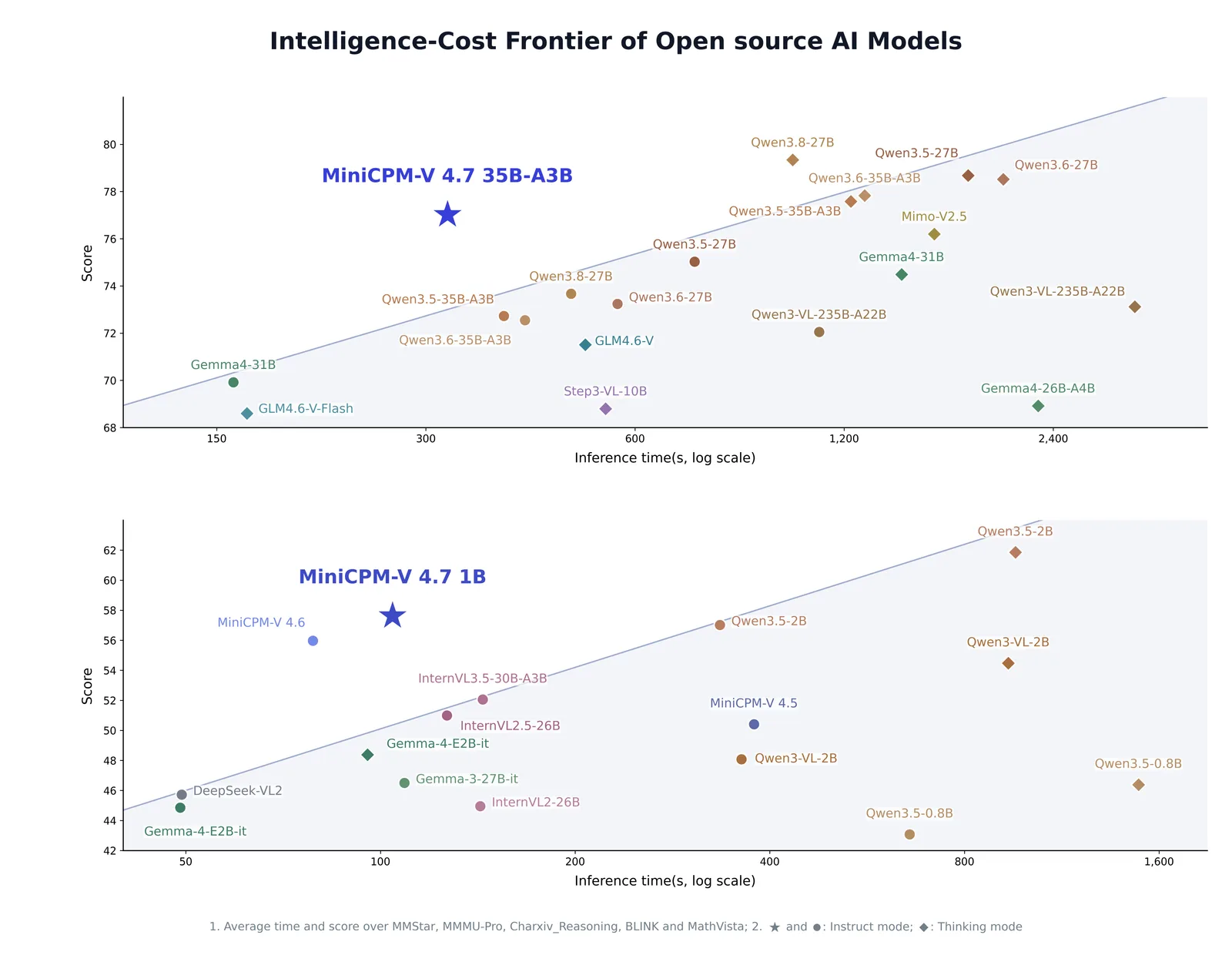
The 35B-A3B model pairs a SigLIP2 vision encoder with a language backbone from the Qwen3.5/Qwen3.6 family. Visual tokens can be compressed 4x or 16x, so the same model can trade a little accuracy for fewer tokens per image. To make a mixture-of-experts model practical on a phone, OpenBMB added Lookahead Expert Scheduling, which preloads the experts the next layer is likely to need; the README credits it with a 5x speedup on real devices.
OpenBMB reports a decoding speed of more than 13 tokens per second on an iPhone 17 Pro Max using about 3 GB of memory. In its own instruct-mode table, the 35B-A3B model at 4x compression scores 91.72 on MMBench, 80.22 on MMMU and 94.24 on OmniDocBench v1.6, ahead of Qwen3.6-35B-A3B, Qwen3.6-27B, Qwen3.8-27B and Gemma-4-31B on those rows. Alongside the weights, OpenBMB open-sourced Self-Replay Fine-Tuning, a method to fine-tune the model on a narrow task while limiting the loss of general skills.
| Released | 2026-10-12 |
|---|---|
| License | Apache-2.0 |
| Weights | Open weights |
| Parameters | 35B total (35B-A3B MoE); a separate 1B variant |
| Architecture | Mixture-of-experts language model from the Qwen3.5/Qwen3.6 family with a SigLIP2 vision encoder and mixed 4x/16x visual token compression |
| Modalities | Text, Vision, Video |
| Status | Generally available |
Benchmarks
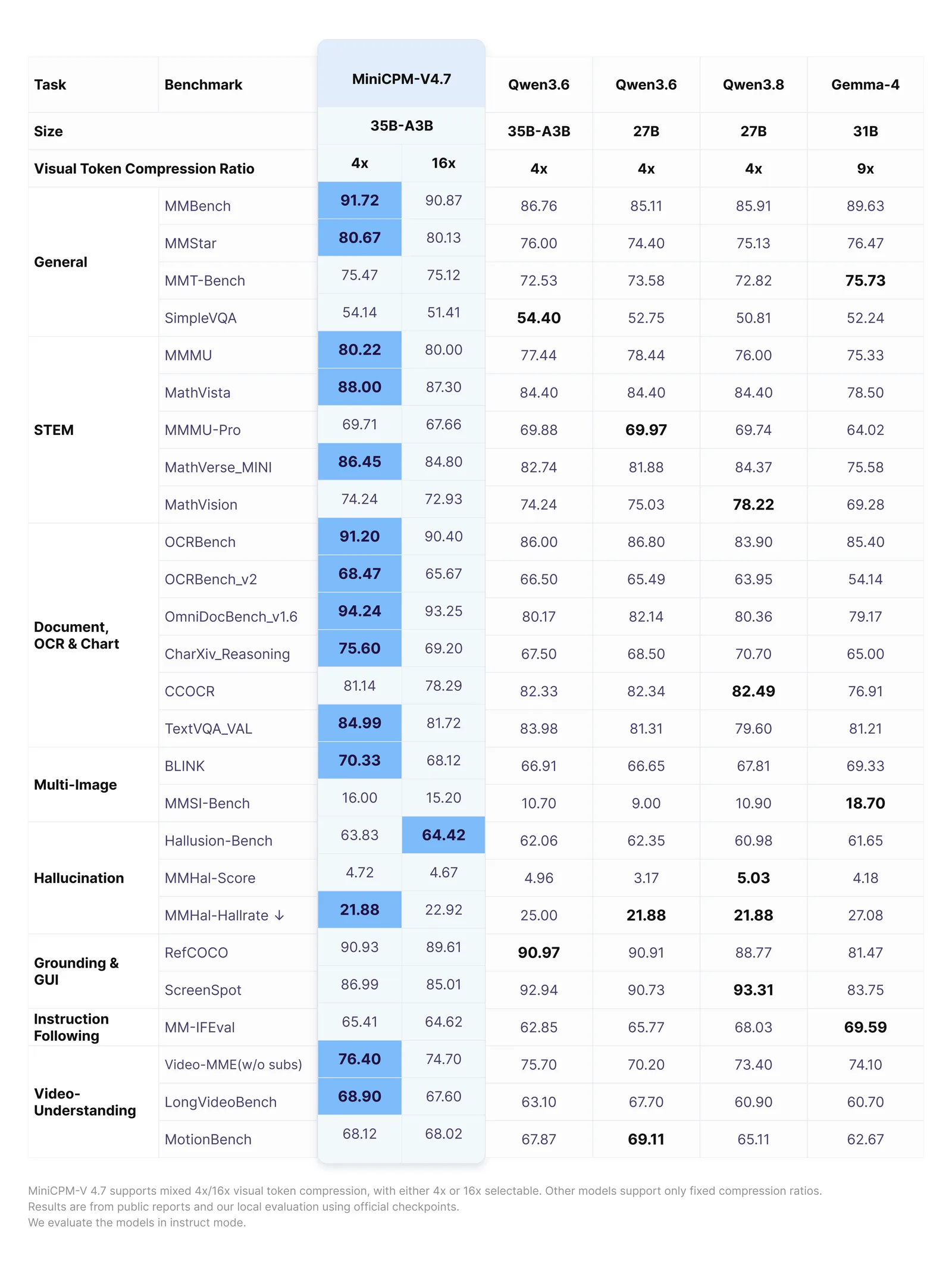
OpenBMB's instruct-mode results; MiniCPM-V 4.7 35B-A3B at 4x visual token compression
| Benchmark | MiniCPM-V 4.7 35B-A3B | Qwen3.6-35B-A3B | Qwen3.6-27B | Qwen3.8-27B | Gemma-4-31B |
|---|---|---|---|---|---|
| MMBench | 91.72 | 86.76 | 85.11 | 85.91 | 89.63 |
| MMMU | 80.22 | 77.44 | 78.44 | 76 | 75.33 |
| MathVista | 88 | 84.4 | 84.4 | 84.4 | 78.5 |
| OCRBench | 91.2 | 86 | 86.8 | 83.9 | 85.4 |
| OmniDocBench v1.6 | 94.24 | 80.17 | 82.14 | 80.36 | 79.17 |
| Video-MME (w/o subs) | 76.4 | 75.7 | 70.2 | 73.4 | 74.1 |
This model's scores
- MMBench91.72%
- MMMU80.22%
- OCRBench91.2%
- OmniDocBench v1.694.24%
- Video-MME (w/o subs)76.4%
Scores on a 0–100 scale (25-point gridlines); higher is better. Each benchmark links to its published source.
Strengths
- Runs on a phone: more than 13 tokens/s on an iPhone 17 Pro Max with about 3 GB of memory, per OpenBMB
- Strong document and OCR reading: 94.24 on OmniDocBench v1.6 and 91.20 on OCRBench in OpenBMB's table
- Selectable 4x or 16x visual token compression in one model
- Apache-2.0 code and weights, with FP8, int4, AWQ, GPTQ and GGUF builds
- Day-0 support for iOS, Android and HarmonyOS and for Intel, AMD, Arm, Rockchip and Houmo chips
Best for
- On-device assistants that read photos, screenshots and documents without sending them to a server
- Document, chart and OCR extraction where data must stay local
- Video question answering on edge hardware
- A base for narrow vision fine-tunes, using OpenBMB's Self-Replay Fine-Tuning to keep general skills
FAQ
Can MiniCPM-V 4.7 run on a phone?
Yes. OpenBMB reports that MiniCPM-V 4.7 35B-A3B decodes at more than 13 tokens per second on an iPhone 17 Pro Max with about 3 GB of memory, and lists day-0 support for iOS, Android and HarmonyOS. Lookahead Expert Scheduling, which preloads likely experts, gives a 5x speedup on real devices per the README.
What is the difference between 4x and 16x visual token compression?
MiniCPM-V 4.7 can compress each image into 4x or 16x fewer visual tokens, selectable in one model. In OpenBMB's table the 4x setting scores slightly higher on most tasks, such as 91.72 against 90.87 on MMBench, while 16x uses fewer tokens per image.
Can MiniCPM-V 4.7 be used commercially?
OpenBMB states that MiniCPM-V 4.7 code and model weights are released under Apache-2.0, which allows commercial use. Quantized FP8, int4, AWQ, GPTQ and GGUF builds are published alongside the BF16 weights.