

Overview
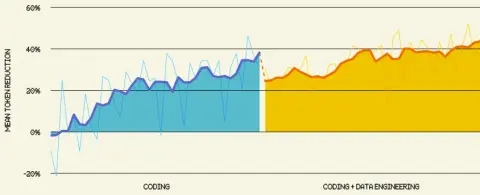
Particle-1 is the first model from Particle AI, a San Francisco company that launched with it on October 28, 2026. It is DeepSeek V4.1 Flash post-trained with reinforcement learning, and the goal of the training is token efficiency: solve the same task with less reasoning and fewer tool-call tokens while keeping the base model's accuracy. Particle says the model uses about 45% fewer tokens on average across a wide variety of tasks, and that this first release focuses on software engineering, with other domains planned for later releases.
Particle measured it on four agentic benchmarks, all run through the Terminus 2 agent with 16 rollouts per task: Terminal-Bench 2.1 (terminal workflows), ReactBench (building and fixing React apps), ADE Bench (analytics and data engineering on real dbt projects) and DeepSWE 1.1 (longer codebase-level tasks). Across them Particle-1 passed 72.57% of tasks against 71.15% for DeepSeek V4.1 Flash and 66.82% for GLM 5.3 Flash, using a mean 59,580 output tokens per task against 83,246 and 98,155, and cost $0.2211 per task against $0.3368 and $0.6523. Per benchmark, Particle reports 28.4%–52.2% fewer output tokens and 34.4%–51.6% lower average cost per task than the base model, with pass@1 inside the base model's confidence intervals.
Outside its training domains the scores stay close to the base model: GPQA Diamond 90.40% (base 90.91%), Tau Airlines 86.00% (base 88.00%), MMLU 86.08% (base 85.98%) and BabyVision with tools 89.18% (base 89.60%). On a Harvey LAB contract-review task, Particle-1 used 24.6% fewer output tokens than the base and all eight of its reports passed every criterion, against 62.5% accuracy for DeepSeek V4.1 Flash.
The training recipe is described in the launch post. Particle trained a rank-64 LoRA adapter covering the experts in all layers — about 1.25% of the model's parameter count — on coding and data-engineering tasks in Harbor format generated by its Datamaker synthetic-data system, in two successive stages following the Cascade RL approach. The policy update is Group Sequence Policy Optimization (GSPO) at a constant 5e-5 learning rate, run on RadixArk's open-source Miles RL framework with SGLang rollouts and Megatron training. Particle's analysis attributes roughly 90% of the savings on Terminal-Bench 2.1, ReactBench and ADE Bench to shorter reasoning.
Particle-1 is served only through the Particle API (no weights are published), an OpenAI-compatible endpoint at https://api.particle.ai/v1 with the request alias particle-1 (public id particle-ai/particle-1). The docs list a 1,048,576-token context window, an output ceiling of 131,072 tokens (32,000 by default), text and image input, reasoning on by default at high effort, and OpenAI-style tool calling.
| Released | 2026-10-28 |
|---|---|
| License | Proprietary |
| Weights | API only |
| Context | 1,048,576 tokens |
| Max output | 131,072 tokens |
| Architecture | DeepSeek V4.1 Flash (Mixture-of-Experts) with a rank-64 LoRA adapter on the experts in all layers, trained with RL |
| Modalities | Text, Vision |
| Status | Generally available on the Particle API |
Benchmarks
Particle-1 vs its base and GLM 5.3 Flash, as published in Particle's launch post
| Benchmark | Particle-1 | DeepSeek V4.1 Flash | GLM 5.3 Flash |
|---|---|---|---|
| Task pass rate (4 coding benchmarks) | 72.57% | 71.15% | 66.82% |
| Mean output tokens per task | 59,580 | 83,246 | 98,155 |
| Cost per task (USD) | $0.2211 | $0.3368 | $0.6523 |
| GPQA Diamond | 90.4% | 90.91% | — |
| Tau Airlines | 86% | 88% | — |
| MMLU | 86.08% | 85.98% | — |
| BabyVision (with tools) | 89.18% | 89.6% | — |
This model's scores
- Task pass rate (Terminal-Bench 2.1, ReactBench, ADE Bench, DeepSWE 1.1)72.57%
- GPQA Diamond90.4%
- Tau Airlines86%
- MMLU86.08%
- BabyVision (with tools)89.18%
Scores on a 0–100 scale (25-point gridlines); higher is better. Each benchmark links to its published source.
Pricing
| Input | $0.25 / 1M tokens |
|---|---|
| Cached input | $0.03 / 1M tokens |
| Output | $1.00 / 1M tokens |
Peak defaults; off-peak and Flex-tier requests are billed at 50% of these rates.
Strengths
- 72.57% task pass rate across Terminal-Bench 2.1, ReactBench, ADE Bench and DeepSWE 1.1, against 71.15% for DeepSeek V4.1 Flash
- 59,580 mean output tokens per task against 83,246 for its base model
- $0.2211 per task in Particle's evaluation, against $0.3368 for the base and $0.6523 for GLM 5.3 Flash
- General scores held close to the base: 90.40% GPQA Diamond and 86.08% MMLU
- 1,048,576-token context window with text and image input
- OpenAI-compatible API, so existing SDKs and agent harnesses work by changing the base URL
Best for
- Reach for Particle-1 as the model behind a coding agent, where long agent loops make output tokens the main cost.
- Reach for it for data-engineering agents working on dbt projects and SQL, one of the two domains it was trained on.
- Reach for it when you already run DeepSeek V4.1 Flash and want shorter runs at a similar pass rate.
- Look elsewhere when you need downloadable weights: Particle-1 is available only through the Particle API.
How to access
| Provider | Model ID |
|---|---|
| Particle API ↗ | particle-1 |
FAQ
What is Particle-1?
Particle AI's first model, released October 28, 2026: DeepSeek V4.1 Flash post-trained with reinforcement learning so that it solves software-engineering tasks with fewer tokens at a similar pass rate.
How does it compare with DeepSeek V4.1 Flash?
On Particle's four coding benchmarks it passed 72.57% of tasks against 71.15%, with a mean 59,580 output tokens per task against 83,246, and $0.2211 against $0.3368 per task. On GPQA Diamond, Tau Airlines, MMLU and BabyVision it stays within about two points of the base.
How much does it cost?
The Particle docs list $0.25 per million input tokens, $0.03 per million cached input tokens and $1.00 per million output tokens at peak. Off-peak requests and the Flex service tier are billed at 50% of those rates.
How do I call it?
Create an API key at platform.particle.ai, point an OpenAI SDK at https://api.particle.ai/v1 and request the model particle-1. Reasoning is on by default at high effort and can be changed with reasoning_effort.
Are the weights available?
No. Particle-1 is served only through the Particle API; the launch post and docs publish no weights.