

Overview
ZONOS3-Mini is the compact zero-shot voice-cloning text-to-speech model Zyphra released on 9 November 2026, with weights on Hugging Face (Zyphra/ZONOS3-Mini) under Apache 2.0, an inference runtime on GitHub and a technical report on arXiv. Give it a short reference clip (or a 192-dimensional speaker embedding) and a transcript, and it speaks the text in that voice; the model card lists 43 supported languages, from English, Mandarin and Arabic to Hindi, Tamil and Tagalog. Zyphra describes control axes for identity across age, gender, accent and quality, word-level delivery control, and pace, emotion, projection and liveliness steered through activation steering.
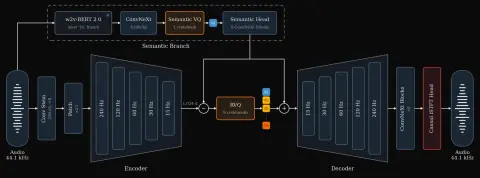
It is a sparse mixture of experts: 800M parameters in total, about 100M active per token, in 11 layers (9 Gated DeltaNet layers and 2 global attention layers) with 64 experts and top-2 routing. The model predicts audio tokens from Zyphra's ZAC-1 codec at 15 Hz — ten codebooks of 4,096 entries, one semantic and nine acoustic — and decodes them to 44.1 kHz audio with a causal iSTFT head, generating up to 10 minutes of audio at once. Zyphra trained it on 112 NVIDIA H100s in 2.5 days, then post-trained it first with direct preference optimization (DPO) and then with GRPO.
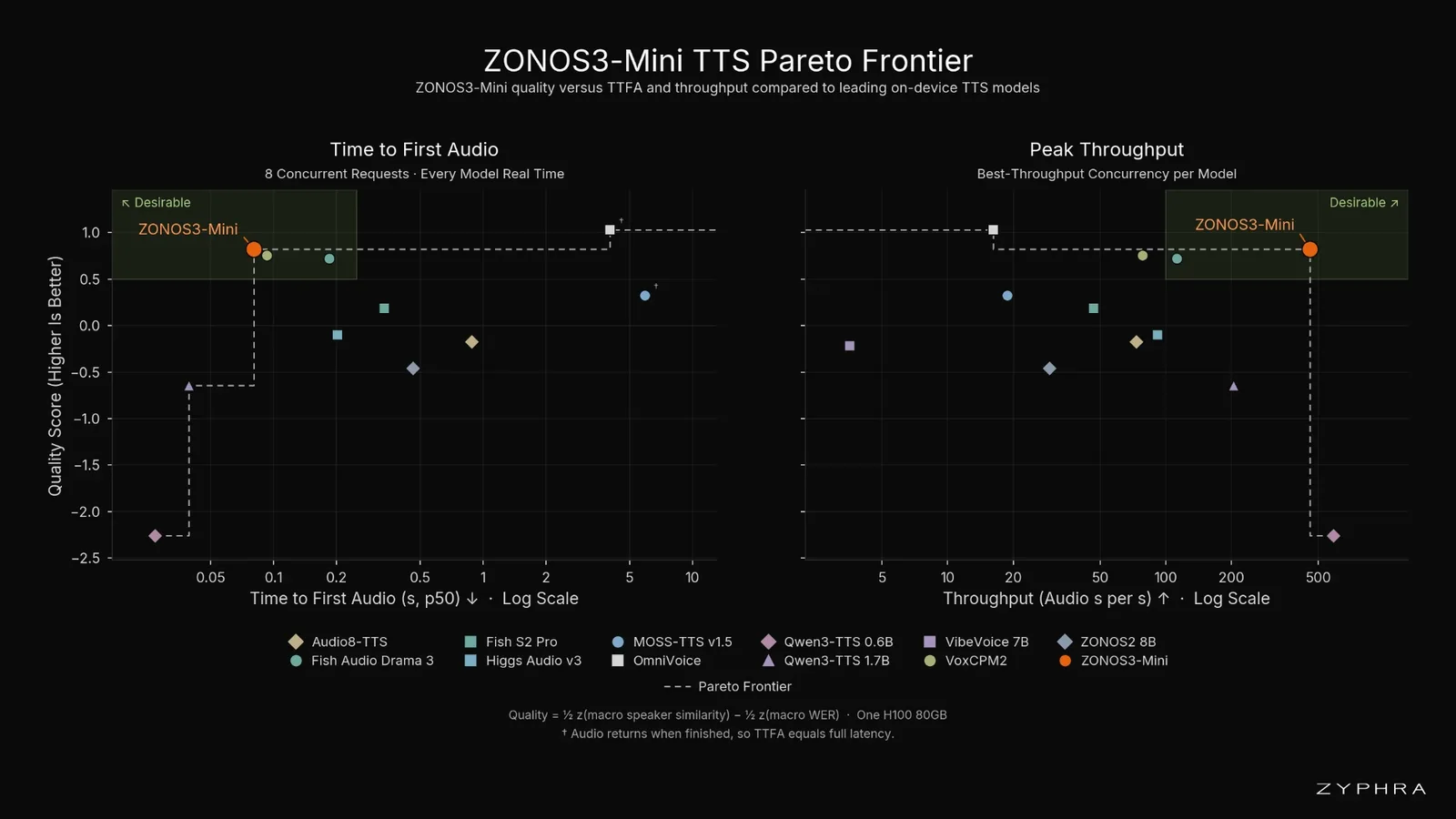
The point is speed on small hardware. Zyphra reports under 150 ms to first audio on an M3 MacBook Air and under 570 ms in the browser on a Pixel 9; on one H100 80GB the model card gives a median 80 ms to first audio with 8 concurrent requests and peak throughput of 457 seconds of audio per second. Zyphra ships day-0 serving through SGLang, plus a native C++/GGML runtime and a WebGPU runtime, and the model card shows it running under llama.cpp, Ollama and Docker Model Runner. On Zyphra's own TTS Capability Index v1, Zyphra reports that ZONOS3-Mini ranks first among open models, followed by Fish S2 Pro and MOSS TTS v1.5.
| Released | 2026-11-09 |
|---|---|
| License | Apache 2.0 |
| Weights | Open weights |
| Parameters | 800M total · ~100M active |
| Architecture | Sparse Mixture-of-Experts (64 experts, top-2) with 9 Gated DeltaNet + 2 global attention layers, predicting 15 Hz tokens from Zyphra's ZAC-1 audio codec |
| Modalities | Text, Audio |
| Status | Generally available |
Benchmarks
Strengths
- Zero-shot voice cloning from a raw reference clip of up to 60 seconds, or from a 192-dimensional speaker embedding
- 43 languages across Europe, the Middle East, East, Southeast and South Asia
- Small enough for the edge: 800M total / ~100M active parameters, with under 150 ms to first audio on an M3 MacBook Air and under 570 ms in a Pixel 9 browser, as reported by Zyphra
- Explicit controls for loudness, bandwidth and speaking rate, plus word-level delivery control and activation-steered emotion, pace and projection
- Apache 2.0 weights with runtimes for CUDA (SGLang), Apple Silicon (MLX), C++/GGML and WebGPU
- Up to 10 minutes of 44.1 kHz audio per generation
Best for
- Reach for it to build a voice agent that has to answer quickly on a laptop, phone or in a browser tab without a GPU server
- Reach for it for offline narration or accessibility read-aloud in many languages, where the audio never leaves the device
- Reach for it when you need to clone or design a voice under a permissive licence you can ship commercially
- Reach for it as a high-throughput server TTS — Zyphra reports 80 ms median first audio with 8 concurrent requests on one H100
How to access
| Provider | Model ID |
|---|---|
| Zyphra Cloud ↗ | — |
FAQ
What is ZONOS3-Mini?
ZONOS3-Mini is an open-weight text-to-speech model Zyphra released on 9 November 2026. It clones a voice zero-shot from a short reference clip, speaks 43 languages, and is a sparse mixture of experts with 800M parameters in total and about 100M active per token, small enough to run in real time on laptops, phones and in the browser.
What licence is ZONOS3-Mini under?
The model weights are released under Apache 2.0, which allows commercial use. Zyphra's inference runtime repository on GitHub is released under the MIT License.
How fast is ZONOS3-Mini?
Zyphra reports under 150 ms to first audio on an M3 MacBook Air and under 570 ms in the browser on a Pixel 9. On one H100 80GB the model card gives a median 80 ms to first audio with 8 concurrent requests and peak throughput of 457 seconds of audio per second.
How do I run ZONOS3-Mini locally?
The model card lists several routes: `ollama run hf.co/Zyphra/ZONOS3-Mini`, `llama serve -hf Zyphra/ZONOS3-Mini` with llama.cpp, `docker model run hf.co/Zyphra/ZONOS3-Mini`, an SGLang-Omni server with an OpenAI-style /v1/audio/speech endpoint, or the Zonos Python package. Zyphra's GitHub repository adds servers for CUDA, Apple Silicon (MLX), C++/GGML and an in-browser WebGPU build.
How was ZONOS3-Mini trained?
Zyphra says it trained ZONOS3-Mini on 112 NVIDIA H100s in 2.5 days, then added two post-training stages: direct preference optimization (DPO) followed by Group Relative Policy Optimization (GRPO).