Black Forest Labs · 2026-07-23 · major
FLUX 3 — Black Forest Labs' multimodal video, image, and robotics model
FLUX 3 is Black Forest Labs' new multimodal foundation model that generates 20-second video with synchronized audio, edits images, and predicts robot actions from a single set of weights.
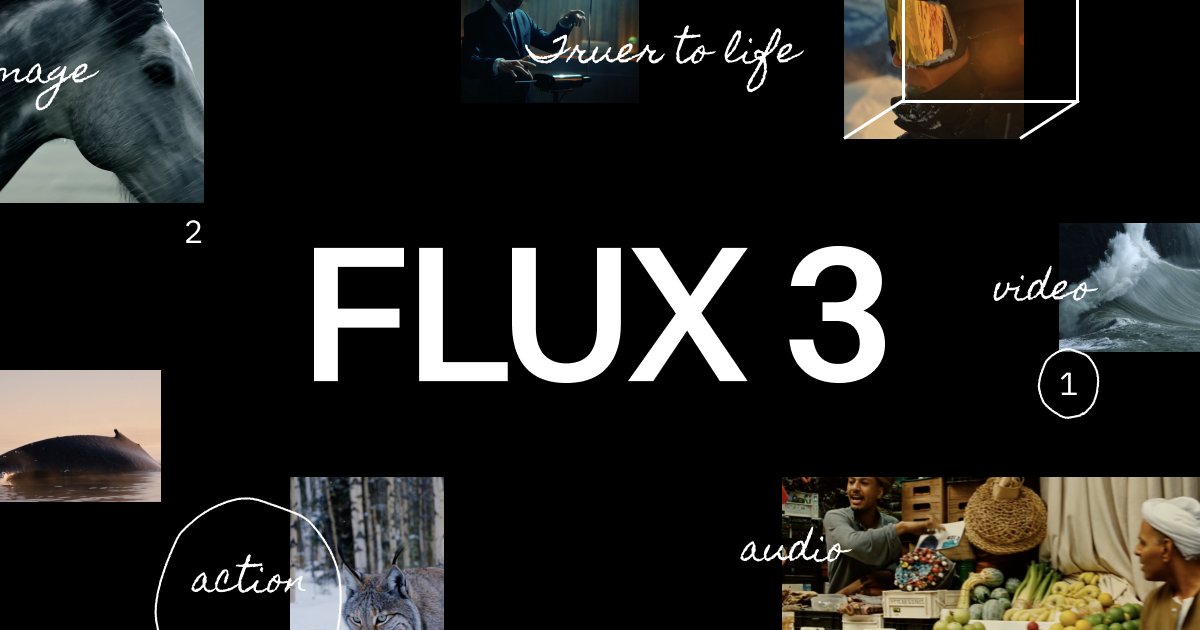
One Black Forest Labs model that generates video with audio, edits images, and drives real robots at Audi.
Key specs
| Video length | up to 20s |
|---|---|
| Vs runway gen 4.5 | 77% preferred |
| Vs kling v3 pro | 60% preferred |
Quick facts
| Maker | Black Forest Labs |
|---|---|
| Variants | Video, Image, Action, Dev (open-weight) |
| Video length | Up to 20s with native audio |
| Access | Early access via bfl.ai/models/flux-3 |
| Robotics partner | mimic robotics — deployed at Audi |
| Licensing | Non-commercial, commercial self-hosted, and API |
| Announced | July 23, 2026 |
Benchmarks
| FLUX 3 Video (vs Luma Ray 3.2) | 93% | |
|---|---|---|
| FLUX 3 Video (vs Runway Gen-4.5) | 77% | |
| FLUX 3 Video (vs Grok Imagine Video) | 69% | |
| FLUX 3 Video (vs Kling v3 Pro) | 60% | |
| FLUX 3 Video (vs Seedance 2.0) | 52% |
What is it?
FLUX 3 is a single multimodal foundation model from Black Forest Labs, announced July 23, 2026, that generates video, images, and audio and predicts robot actions from one shared set of weights. Variants ship as FLUX 3 Video, FLUX 3 Image, FLUX 3 Action, FLUX-mimic (robotics), and a planned open-weight FLUX 3 Dev backbone.
How does it work?
The model is trained jointly on video, images, and audio with an approach BFL calls Self-Flow, so understanding and generation share the same architecture. FLUX 3 Video renders up to 20 seconds of clip with native synchronized audio from text, an image, or another video, and supports keyframe transitions and multilingual dialogue. FLUX-mimic sits on top of the backbone and, as CTO Elvis Nava puts it, 'picks up a new task in minutes, not days.'
Why does it matter?
This is Black Forest Labs stepping out of the pure image lane into full physical AI. In BFL's own side-by-side tests, FLUX 3 Video is preferred over Runway Gen-4.5 in 77% of comparisons, Luma Ray 3.2 in 93%, and Kling v3 Pro in 60% — putting it in the frontier video-model conversation for the first time. The FLUX-mimic partnership with mimic robotics, already running on an Audi line, signals that the same weights are meant to control real hardware, not just generate clips.
Who is it for?
video creators, image editors, and robotics teams
Frequently asked questions
- How is FLUX 3 different from FLUX.1?
- FLUX 3 is Black Forest Labs' first unified multimodal model. Instead of separate image models, FLUX 3 jointly learns video, images, audio, and action prediction inside one architecture and one set of weights, using what the company calls the Self-Flow approach.
- How can I try FLUX 3?
- FLUX 3 Video is in early access at bfl.ai/models/flux-3, gated by a request form. FLUX 3 Image is expected in the following weeks, and FLUX 3 Dev — the open-weight multimodal backbone — is on the launch plan but has no public release date yet.
- How does FLUX 3 Video compare to Runway, Luma, Kling, and Grok Imagine?
- In Black Forest Labs' preliminary side-by-side tests at 720p, FLUX 3 Video was preferred over Luma Ray 3.2 in 93% of comparisons, Runway Gen-4.5 in 77%, Grok Imagine Video in 69%, and Kling v3 Pro in 60%. Numbers are BFL's own evaluations, not an independent leaderboard.
- What is FLUX-mimic and why is it running at Audi?
- FLUX-mimic is a robotics variant built with mimic robotics on top of the FLUX 3 backbone. It maps the video model's world understanding onto real robot actions, so a robot can learn a new manipulation task in about 30 minutes of demonstrations instead of days — and is already being tested on Audi's production line.
Try it
Request early access: https://bfl.ai/models/flux-3