Canva · 2026-04-16 · major
Canva AI 2.0 — World's First Design-Specific Foundation Model Ships Editable Layered Output
Canva AI 2.0 ships a proprietary design-specific foundation model that produces fully layered, editable design files — not flat images. Claimed 7× faster and 30× cheaper than comparable frontier models. Agentic orchestration, persistent memory, connectors to Gmail/Slack/Notion, and Canva Code 2.0.
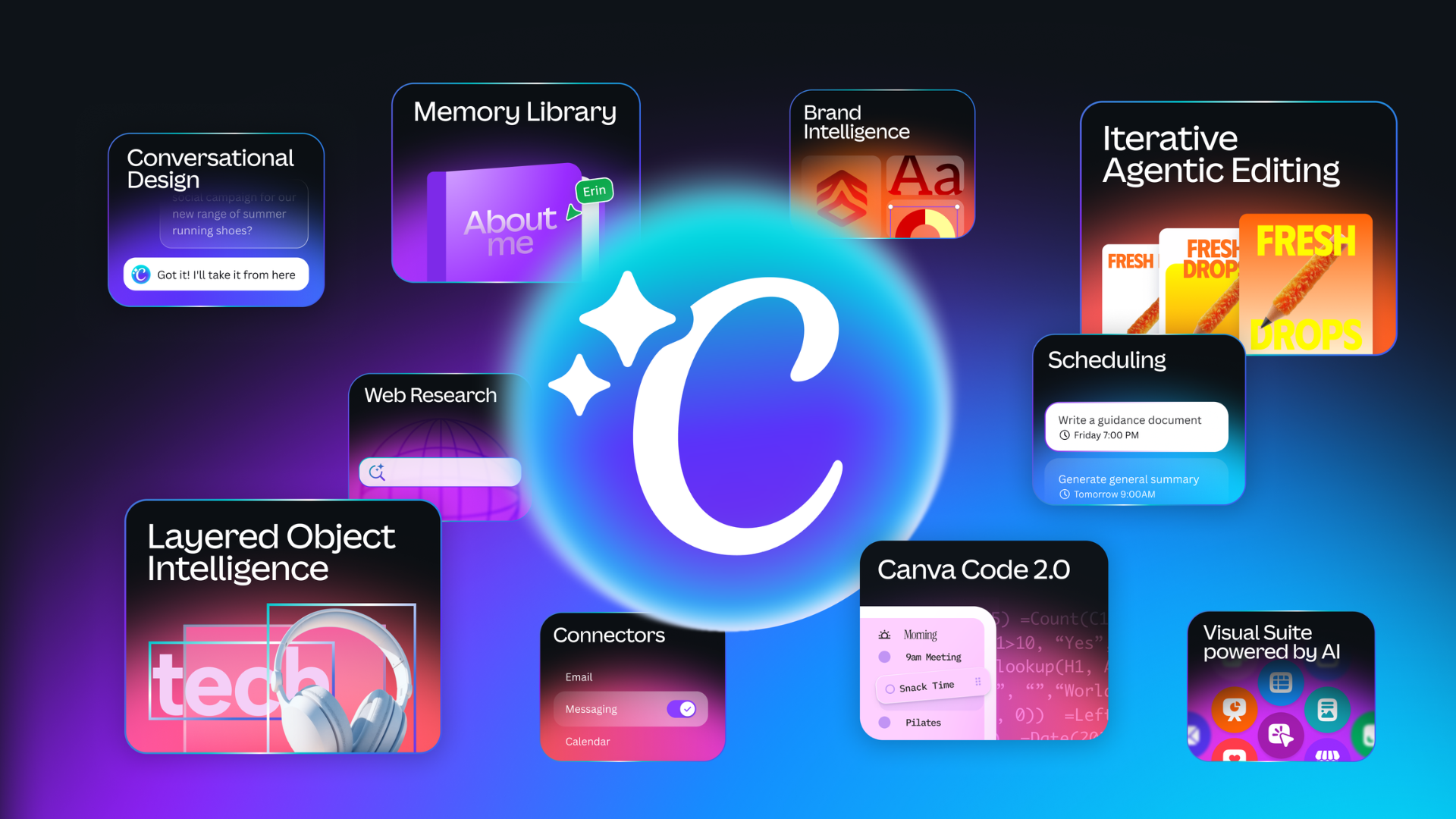
Canva ships its own design-specific foundation model — and it outputs editable layered files, not flat images.
Key specs
| Speed vs frontier models | 7× |
|---|---|
| Cost vs frontier models | 30× cheaper |
| Monthly active users | 3rd most-used generative AI web product |
| 2025 revenue | $4B |
What is it?
Announced at Canva Create on April 15–16, 2026, Canva AI 2.0 centers on the Canva Design Model, a proprietary foundation model trained on millions of designs and the edit sequences used to build them. Unlike text-to-image systems that produce flat rasters, the Canva Design Model generates fully layered output: every headline, image, and shape is a separate, manipulable object. The model is claimed to run 7× faster and 30× cheaper than comparable frontier models. Canva built it by acquiring AI startups including Leonardo AI, Simtheory, and Ortto. The company now ranks third by monthly active users among generative AI web products, behind only Google Gemini, and reported $4B in 2025 revenue.
How does it work?
The Canva Design Model understands design hierarchy, component relationships, and brand guidelines — it was trained on both completed designs and the editing sequences that produced them, so it learns the 'grammar' of design decisions, not just the visual output. Agentic orchestration chains Canva tools (resize, brand-match, schedule, write, code) in response to natural-language goals. Connectors pull real-time context from Gmail, Slack, Google Drive, Notion, HubSpot, and Linear. Persistent Living Memory learns team style preferences across sessions. Canva Code 2.0 generates interactive web components directly inside designs.
Why does it matter?
Most design AI sits on top of general-purpose models — Canva's design-specific foundation model is the first to optimize specifically for the design task and produce editable artifacts as output rather than flat images. That distinction matters enormously in production: a designer who gets back a layered PSD-equivalent can keep working; a flat image is a dead end. With hundreds of millions of users and $4B in revenue, Canva occupies the creative knowledge-worker layer that Microsoft 365 Copilot and Google Workspace are also targeting — and this reframe as a 'Creative Operating System' is a direct competitive move.
Who is it for?
Marketing teams, designers, content creators, and ad agencies using Canva in production