Castform · 2026-08-05 · major
Castform — RL post-trains a 4B open model to match GPT-5.6 Sol on search at 1/100 the cost
Castform lets developers run reinforcement learning post-training on open-weights models without touching GPUs. A 4B model trained with it matches GPT-5.6 Sol on Neon's multi-turn search benchmark and costs roughly 100x less per request.
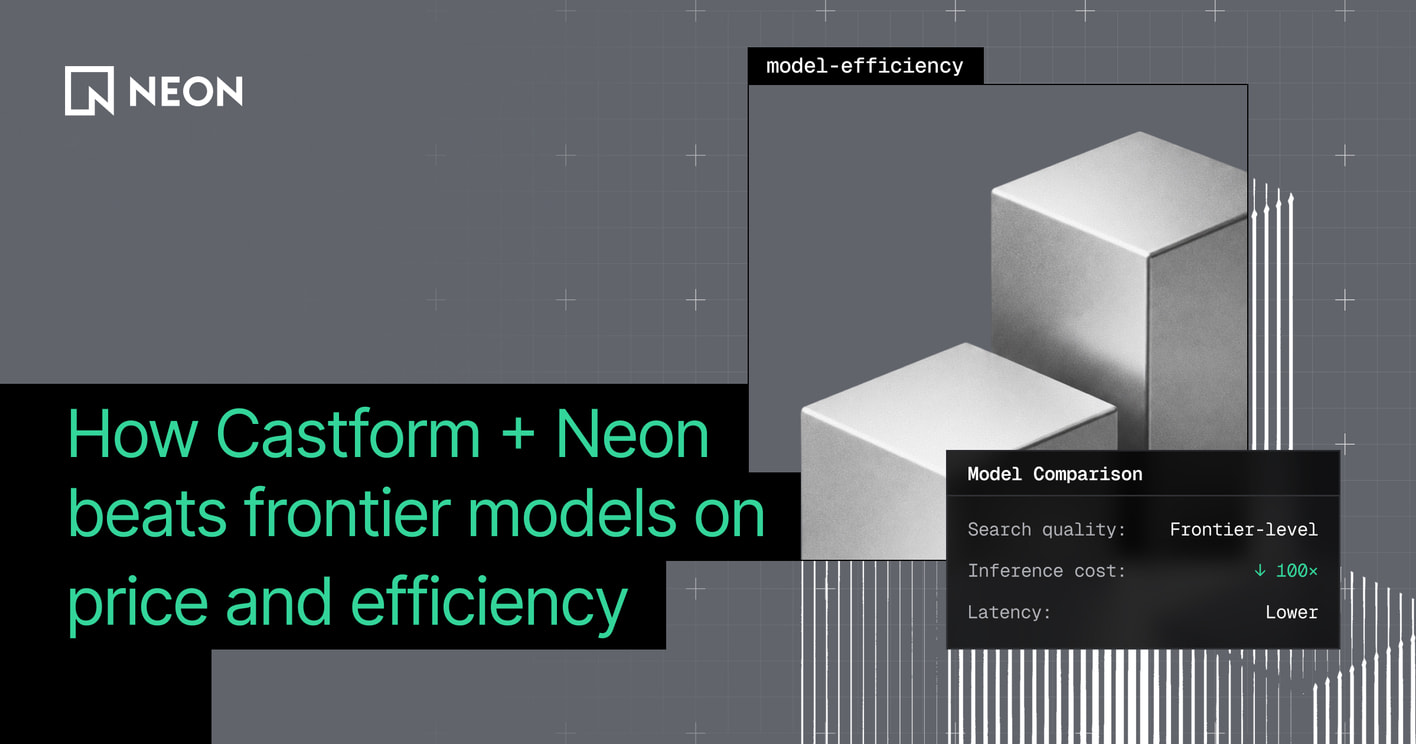
A managed RL post-training service that specialises 4B open models to match frontier accuracy on narrow tasks for a fraction of the cost.
Key specs
| Trained model size | 4B parameters |
|---|---|
| Target model | GPT-5.6 Sol |
| Cost multiple vs gpt 5.6 sol | ~100x cheaper |
| Gpt 5.6 sol request cost | ~$0.03 (>10s latency) |
Quick facts
| Maker | Castform (with Neon) |
|---|---|
| What it is | RL post-training platform for open models |
| No GPU wrangling | Managed training + reward loops |
| Trained model | 4B open-weights base |
| Match on search task | GPT-5.6 Sol accuracy |
| Cost delta | ~100x cheaper per request |
| Example code | github.com/castform-ai/benchmax |
What is it?
Castform is a platform that lets developers run reinforcement learning post-training on open-weights models without managing GPUs or ML infrastructure. Neon co-published a case study on August 5, 2026 in which a 4B model trained through Castform matches GPT-5.6 Sol on their multi-turn search benchmark.
How does it work?
A developer picks an open-weights base, wires up a reward signal for the target task, and Castform handles the RL loops on managed hardware. The Neon example rewards the model for correct answers over live search tool calls, so each training rollout teaches the 4B model when to search, how to phrase queries, and how to synthesise the results.
Why does it matter?
A specialised 4B model that ties a frontier model on one workload at roughly 1/100 the per-request cost changes the economics of retrieval-heavy products. Instead of routing every query to GPT-5.6 Sol at about $0.03 per multi-turn search, teams can train a smaller model for the exact workload once and serve it cheaply. The example repo makes the pattern copyable.
Who is it for?
product teams running retrieval or search-heavy LLM features
Frequently asked questions
- How does Castform get a 4B model to match GPT-5.6 Sol?
- Castform runs reinforcement learning post-training on an open 4B base model with rewards from real search tool use. Each rollout lets the model attempt a multi-turn retrieval, score the answer against ground truth, and update its weights. Over enough loops the specialised 4B catches GPT-5.6 Sol on Neon's search benchmark without matching its general capability.
- How much cheaper is the Castform-trained model?
- Neon reports the specialised 4B model is roughly 100x cheaper per request than GPT-5.6 Sol on the same multi-turn search workload, where a Sol query costs about $0.03 and takes over ten seconds. The savings compound at production scale, which is why the post frames RL-post-training as an alternative to always calling a frontier model.
- Do I need my own GPUs to use Castform?
- Castform manages the training infrastructure so developers do not need GPUs or an ML platform team. The workflow is: pick an open-weights base, define a reward function against your task, and Castform runs the RL loops on managed hardware. The Neon example uses the benchmax repo on GitHub as a template for wiring in the reward and rollout code.
- Where is the code and where do I start?
- Castform published the Neon retrieval-augmented generation example under github.com/castform-ai/benchmax as a working blueprint for the RL rewards, rollouts, and evaluation harness described in the post. A concrete training run for the 4B model is viewable at app.castform.com. Start by cloning the benchmax example and pointing it at your own retrieval workload.
Try it
git clone https://github.com/castform-ai/benchmax