Current AI · 2026-07-02 · major
Open Source AI Gap Map — Current AI charts 421 open-source AI products in one place
Current AI's Gap Map v0.1 indexes 421 open-source AI products from 228 organizations across models, tools, datasets, and hardware, scoring each on openness, capability, and adoption.
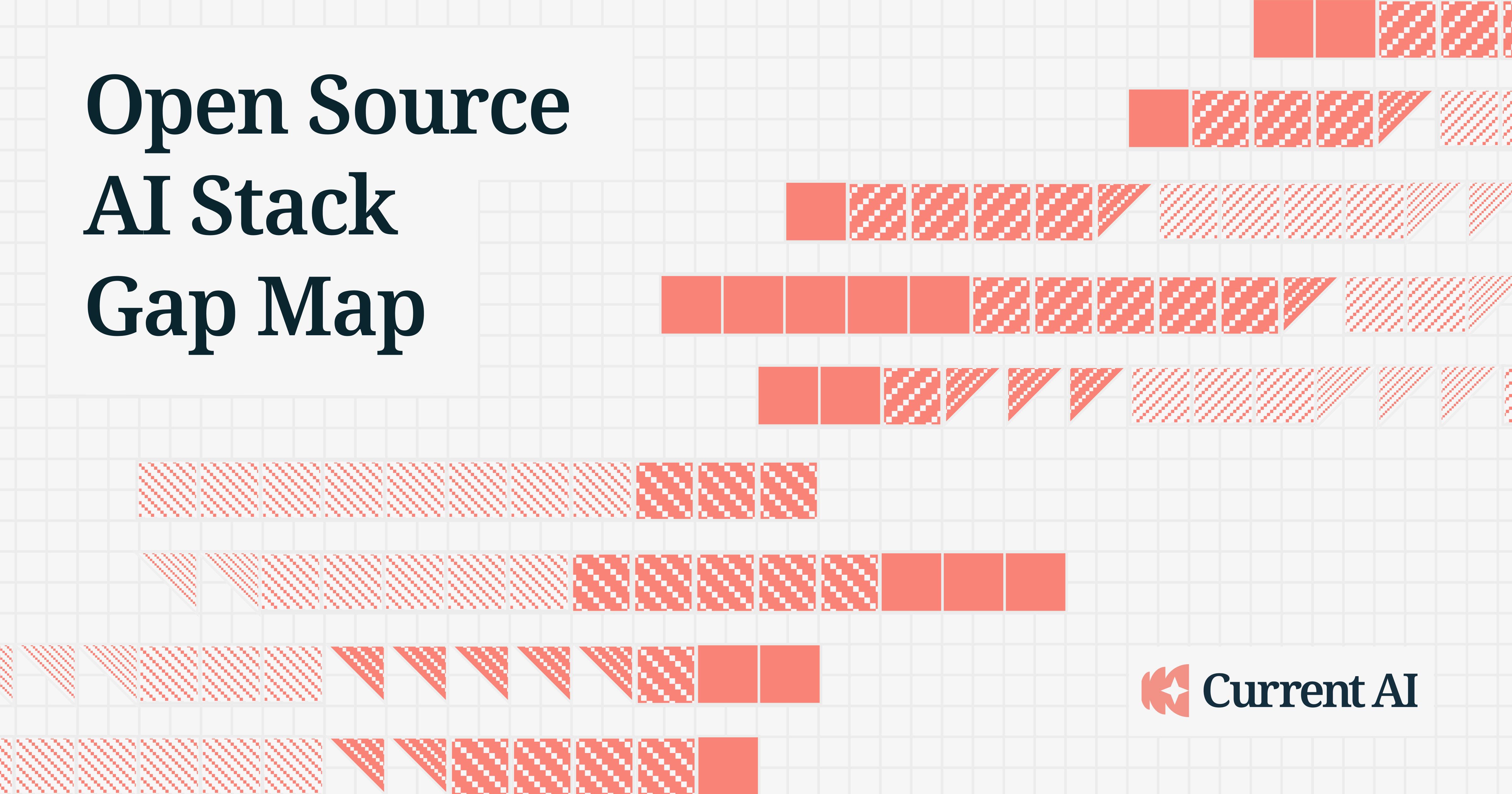
A living, MIT-licensed atlas of the open-source AI stack with 421 scored products across 9 layers.
Quick facts
| Publisher | Current AI (non-profit) |
|---|---|
| Version | v0.1 |
| Products indexed | 421 across 228 orgs |
| Categories | 9 stack layers, 15 categories |
| Scoring axes | Openness, capability, adoption |
| License | MIT (data + code) |
| Source | github.com/currentai-org/os-ai-map |
What is it?
The Open Source AI Gap Map is a public catalog that names every meaningful open-source project across the AI stack, from base models and inference code to agent frameworks and hardware. Version 0.1 covers 421 products from 228 organizations and, unlike an awesome-list, scores each entry on openness, capability, and adoption so gaps stand out.
How does it work?
Each Gap Map entry lives as a YAML file in a public GitHub repo with three independent scores plus links to primary sources. Current AI groups the 421 products into 9 stack layers, then renders the map at map.currentai.org so a thin layer, such as training or synthetic datasets, is immediately visible as a hole in the stack.
Why does it matter?
For researchers, funders, and policy teams, the Gap Map turns "is there a real open alternative to X?" from vibes into a scored comparison across 421 projects. It is also the first artifact published by Current AI, a $400M non-profit whose goal is a vendor-independent open-source stack — treat it as a living scoreboard rather than a static list.
Who is it for?
OSS AI maintainers, funders, policy teams, and researchers picking dependencies.
Frequently asked questions
- What does the Open Source AI Gap Map actually track?
- The Gap Map catalogs 421 mature open-source AI products spanning base models, fine-tuned chat models, inference and fine-tuning code, evaluation code, benchmark and training datasets, orchestration and agent frameworks, plus UI and API layers. Each product is scored on three independent axes: openness of weights and data, capability, and community adoption.
- Where can I explore the Gap Map data myself?
- The live Gap Map lives at map.currentai.org, with the underlying YAML data plus scoring methodology published at github.com/currentai-org/os-ai-map under an MIT license. The repo ships 1,184 curated product YAML files and tracks 16,185 GitHub repositories, and Current AI accepts pull requests to add or update entries.
- Who is Current AI and why are they publishing this?
- Current AI is a non-profit founded at the February 2025 Paris AI Action Summit with about $400M in initial commitments. The Gap Map is Current AI's first public artifact toward its stated goal of building an auditable open-source stack for AI that is independent of any single vendor's platform.
- Which layers of the open-source AI stack have the biggest gaps today?
- The Gap Map v0.1 highlights training and synthetic datasets as the layer with no mature open-source products, while benchmark and evaluation datasets, orchestration and agent frameworks, and evaluation code look strongest with 11 to 18 mature entries each. The chart makes each thin layer directly visible so contributors can target the gaps.
Try it
https://map.currentai.org