Databricks · 2026-08-07 · major
Databricks on cutting AI coding bills — routing beats rationing
Databricks explains how it holds down AI coding costs with four levers: efficient models, flexible model choice, smart request routing, and less token overhead. Unity AI Gateway and the Apache-2.0 Omnigent harness do the work.
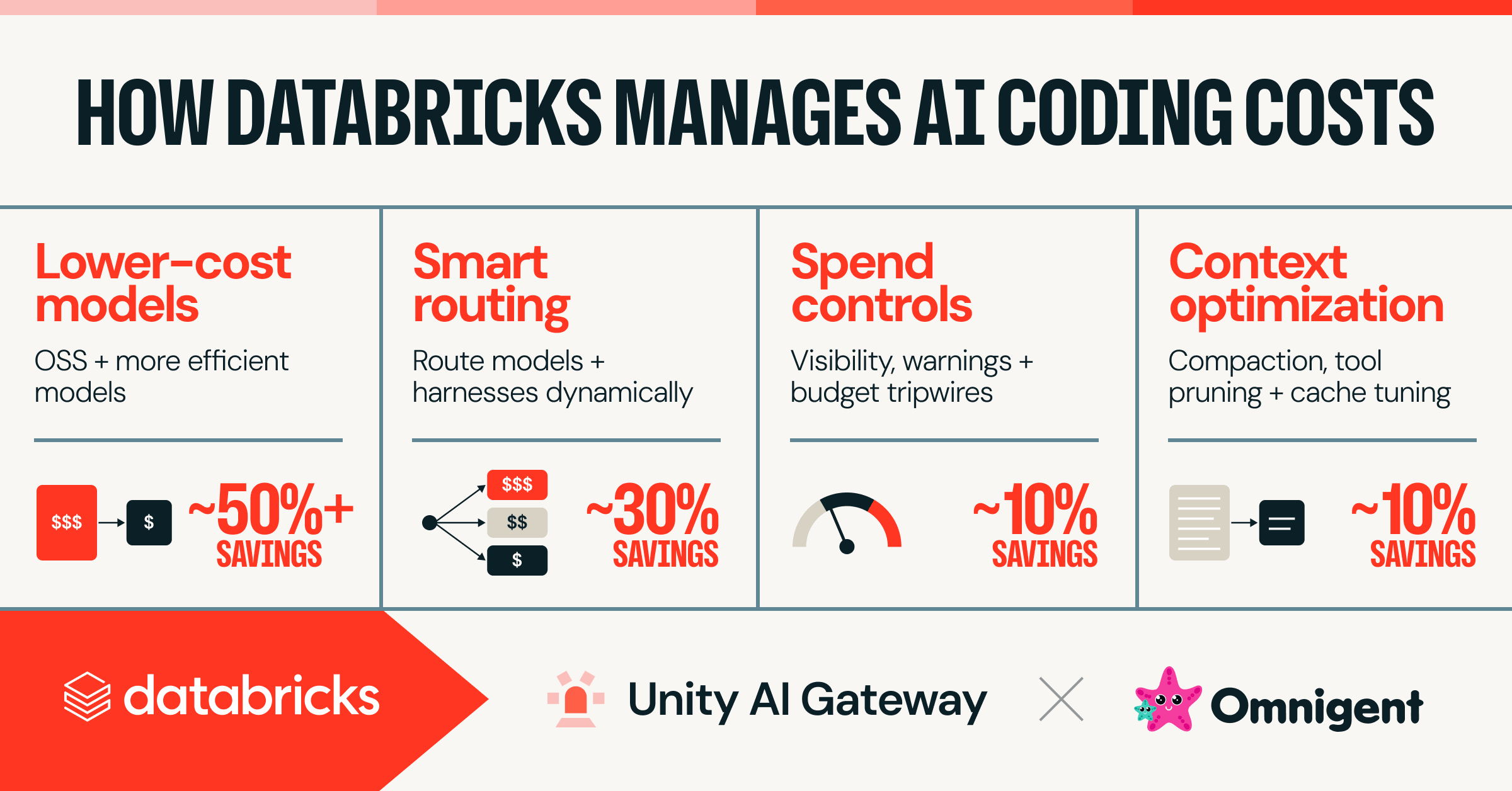
Databricks argues runaway AI coding spend is an engineering problem, not a bill you have to accept.
Quick facts
| Publisher | Databricks |
|---|---|
| Published | August 7, 2026 |
| Cost levers | Efficient models, model flexibility, request routing, token overhead |
| Smart Router savings | Over 30% lower average task cost |
| Gateway | Unity AI Gateway, GA since August 4, 2026 |
| Client-side harness | Omnigent, Apache-2.0 |
What is it?
Databricks published a breakdown on August 7, 2026 of how it keeps the cost of AI coding tools under control across its own engineering organisation. The post walks through four levers, from picking efficient models to cutting the tokens a request wastes. Patrick Wendell and four co-authors write that exponential cost growth is a solvable engineering and governance problem.
How does it work?
Two pieces of infrastructure carry the plan. Unity AI Gateway sits in front of the model providers and handles access, budget tracking, configuration and logging, with Smart Router choosing a model per task. Omnigent sits on the developer side as a meta-harness, showing one interface while dispatching each request to whichever underlying harness fits, so a team can change models without changing how people work.
Why does it matter?
The approach saves money without taking tools away from developers, which is the usual reaction to a large AI bill. Routing each task to a cheaper model held quality roughly level with the most expensive option, and trimming token overhead cut generated tokens nearly in half with no quality drop the team could see. Anyone watching an AI coding budget climb now has a written account of which levers actually moved the number.
Who is it for?
engineering leaders paying for AI coding tools
Frequently asked questions
- Is Omnigent open source?
- Omnigent is an Apache-2.0 licensed meta-harness for building and running AI agents, published at omnigent.ai with source on GitHub. Omnigent sits above individual harnesses such as Claude Code, Codex and Pi, so a team can compose them, control them with policies, and collaborate in real time. The project describes itself as alpha and built in the open.
- What does Unity AI Gateway do?
- Unity AI Gateway is the Databricks governance layer for AI traffic, generally available since August 4, 2026. Unity AI Gateway centralizes access to model providers, attributes spend across models, teams and applications, enforces hard spend caps, and logs requests. Databricks offers access to Anthropic, OpenAI, Gemini, Kimi and GLM models through a single-query API.
- Does spending less mean limiting what developers can use?
- Databricks argues the opposite. The post's position is that exponential growth in AI coding costs is a solvable engineering and governance problem, addressed by better model selection and routing rather than by restricting developer access. Databricks reports it held quality roughly level with its most expensive model while paying less per task.
- How solid are the savings numbers in the post?
- Databricks labels the per-technique ranges in its summary table as directional and based on an informal survey, not a controlled benchmark. The Smart Router and token-trimming results are reported as measured outcomes with no observed quality degradation, so treat the table as a guide to which lever to pull rather than a promise of a specific number.