
Liquid AI · 2026-10-27 · major
LFM3 — Liquid AI's 2B-class open models for text, vision, audio and omni
Liquid AI released LFM3, six open-weight 2B-class models on one backbone: text, vision, audio, omni and two decision models. LFM3-1.7B has a 256K context, fits in about 1 GB at 4-bit, and scores 38.42 on WebArena-Verified.
Six small open models from Liquid AI share one 1.7B backbone and cover text, images, video, speech and calibrated decisions.
Key specs
| Context window | 256K |
|---|---|
| Web arena verified | 38.42 |
Quick facts
| Maker | Liquid AI |
|---|---|
| Models | LFM3-1.7B, LFM3-VL-2B, LFM3-Audio-2B, LFM3-Omni-2B, d1-2B, d1-omni-2B |
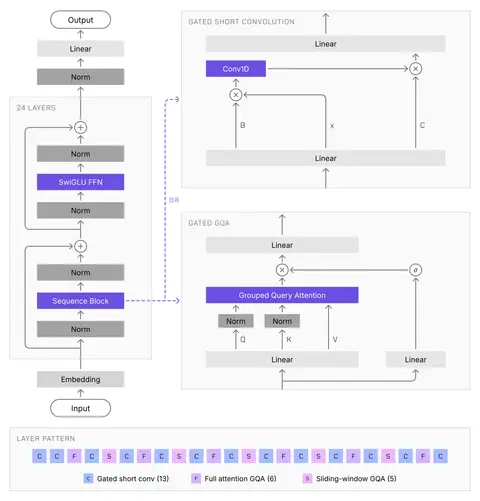
| Backbone | LFM3-1.7B-Base: 24 layers, convolution + sliding-window + global attention |
| Pre-training | 22T tokens, last 3.5T extend context to 256K |
| License | LFM Open License v1.0 |
| Availability | Hugging Face, Liquid Playground, Liquid API |
Benchmarks
| LFM3-1.7B | 41.29 | |
|---|---|---|
| Qwen3.5 9B | 15.1 | |
| Qwen3.5 4B | 8.67 | |
| MiniCPM5 2B | 4.71 | |
| Gemma 4 E4B | 1.92 |
| LFM3-1.7B | 38.42 | |
|---|---|---|
| Qwen3.5 9B | 28.94 | |
| Qwen3.5 4B | 21.92 | |
| Gemma 4 E4B | 17.06 | |
| MiniCPM5 2B | 9.11 |
What is it?
LFM3 is Liquid AI's new family of open-weight models of about 2B parameters, built for phones, laptops and edge devices. The first release has six models: LFM3-1.7B for text, LFM3-VL-2B for images and video, LFM3-Audio-2B for speech in and out, LFM3-Omni-2B for all of these, and two decision models, d1-2B and d1-omni-2B, that return calibrated answers.
How does it work?
Every LFM3 model branches from LFM3-1.7B-Base, a 24-layer hybrid that mixes 13 gated short convolutions with 5 sliding-window attention layers and 6 global attention layers. The base was pre-trained on 22T tokens, and a final 3.5T-token stage extends context to 256K. Vision and audio encoders plug into the same backbone, and LiquidCodec turns audio into tokens.
Why does it matter?
Liquid AI reports that LFM3-1.7B beats Qwen3.5 9B on long browser and business-app tasks with less than a fifth of the parameters. Developers who need private, offline agents on cheap hardware get one tested family for text, vision and voice, and can fine-tune each model on a single GPU.
Who is it for?
on-device and edge AI developers
Frequently asked questions
- Can LFM3 run on a phone or a Raspberry Pi?
- Liquid AI tested LFM3 across 14 device and backend combinations, including phones, a Raspberry Pi 5, laptops, cloud CPUs, GPUs and the Qualcomm Hexagon NPU. The LFM3-1.7B text model fits in about 1 GB at 4-bit, and a full 128K context needs 1.6 GB of KV cache, compared with 4.3 GB for Qwen3.5-4B.
- How does LFM3-1.7B compare to Qwen3.5 9B?
- In Liquid AI's comparison LFM3-1.7B averages 49.37 against 47.24 for Qwen3.5 9B, and leads on agent tasks such as BFCL V4 (71.39 vs 62.83) and AutomationBench (41.29 vs 15.10). Qwen3.5 9B stays ahead on SWE-bench Verified (51.20 vs 43.40), GPQA Diamond (80.40 vs 63.37) and RULER 128K (87.11 vs 65.56).
- Can I fine-tune LFM3 on my own data?
- Liquid AI says every LFM3 model can be fine-tuned on a single GPU. Its cookbook notebooks cover SFT, DPO, GRPO and continued pre-training, with examples such as JSON extraction from documents, calling 108 phone-app tools, receipt photos to JSON, spoken smart-home commands to function calls, and training a new voice.
- Which frameworks support LFM3?
- The LFM3-1.7B model card lists vLLM, SGLang and Transformers for BF16 weights, llama.cpp, Ollama and LM Studio for GGUF files, MLX 4-bit for Apple Silicon, and ONNX Runtime. Liquid AI also offers the models in its Playground and through the Liquid AI API.
Try it
pip install -U transformers, then load LiquidAI/LFM3-1.7B