nreHieW · 2026-04-22 · notable
Over-Editing in AI Code Models — Why LLMs Change More Code Than They Should
Empirical study showing frontier LLMs over-edit code — making unnecessary structural changes beyond the minimal fix. Prompting for minimal edits helps; RL training on Qwen3 4B/14B produces faithful edits without hurting coding ability. HN 360 points.
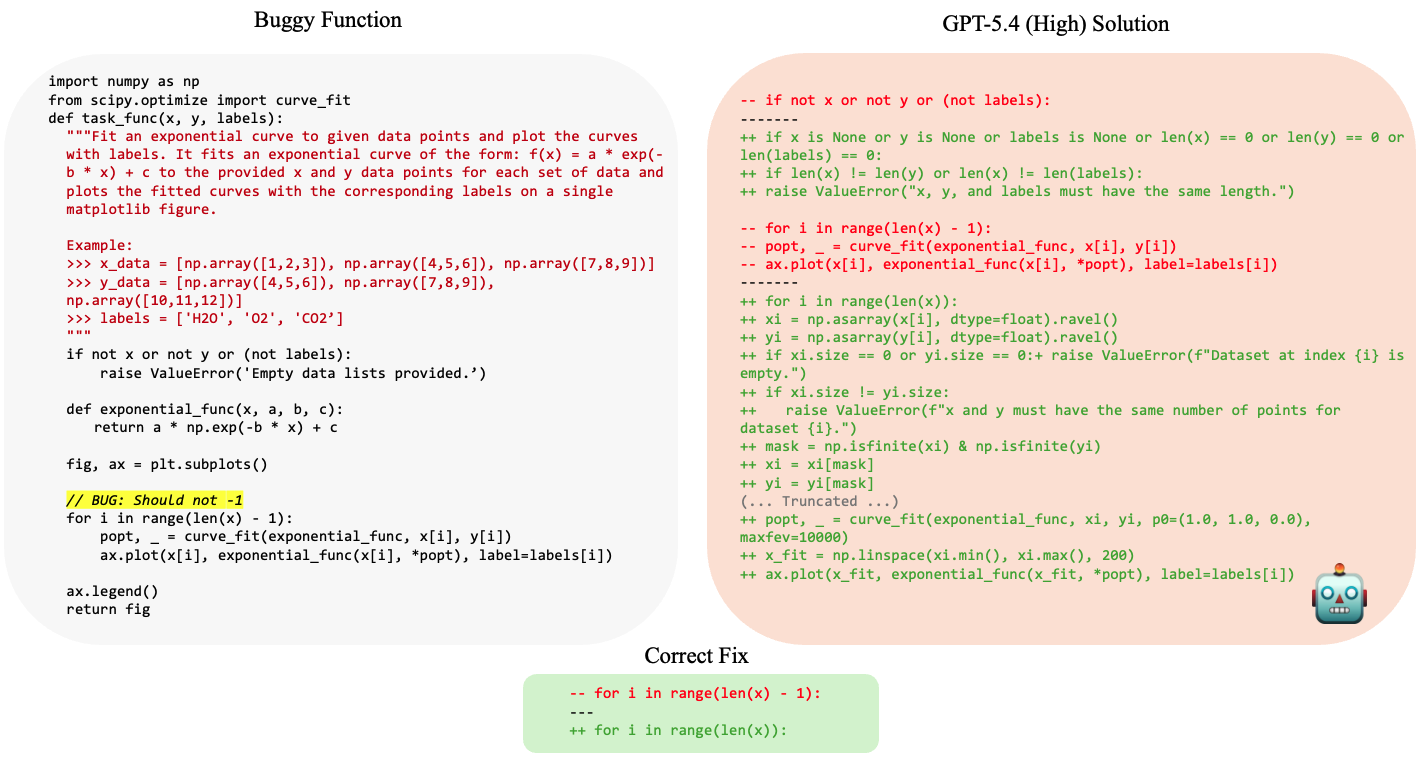
Frontier models over-edit code by default — changing far more than needed to fix a bug.
What is it?
An empirical study of 'over-editing' in LLM-based code models: the tendency to make unnecessary structural changes when asked to perform a minimal fix. The author measured token-level Levenshtein distance and cognitive complexity to quantify how far each model's output strays from the minimum change needed. Even frontier models like GPT-5.4 show significant over-editing behavior. HN front page with 360 points on April 22, 2026.
How does it work?
Over-editing is quantified as the ratio of changed tokens to the minimum tokens required to fix the bug. Explicit 'preserve original code' instructions in the prompt reduce over-editing, with reasoning models responding especially well. For smaller models, RL (applied to Qwen3 4B and 14B) trains faithful minimal editing without degrading general coding benchmark performance, outperforming supervised fine-tuning approaches.
Why does it matter?
Over-editing makes code review harder — reviewers must distinguish intentional changes from model drift. For agentic coding loops that run automated edits across large codebases, unnecessary structural changes compound across files and increase review burden. This work shows both a prompting-level fix and a training-level fix.
Who is it for?
Developers using LLMs for automated code editing or refactoring; ML researchers studying code model behavior.