
OpenAI · 2026-11-06 · notable
BioBasicsBench — OpenAI tests AI agents on everyday wet-lab data
In short
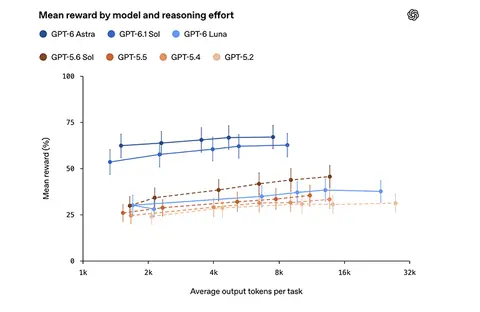
BioBasicsBench is a 100-task OpenAI benchmark, built with Ligo, that asks AI agents to read raw lab data, catch errors and flag weak evidence. GPT-6 Astra leads at 66.7%; GPT-5.2 scores 31.2%.
OpenAI · 2026-11-06 · 3 sources checked
OpenAI's BioBasicsBench checks whether AI agents can read gels, colony plates and microscopy from real lab work.
Key specs
| Tasks | 100 |
|---|---|
| Gpt 6 astra (xhigh) | 66.7% |
What is it?
BioBasicsBench is a new OpenAI benchmark of 100 routine wet-lab tasks, made with the enzyme-design company Ligo. The tasks come from Ligo scientists' own experiments, including failed runs and unclear images, across protein methods, imaging and cytometry, quantification and assays, nucleic acid methods, and molecular cloning.
How does it work?
Each task gives an agent raw evidence such as gel and blot images, colony plates, microscopy stacks, sequencing reads, plate-reader exports or bench photos, and a rubric scores accurate measurement, sound reasoning and stated uncertainty. Every task passed three reviews, including one by an outside PhD-level wet-lab scientist. OpenAI ran seven of its own models at 37 reasoning-effort settings, five attempts per task, for 18,500 graded answers.
Why does it matter?
At the highest effort, GPT-6 Astra scored 66.7% and GPT-6.1 Sol 62.0%, against 43.8% for GPT-5.6 Sol and 35.4% for GPT-5.5, so the newest models are much better at lab data. OpenAI still warns that higher scores do not yet mean reliable lab judgment: in one colony PCR task Astra picked the wrong colonies, and it overcounted a plate by about 12%. OpenAI says the results will feed its biosafety and biosecurity assessments.
Who is it for?
lab scientists and teams building AI agents for biology