ProgramAsWeights · 2026-09-03 · notable
Compile by Training — turn an English spec into a local neural function
Compile by Training is a compiler that turns a plain-English function description into a small neural program you can run offline. It reaches 83.6% semantic accuracy on FuzzyBench-Hard, where the older fast compiler scored 22.4%.
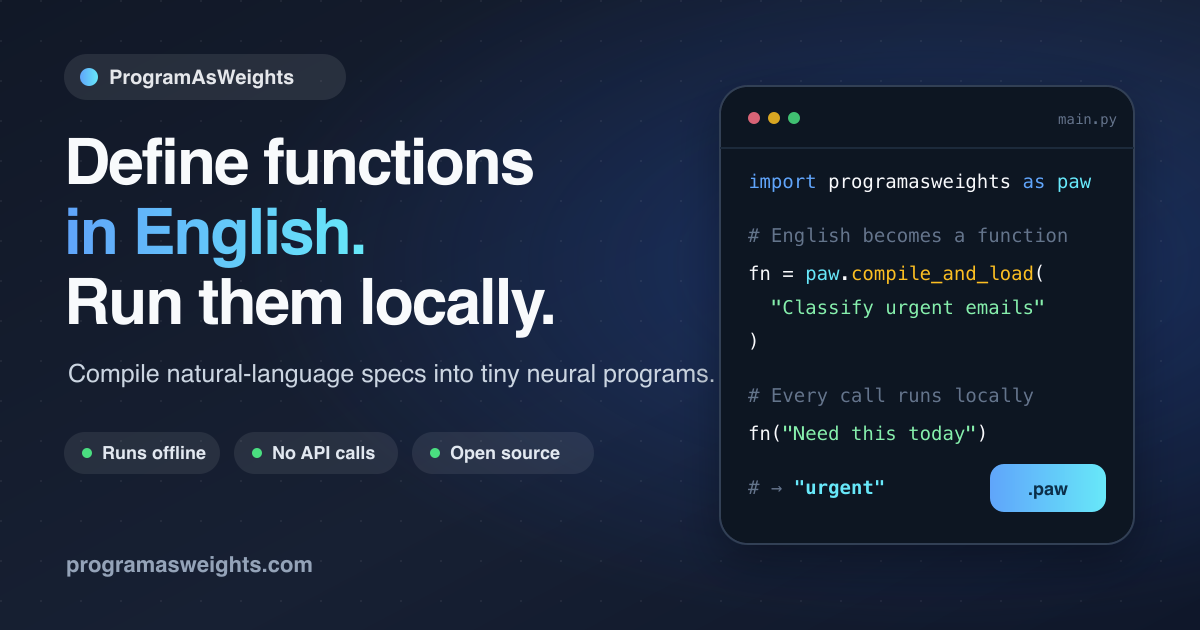
Describe a fuzzy text function in English, wait about a minute, and get a .paw file that runs locally with no API calls.
Key specs
| Fuzzy bench hard (lem) | 83.6% |
|---|---|
| Compile time (b300) | 50.9s |
What is it?
Compile by Training is a new, slower compiler for ProgramAsWeights (PAW) that trades compile speed for a large jump in accuracy. It takes a natural-language description of what a function should do and produces a reusable neural program. The paper is by Yuntian Deng, Pengyu Nie and Stuart Shieber, posted to arXiv on 3 September 2026.
How does it work?
During compilation, teacher models generate example input-output pairs for the spec. Those examples finetune a compact adapter over a small fixed interpreter, and the result is packaged as a .paw file. Running that file needs no further model calls. On FuzzyBench-Hard the method scores 83.6% LLM Exact Match against 22.4% for the PAW fast compiler, and compiling takes 50.9 seconds on a B300 GPU versus 3.5 seconds for the fast path.
Why does it matter?
Small fuzzy text jobs — sentiment labels, PII typing, format cleanup — usually mean one API call per invocation. ProgramAsWeights turns each of those into a local file with a name and a version, so it can be stored and reused like any other module. The authors show it driving a website helper, 3D avatar control and a two-way translator.
Who is it for?
developers shipping small text-processing features
Try it
uv run compile.py "Classify sentiment. Return only positive, negative, or neutral." -o sentiment.paw