Simon Willison · 2026-07-31 · notable
Simon Willison — Stateless MCP spawns mcp-explorer and datasette-mcp
Simon Willison walks through MCP 2.0's stateless transport, calls it the biggest change since the protocol shipped, and open-sources two new demos — mcp-explorer for probing servers and datasette-mcp for exposing SQLite over the new spec.
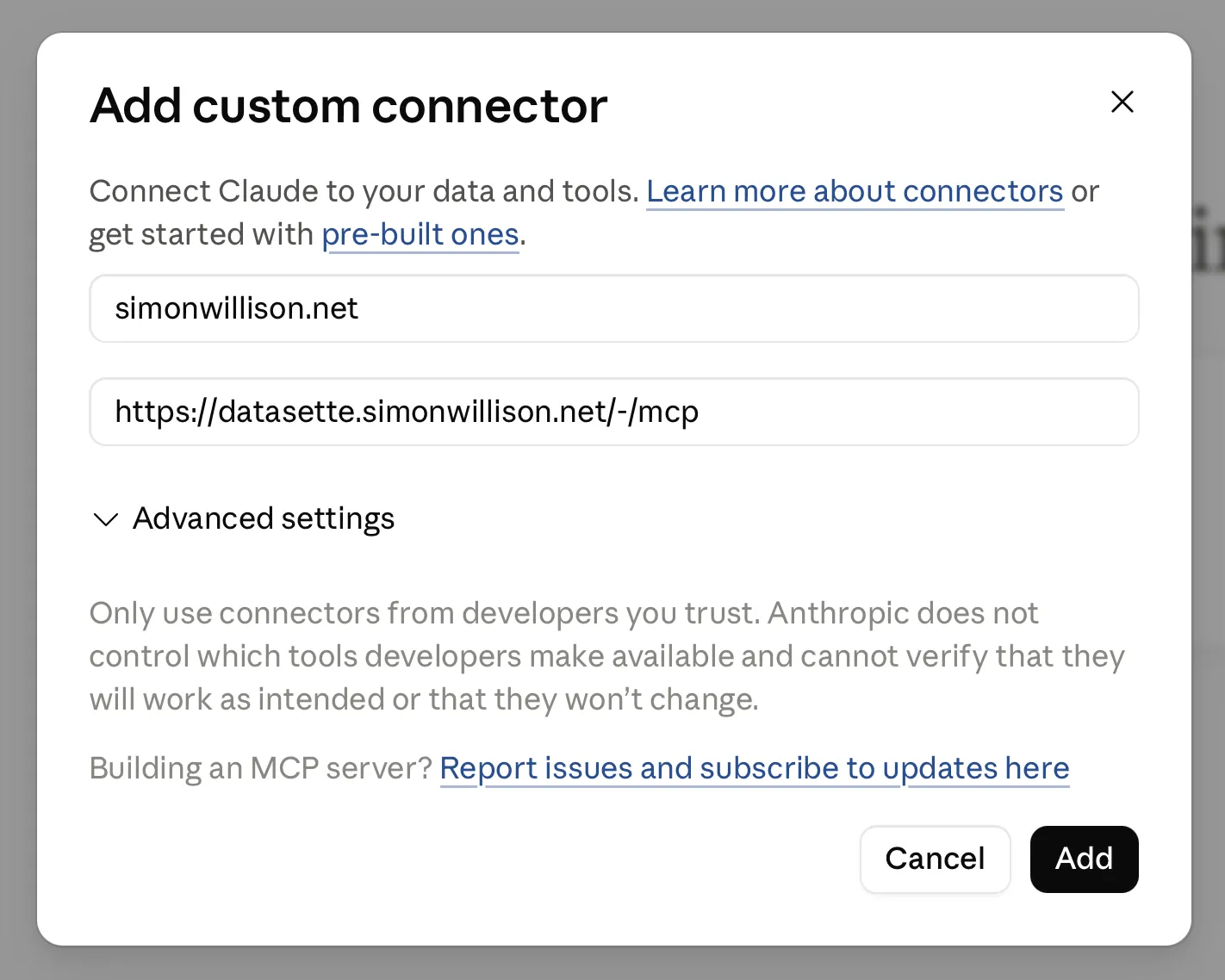
Simon Willison argues MCP 2.0's stateless transport is the biggest spec change since launch, and ships two demos to prove it.
What is it?
Simon Willison's July 31 post is a roughly 2,100-word walkthrough of the Model Context Protocol 2026-07-28 revision — 'MCP 2.0' — plus two open-source companion projects he built while playing with the new transport: mcp-explorer, a probe for MCP servers, and datasette-mcp, an adapter that exposes any Datasette instance over MCP.
How does it work?
The new spec drops the long-lived HTTP+SSE session model in favor of stateless calls that each carry their own context — closer to a normal HTTP API than the earlier connect-and-hold design. Willison uses that shift to build mcp-explorer as a plain client that can be pointed at any server and inspect its tools, and datasette-mcp as a wrapper that turns Datasette's read-only query API into an MCP-compliant surface consumable by Claude, LLM CLI, and other MCP clients.
Why does it matter?
MCP has been notoriously hard to reason about because of its long-lived state; the stateless variant means an MCP server can now be a normal HTTP handler you deploy anywhere, which is what MCP needed to make the leap from Anthropic's ecosystem to general infrastructure. When someone with Willison's profile ships both a well-argued explainer and two working tools on the same day, it materially accelerates how many people can pick the protocol up.
Who is it for?
Developers evaluating MCP for their own products or trying to expose an existing data source to Claude and other MCP clients.
Try it
pip install mcp-explorer # then point it at any MCP 2.0 endpoint