Stanford University · 2026-04-28 · major
RecursiveMAS — Stanford/MIT/NVIDIA Multi-Agent System Cuts Tokens 75% With 8.3% Accuracy Gain
RecursiveMAS extends recursive computation to multi-agent systems via a RecursiveLink module for cross-agent latent state transfer, averaging +8.3% accuracy across 9 benchmarks with 1.2–2.4× speedup and up to 75.6% token reduction.
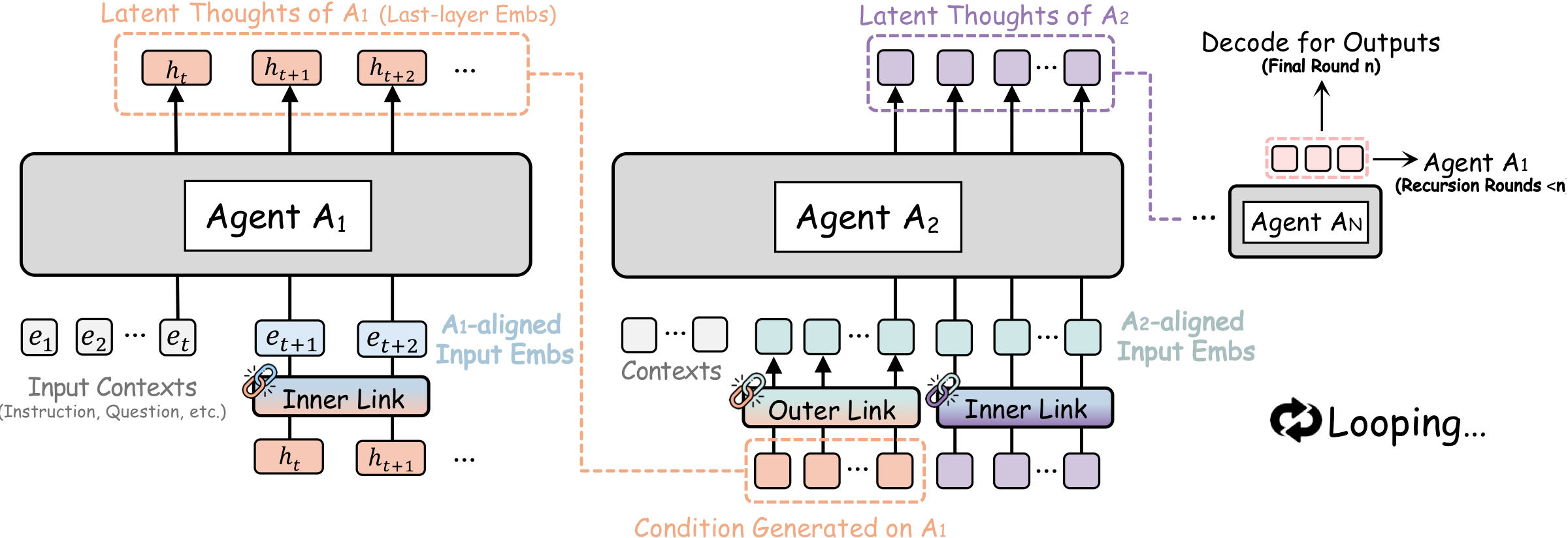
Recursive computation, now for teams of AI agents
Key specs
| GitHub stars | 287 |
|---|---|
| Upvotes | 258 |
What is it?
A framework that applies recursive latent-space computation across heterogeneous agents, connecting them through a lightweight RecursiveLink module that passes latent states between rounds of collaboration.
How does it work?
Each agent refines its outputs in multiple rounds, sharing latent thoughts through RecursiveLink rather than text. An inner-outer loop training algorithm assigns credit across the whole recursion, optimizing the entire multi-agent system end-to-end.
Why does it matter?
Same accuracy improvement as adding more agents—but with far fewer tokens and faster inference. Tested across math, science, medicine, search, and code generation benchmarks.
Try it
https://github.com/RecursiveMAS/RecursiveMAS