From the Trenches · 2026-04-21 · major
The West Forgot How to Make Things. Now It's Forgetting How to Code
430 HN points for an essay on AI tools and tacit knowledge loss: METR's RCT found experienced devs took 19% longer with AI despite predicting 24% faster. Follow-up study found devs refused to participate without AI.
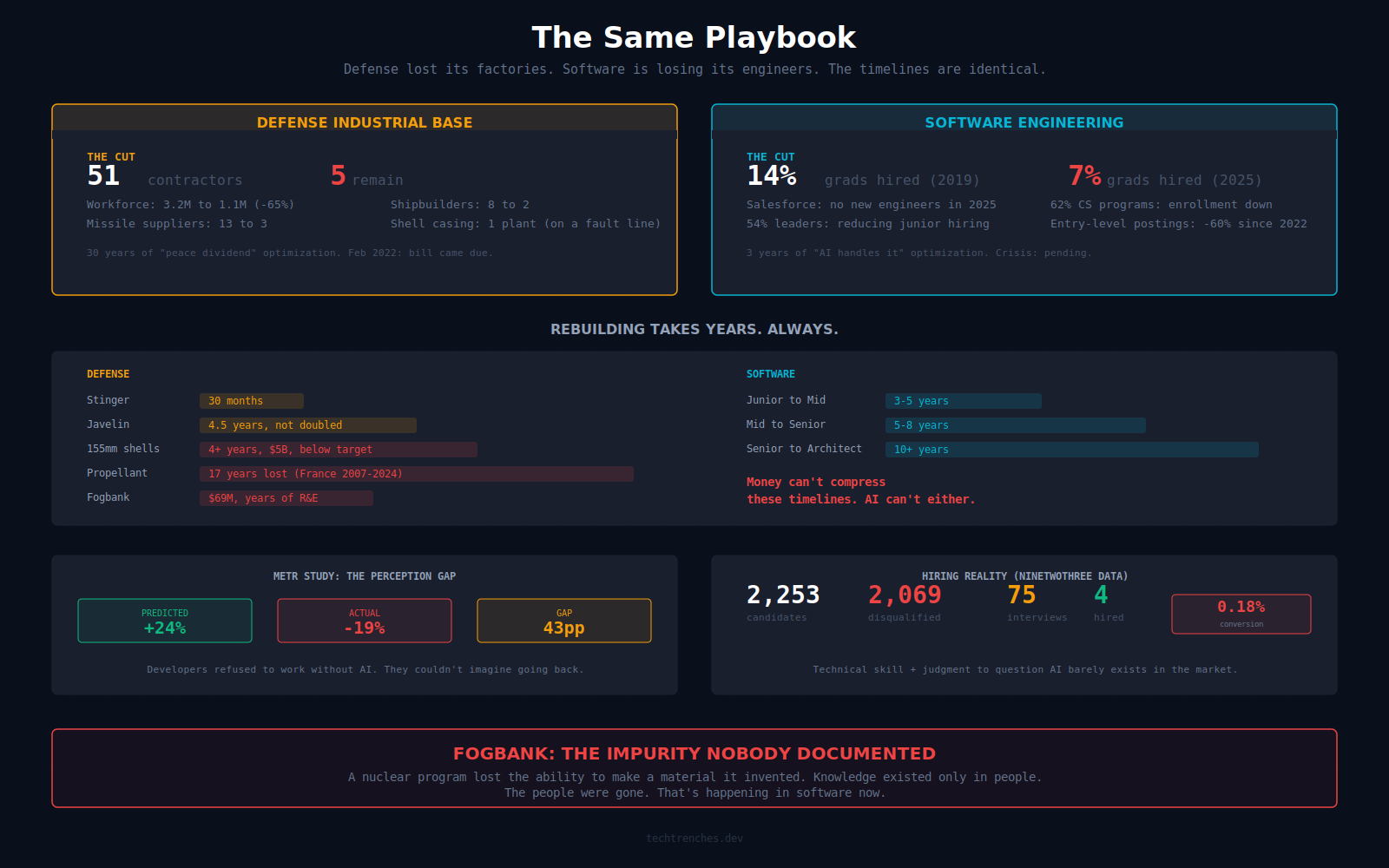
A 430-point HN essay argues AI coding dependency is quietly eroding the tacit knowledge junior engineers are supposed to absorb.
What is it?
An essay by Denis Stetskov drawing a parallel between defense manufacturing failures and current AI-assisted software development. The central data: METR ran a randomized controlled trial where experienced developers took 19% longer with AI tools than without, while predicting they would be 24% faster — a 43-percentage-point gap between perception and measurement. A follow-up study found many developers refused to participate if it meant working without AI.
How does it work?
The defense parallel: Raytheon had to bring back retired engineers in their 70s to restart Stinger missile production because tacit knowledge had not been passed on. Stetskov's thesis: junior developers who learn to prompt AI rather than debug and reason from scratch build 'AI-mediated competence' — they can produce code outputs but not the underlying mental models. When AI tools change or fail, that gap becomes structural. The path to senior engineer takes five to eight years; decisions made today shape who exists in that role in 2031.
Why does it matter?
The METR finding is concrete: AI didn't just fail to speed up experienced developers — it slowed them down on real open-source tasks. Combined with reduced junior hiring at major firms, the essay raises a specific structural risk: the generation that should be learning foundational engineering right now isn't.
Who is it for?
Engineering leaders and developers thinking about AI adoption at the team level