In plain English
Three job titles dominate every AI hiring post right now: AI engineer, ML engineer, and data scientist. Companies use them loosely, recruiting posts blur them together, and people agonize over which one to aim for. The confusion is understandable — all three involve Python, all three touch models, and a single team might have someone doing all three things at once. But these are genuinely different crafts with different day-to-day work, different career paths, and increasingly different pay grades.
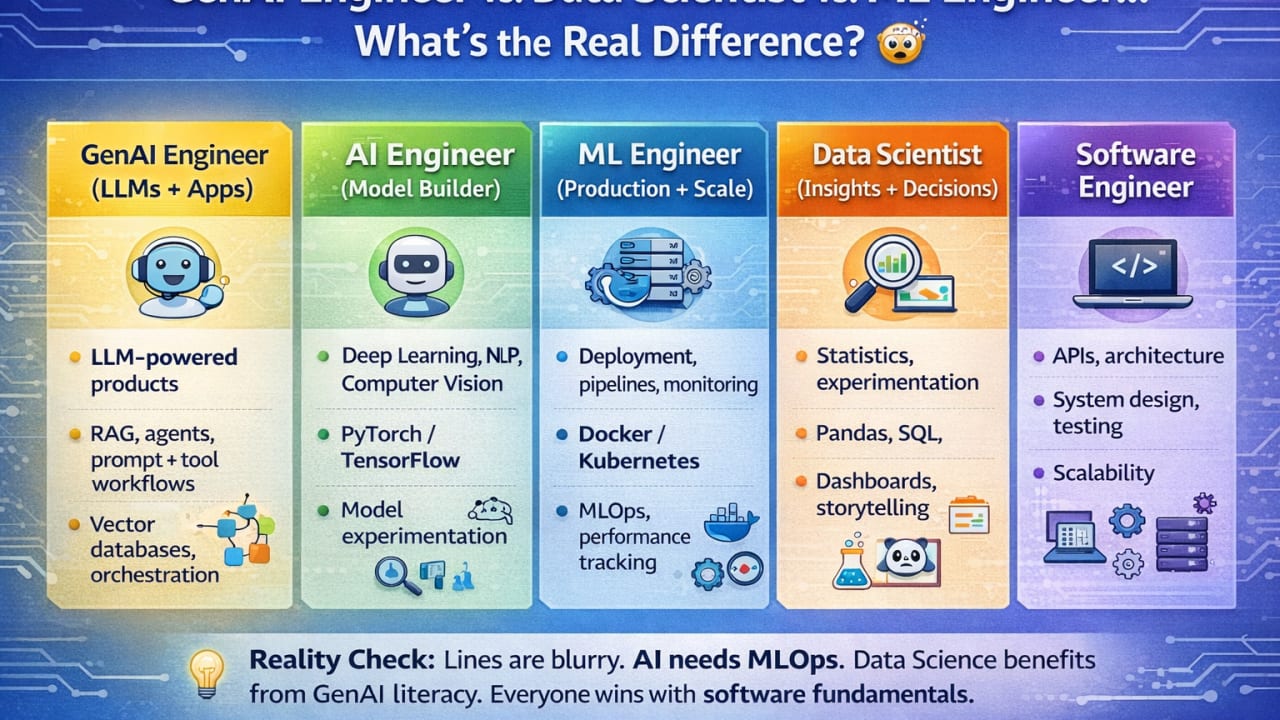
The cleanest analogy is a restaurant kitchen. The data scientist is the food critic who analyses what customers ordered last season, identifies trends, and tells the chef "the truffle dishes are underperforming in the suburbs." The ML engineer is the specialist who builds and maintains the kitchen's core equipment — the custom oven, the temperature-controlled prep station — so it performs reliably under pressure. The AI engineer is the line cook who takes that equipment as a given and assembles today's dishes for actual customers, fast, at scale, and consistently.
Each role asks a different question. The data scientist asks "what does the data tell us?" The ML engineer asks "how do we make a model that works reliably at scale?" The AI engineer asks "how do we ship a useful product on top of this model today?" Same ecosystem, very different jobs.
Why it matters
Picking the wrong path wastes years. Someone with a software-engineering background who spends two years studying academic ML math to become an ML engineer — when what they actually want to do is ship AI-powered features — has taken a costly detour. The reverse is equally true: a statistics PhD who skips the engineering fundamentals to call themselves an AI engineer will struggle when they need to build something that actually runs in production.
The roles also have meaningfully different hiring markets right now. AI and ML engineering role postings grew by over 160% from 2024 to 2025, while demand growth for data science roles has flattened considerably. The AI engineer title itself barely existed before 2022 — it emerged directly from the generative-AI wave and the explosion of hosted model APIs. Latent.Space's influential 2023 essay "The Rise of the AI Engineer" argued this role would eventually outnumber traditional ML engineers, because building with models is a far larger surface area than building the models themselves.
- Software engineers trying to move into AI need to know whether to study ML fundamentals or API integration patterns.
- Data scientists wondering whether to pivot need to understand which skills transfer and what new ones they need.
- Hiring managers writing job specs need to be precise — "AI engineer" and "ML engineer" are not interchangeable and attract different candidate pools.
- Career changers who don't have a CS degree need to know which role is actually reachable without going back to school.
- Early-career builders want to know which roles pay more and why — the salary gap is real and widening.
How the three roles work
All three roles touch AI systems, but they occupy different positions in the pipeline that turns raw data into value for end users. Here is where each role sits and what they own.
What an AI engineer does daily
The AI engineer's job is to take a model that already works and build a reliable, useful product on top of it. A typical day might include: writing and refining system prompts; wiring up a RAG pipeline so the app can answer questions against a company knowledge base; adding function-calling tools so an agent can look up live data; running an eval suite to catch regressions; and debugging a latency spike caused by an over-sized context window. The work is fundamentally software engineering — async code, APIs, databases, observability — with a layer of AI-specific craft on top.
What an ML engineer does daily
The ML engineer's job is to make models that work correctly and efficiently at scale. A typical day might include: running training jobs on GPU clusters; tuning hyperparameters and monitoring training loss; setting up an MLflow experiment tracker to compare model versions; building data preprocessing pipelines with Apache Spark; containerizing a model in Docker and deploying it to Kubernetes; and writing latency benchmarks against a new model checkpoint. The work is a blend of ML mathematics, systems engineering, and DevOps. PyTorch and TensorFlow are the core frameworks; MLOps platforms like MLflow, Kubeflow, and Weights & Biases are the operating environment.
What a data scientist does daily
The data scientist's job is to find signal in data and communicate it to people who make decisions. A typical day might include: pulling and cleaning a dataset with pandas; running an A/B test and checking statistical significance; building a regression model to predict churn; creating a Tableau or Power BI dashboard for the marketing team; and writing up a recommendation memo. The output is usually a finding or a recommendation — not a deployed system. The core toolkit is Python (pandas, NumPy, scikit-learn, statsmodels, matplotlib, seaborn), SQL, and a BI tool.
- Output: shipped AI feature or product
- Tools: OpenAI/Anthropic/Gemini APIs, LangChain, LlamaIndex, vector DBs
- Skills: software engineering, prompt engineering, RAG, evals, agentic systems
- Degree: software background, no PhD needed
- Output: trained, deployed, maintained model
- Tools: PyTorch, TensorFlow, MLflow, Kubeflow, Docker, Kubernetes
- Skills: ML math, training pipelines, model serving, MLOps, GPU infra
- Degree: CS/stats/math background common
- Output: insight, dashboard, recommendation
- Tools: pandas, scikit-learn, SQL, Tableau, statsmodels
- Skills: statistics, EDA, experimentation, visualization, communication
- Degree: stats/math/domain-science background common
Skills and tools compared
Listing the actual tools each role uses is the fastest way to feel the difference concretely. The overlap is real — all three use Python, all three need some understanding of model behavior — but the center of gravity is very different.
| Skill / Tool | AI Engineer | ML Engineer | Data Scientist |
|---|---|---|---|
| Python | Yes — primary language | Yes — primary language | Yes — primary language |
| SQL | Yes — querying DBs and pipelines | Yes — data pipelines | Yes — core daily skill |
| Statistics | Light — enough to read evals | Medium — needed for model metrics | Heavy — core expertise |
| PyTorch / TensorFlow | Rare (maybe fine-tuning) | Daily | Rarely |
| LLM APIs (OpenAI, Anthropic, Gemini) | Daily | Occasional | Rare |
| Prompt engineering | Core skill | Rarely needed | Rarely needed |
| RAG + vector databases | Core skill | Sometimes (embedding models) | Rarely |
| MLflow / Kubeflow / MLOps | Rarely | Core skill | Rarely |
| Docker / Kubernetes | Sometimes (deployment) | Core skill | Rarely |
| Tableau / Power BI | Rarely | Rarely | Common |
| A/B testing + stats tests | Light | Light | Core skill |
| Eval frameworks (e.g. RAGAS, Braintrust) | Core skill | Light | Rarely |
Notice the pattern: the AI engineer's toolkit is almost entirely about integrating with existing model APIs and building production software around them. The ML engineer's toolkit is about the model itself — training, measuring, serving. The data scientist's toolkit is about insight extraction — statistics, visualization, communication.
Salary and job demand
All three roles pay well above the median software engineering salary. But there is a real and widening gap, driven by one factor: owning production systems. Insights that stay in notebooks are easier to cut. Production AI features that break in the night need someone on call. The market prices that responsibility accordingly.
| Role | Entry level (US) | Mid level (US) | Senior (US) |
|---|---|---|---|
| Data Scientist | $95k–$110k | $120k–$150k | $160k–$200k+ |
| ML Engineer | $100k–$120k | $130k–$160k | $175k–$220k+ |
| AI Engineer | $110k–$130k | $145k–$180k | $180k–$250k+ |
These are US base salary ranges for 2026 from multiple industry surveys. Total compensation at top-tier companies can run significantly higher — senior ML engineers in San Francisco can clear $400,000+ total comp when equity is included. Engineers with LLM specializations now earn approximately 25–40% more than generalist ML engineers, and MLOps specialists command about 20–35% premiums over baseline.
Job demand tells an equally stark story. AI and ML engineering role postings grew by over 160% from 2024 to 2025. The "AI engineer" title specifically grew by more than 143% year over year in one period, while data science role growth flattened to roughly 12%. That doesn't mean data science is dying — the base is larger and the work isn't going away — but new hiring is heavily skewed toward the engineering side of AI.
Which role fits your background?
The best predictor of which role you'll enjoy is what you've been doing — or what you genuinely love doing — before AI became the center of every job description. Here's a direct mapping.
Choose AI engineer if...
- You have a software-engineering or full-stack background and want to stay primarily in product-building.
- You find yourself most energized when you ship something a real user interacts with.
- You don't have (and don't want to pursue) a research or math-heavy background.
- You're comfortable with APIs, async code, databases, and debugging distributed systems.
- You're coming from a bootcamp or self-taught path — this is the most accessible AI role for non-traditional backgrounds.
Choose ML engineer if...
- You have (or are building) a strong foundation in ML math: backprop, optimization, loss functions, model architectures.
- You enjoy working close to the model — training loops, hyperparameter tuning, GPU efficiency.
- You have a CS, statistics, or applied-math background and want to go deep, not wide.
- You want to work at a frontier lab or on specialized models where prompt engineering alone isn't enough.
- Infrastructure and systems performance genuinely interest you — not just as a means to an end.
Choose data scientist if...
- You have a background in statistics, economics, biology, physics, or another data-heavy domain science.
- You enjoy exploration and analysis more than building systems — your best work day involves finding a surprising pattern in a dataset.
- Your audience is internal decision-makers (executives, product managers, policy teams) rather than external users.
- You want to run experiments, design studies, and communicate findings — not own production deployments.
- You prefer the scientific rigor of proper A/B testing and causal inference over shipping speed.
One useful frame: where is the work sitting when it's done? If the end state is a recommendation in a doc or a dashboard, that's data science. If it's a deployed model artifact on a server, that's ML engineering. If it's a feature inside a product that users interact with, that's AI engineering.
Going deeper
These roles don't have fixed borders, and the best practitioners in each borrow heavily from the others. Here's where the intersections get interesting — and how to think about them once you're past the basics.
The AI engineer who needs to go deeper on models
Most AI engineering projects eventually hit a wall where prompt engineering and RAG aren't enough. The model hallucinates on domain-specific content. Latency is too high for the use case. The task requires capabilities that general-purpose models handle poorly. At that point, an AI engineer needs enough ML knowledge to evaluate whether fine-tuning is the right call, how to prepare a training dataset, and how to measure whether a fine-tuned model is actually better. You don't need to become an ML engineer — but you need to speak the language fluently enough to collaborate with one or to do lightweight fine-tuning yourself using tools like LoRA and QLoRA.
The ML engineer who builds toward products
ML engineers increasingly need product sense. A model that scores well on benchmarks but is deployed behind a broken API, with no rate-limit handling, no streaming, and no observability, doesn't ship. The best ML engineers understand the full lifecycle: how their model will be called, how latency affects UX, how token costs accumulate at scale, and how the AI engineer downstream will actually integrate what they've built. LLMOps is the fastest-growing sub-specialty here — taking the MLOps discipline and extending it to the unique challenges of large language models.
The data scientist who pivots toward engineering
Data scientists who want to move toward AI or ML engineering typically need to build two things: production-grade software habits (version control, testing, containerization, APIs), and deeper ML systems knowledge beyond scikit-learn. The Python skills transfer immediately. The gap is usually around software engineering discipline — writing code that runs reliably in production rather than exploratory notebooks — and around the tooling ecosystem of training, serving, and monitoring models at scale. The good news is this transition is well-documented and there are many structured paths (fast.ai, DeepLearning.AI's MLOps specialization on Coursera) that teach it deliberately.
Agentic AI is blurring the lines further
The rise of agentic AI systems — where LLMs plan, use tools, and run multi-step tasks autonomously — is creating hybrid requirements that sit between AI engineering and ML engineering. Building a reliable agent requires AI engineering skills (tool definitions, orchestration, evals) but also needs deeper model understanding to debug why the agent is choosing the wrong plan or getting stuck in loops. In 2025-2026, "agentic AI engineering" is emerging as its own specialization, with salaries tracking toward the top of the AI engineer band and beyond. If you're early in your career and optimizing for future demand, this is the direction to watch.
| Transition | What transfers | What you need to add |
|---|---|---|
| Software engineer → AI engineer | Python, APIs, debugging, production habits | LLM APIs, prompt engineering, RAG, evals |
| Data scientist → ML engineer | Python, stats, model concepts | Production infra, MLOps, GPU systems, software engineering |
| Data scientist → AI engineer | Python, analytical mindset, domain knowledge | Software engineering, LLM APIs, RAG, evals, production skills |
| ML engineer → AI engineer | Model knowledge, Python, production mindset | LLM API patterns, prompt engineering, product thinking |
| AI engineer → ML engineer | Python, production habits, model API knowledge | ML math, training infrastructure, datasets at scale |
FAQ
Can a software engineer become an AI engineer without studying ML?
Yes — this is one of the most accessible transitions in the field. AI engineering is primarily software engineering applied to LLM-powered products. You need to learn how model APIs work, how to write effective prompts, how to build retrieval pipelines, and how to evaluate model outputs. Deep ML math is not required for most AI engineering roles. It becomes useful only if you need to fine-tune models, which many AI engineers never do.
Is the data scientist role dying because of AI?
It's not dying — it's shifting. Demand growth has flattened compared to the explosive growth in AI and ML engineering, but data scientists are still widely hired. What's changed is the job itself: data scientists now increasingly use AI tools to accelerate their analysis. The roles most at risk are junior data analyst positions that focused primarily on SQL reporting and dashboards — generative AI handles more of that work directly. Senior data scientists with strong statistical and domain expertise remain highly valuable.
Do I need a PhD to become an ML engineer?
Not necessarily, but it depends on the role. Frontier research positions at labs like Google DeepMind, OpenAI, or Anthropic typically require a PhD or equivalent research output. Applied ML engineering roles at product companies — where you build training pipelines and serve models rather than invent new architectures — are often filled by people with a strong undergraduate CS or math background plus practical experience. A PhD accelerates entry into research; it is not required for applied ML engineering.
Which role pays the most, AI engineer or ML engineer?
In 2026, AI engineers at senior levels are generally matching or slightly exceeding ML engineers in base pay, driven by high demand and relatively short supply of people who can ship production AI products reliably. However, ML engineers with specialized expertise — particularly in LLM training, inference optimization, or MLOps — can command significant premiums. Total compensation varies enormously by company and location; big-tech ML engineers in San Francisco regularly see $300,000–$400,000+ in total comp.
What is the difference between an ML engineer and an MLOps engineer?
An ML engineer typically owns the full lifecycle of a model — from research and training through deployment. An MLOps engineer is a specialization focused specifically on the operational side: the infrastructure, pipelines, monitoring, and CI/CD systems that keep models running reliably in production. Think of MLOps as DevOps applied to machine learning. Large companies hire dedicated MLOps engineers; at smaller companies, the ML engineer usually covers both.
I'm a data scientist. Should I pivot to AI engineer or ML engineer?
It depends on what you enjoy. If you like building software and shipping user-facing products, AI engineering is the more direct path — your Python skills transfer, and you need to add LLM API fluency and production engineering habits. If you want to go deeper into model mechanics, training, and optimization, ML engineering is the right direction — but it requires building more substantial math and infrastructure skills. AI engineering is the faster transition for most data scientists; ML engineering takes longer but pays a premium for specialized model expertise.