In plain English
The honest answer is: it depends on which AI job you're doing — but for the AI engineering role that most developers are actually pursuing (building products on top of hosted models), the math bar is far lower than the internet's scariest blog posts would have you believe.
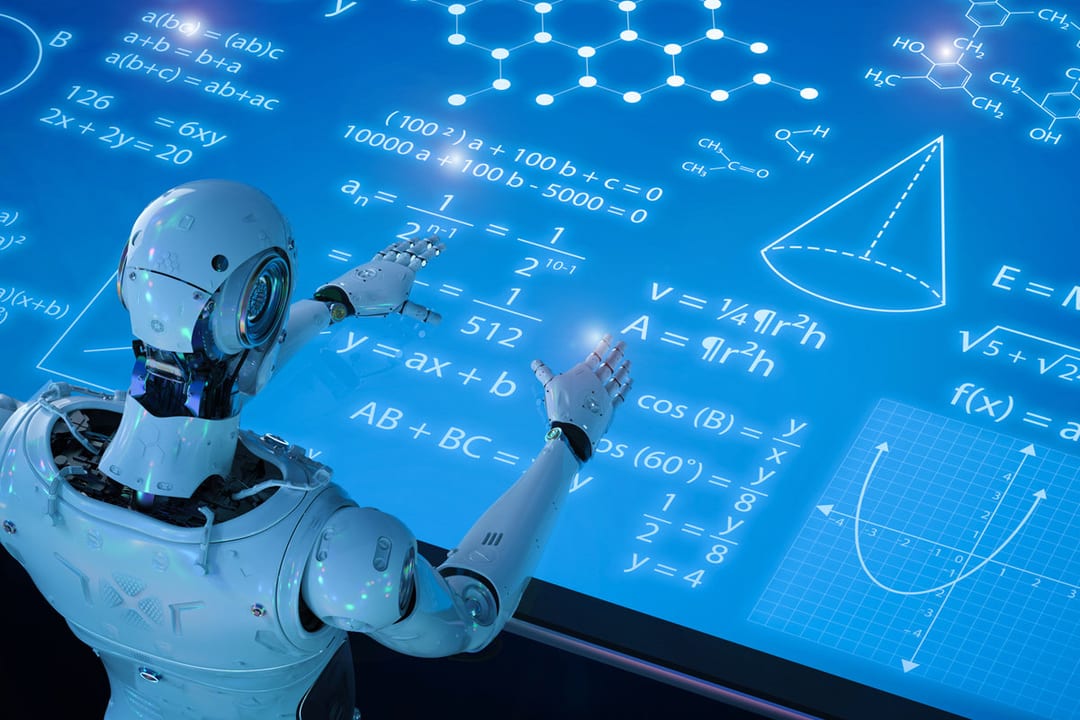
Here's the analogy that cuts through the noise. Electricians work with electricity every day. They absolutely need to know Ohm's law and what voltage does to current. They do not need to derive Maxwell's equations from first principles. An AI engineer sits in a similar position. You need working intuitions about the math that shapes how models behave. You do not need to re-derive the transformer architecture or prove convergence theorems. The people who do that are researchers — a different job with a different math requirement.
The confusion comes from one historical accident: for most of AI's history, the only people who published guides on "learning AI" were researchers and academics. They wrote curriculum that made perfect sense for their path — one that terminates in publishing papers, not shipping APIs. That curriculum got cargo-culted into the broader field, and now developers who just want to build a RAG pipeline are slogging through Lagrange multipliers they will never use on the job.
Why this question matters for your career
Math anxiety is one of the single biggest reasons capable developers never make the jump into AI work. They read a curriculum that starts with multivariable calculus and eigendecomposition and conclude the field is not for them. That is a loss for both the developer and the products they would have built.
At the same time, zero math is not the answer either. AI engineers who never develop any intuition for what is happening inside these systems hit walls that pure prompt-tuning cannot fix. They misdiagnose retrieval failures. They set temperature and top-p values by vibe rather than by what those parameters are actually doing. They can not read an error message from a vector store and understand what the distance metric is telling them. A small, targeted investment in the right math pays outsized dividends.
The goal of this article is to give you a precise map: here is the math you genuinely need (and why), here is the math that is useful but optional, and here is the math you can safely skip until — or unless — you move into research or custom model training.
How the math actually touches your work
Think of the math that underpins AI in three concentric rings. The outermost ring is pure researcher territory. The middle ring helps you build better even if you use library abstractions. The innermost ring is inescapable — these concepts show up directly in the parameters you set and the errors you debug.
The must-know layer: probability and statistics
Every LLM output is a probability distribution over tokens. When you set temperature, you are literally scaling the logits before they pass through a softmax function, which converts them into probabilities. A temperature of 0 makes the highest-probability token almost certain. A temperature of 1.5 flattens the distribution, making surprising tokens more likely. If you have no intuition for what a probability distribution is, you cannot reason about why your chatbot is being either too robotic or too hallucination-prone.
You also need basic statistics for evaluation. When you see that your RAG pipeline has a retrieval precision of 0.73, you need to know what that means and whether it is good. When you run A/B tests on two prompts, you need enough statistics to know whether the difference in outputs is meaningful or noise. You do not need to derive the t-test formula — you need to understand what a p-value is telling you.
The useful-to-know layer: linear algebra intuition
Embeddings are vectors — lists of numbers that encode meaning as a position in high-dimensional space. Semantically similar pieces of text land near each other. The word "cat" and the word "kitten" will have vectors that point in roughly the same direction. Cosine similarity measures the angle between two vectors; a value near 1 means the texts are semantically close, a value near 0 means they are unrelated. This is the entire mathematical foundation of how RAG retrieval works.
You do not need to be able to multiply two 768-dimensional matrices by hand. You do need to understand that when a vector database says a chunk has a cosine similarity of 0.91 to your query, it means the chunk is very likely relevant — and that when you see 0.42, the retrieval is probably going off the rails. That intuition is all linear algebra, but it is linear algebra at the concept level.
The researcher layer: skip it for now
Backpropagation, gradient descent with momentum, custom CUDA kernels for attention, the mathematics of RLHF reward modeling — these are real and important topics, but they sit firmly in the training and research domain. If you are calling an API or fine-tuning a model with a library like Hugging Face's transformers, this machinery is running under the hood. You benefit from it without needing to implement it. Bookmark it for later; do not let it block you today.
The 20% of math that explains 80% of LLM behavior
If you want a concrete study list — the specific concepts that will give you the most leverage as an AI engineer with the least time investment — here it is:
| Concept | Why it matters in practice | How deep to go |
|---|---|---|
| Probability distributions | Understand temperature, top-p, top-k sampling; diagnose hallucinations | Intuition — no calculus needed |
| Vectors and cosine similarity | RAG retrieval, embedding search, semantic deduplication | Concept + formula — no proof needed |
| Log-scale / log-probabilities | Read model confidence scores, perplexity, token log-probs in API responses | Intuition — just know log(0.01) is very negative |
| Softmax function | Understand how logits become token probabilities; why temperature scales them | Understand the formula; do not derive it |
| Mean, variance, percentiles | Evaluate latency, cost, and quality benchmarks; A/B test prompts | High-school statistics level |
| Matrix shape / dot product | Debug tensor shape errors; understand context window limits; embedding dimensions | Know what shape means; no proofs |
That table covers the math behind the majority of the decisions you will make as an AI engineer: which model to use, what parameters to set, how to interpret retrieval scores, how to evaluate outputs, and how to debug failures. None of these requires a degree. All of them can be picked up in a few hours of focused reading.
Math requirements by role
Not all AI jobs have the same math floor. Here is a practical breakdown of four common roles so you can calibrate your own preparation.
| Role | Core work | Math needed | Math you can skip |
|---|---|---|---|
| AI / LLM engineer | Build apps on hosted models (RAG, agents, fine-tuning via APIs) | Probability intuition, vector/cosine basics, stats for eval | Backprop, custom loss functions, optimization proofs |
| ML engineer | Train, fine-tune, and deploy models on company data | Linear algebra depth, calculus for gradients, optimization methods | Topology, formal proofs, CUDA-level numerics |
| AI researcher | Invent new architectures, training methods, alignment techniques | Deep math across all areas — this is where the full curriculum applies | Nothing — but the scope is broad |
| AI product manager | Define AI features, evaluate outputs, own roadmap | High-level statistical literacy, enough to read eval reports | Everything in the bottom two rows above |
The distinction between AI engineer and ML engineer trips people up. An AI engineer wires together existing models and infrastructure to ship products. An ML engineer builds and trains the models themselves. The first role is product-oriented; the second is model-oriented. Most of the job market growth in AI since 2023 has been in the AI engineering side — companies hiring people to build with AI, not on AI's core internals.
Pitfalls: math traps that slow people down
Even with the right attitude about math, there are a few specific traps worth calling out.
Pitfall 1: Treating math prerequisites as sequential blockers
Many online curricula present math as a gate you must pass before you are "allowed" to do AI work. Build the project first. Encounter a concept you do not understand. Learn exactly that concept. Repeat. This approach keeps you motivated, and it ensures you learn math in the context where it is actually meaningful to you. Abstract calculus is hard to retain; calculus that explains why your model is oscillating during fine-tuning sticks immediately.
Pitfall 2: Confusing intuition with memorizing formulas
You do not need to memorize the softmax formula to benefit from understanding softmax. You need to be able to say: "softmax takes a vector of raw scores and converts them into a probability distribution that sums to 1, and temperature controls how spiky or flat that distribution is." If you can say that, you can make informed decisions. If you can only copy-paste the LaTeX formula but not explain it, the formula is not helping you.
Pitfall 3: Under-investing in statistics
Engineers who have backgrounds in systems or web development often have good intuitions about code correctness but poor intuitions about statistical evaluation. This is the one area where AI engineers frequently underinvest. You need to be able to design a meaningful eval, run it, and interpret the results with appropriate skepticism — including knowing when a difference in accuracy scores is real versus within the margin of noise. A basic statistics refresher (means, distributions, confidence intervals, A/B testing logic) is almost always worth the time.
Going deeper
Once you have the essentials in place and you are shipping real AI features, there are a few directions to deepen your math knowledge that pay real dividends.
Understand attention at a conceptual level
The transformer's self-attention mechanism is the core computation behind every major LLM. At its heart it is a weighted average: each token "attends" to every other token in the context, and the weights are computed from the similarity of learned projections of those tokens. The query, key, and value matrices (Q, K, V) are linear transformations of the input. The attention scores are dot products of Q and K, scaled and softmaxed into weights, then used to take a weighted sum of V. Understanding this at a conceptual level — not at a gradient-descent-derivation level — helps you reason about why context window limits exist, why the model can lose track of information at the beginning of a very long context, and why certain retrieval strategies work better than others.
Learn enough about fine-tuning to read the literature
Techniques like LoRA (Low-Rank Adaptation) and QLoRA have made fine-tuning accessible without needing to understand the full training loop. But to evaluate whether a fine-tuning approach is right for your problem — versus RAG, versus prompt engineering — you need to understand what fine-tuning actually changes: it adjusts the model's weights to shift its behavior on a target distribution. The math behind why LoRA works (decomposing the weight update into two low-rank matrices to reduce the parameter count) is linear algebra, but you can understand it at a conceptual level without proving the rank-deficiency argument.
Resources worth the time
3Blue1Brown's "Essence of Linear Algebra" series on YouTube teaches vectors and matrix operations with geometric intuition in about three hours — it is the best single resource for building the linear algebra intuition an AI engineer actually needs. For probability and statistics, the free "Statistics and Probability" course on Khan Academy is comprehensive enough to cover everything in the must-know and useful-to-know layers. Neither of these require calculus to start.
FAQ
Can I get an AI engineering job without a math degree?
Yes. The majority of AI engineering roles prioritize demonstrated ability to build and ship AI-powered products over formal math credentials. A portfolio of projects using LLM APIs, RAG pipelines, or agents carries more weight in most hiring processes than a transcript. Where math degrees matter more is in ML research and model training roles, which are a smaller subset of the overall AI job market.
Do I need to understand backpropagation to be an AI engineer?
Not to build on top of existing models. Backpropagation is the algorithm that trains neural networks by computing gradients and adjusting weights. If you are calling a hosted API or using a fine-tuning service, this runs entirely behind the scenes. You need backprop intuition if you are writing custom training loops or debugging fine-tuning divergence — roles closer to ML engineering than AI engineering.
What is the minimum math I need to start building with LLMs today?
You can start with almost none and learn as you go. The first wall most people hit is understanding temperature and sampling parameters (probability intuition) and understanding why RAG retrieval works or fails (vector similarity intuition). Both of these can be picked up in a few hours without any formal coursework, because they are conceptual rather than computational.
Is linear algebra important for AI engineering?
Conceptually, yes. Computationally, no. Embeddings are vectors, attention operates on matrices, and understanding that "higher cosine similarity = closer meaning" is linear algebra knowledge that directly affects how you build and debug retrieval systems. But you are not multiplying matrices by hand — libraries do that. The goal is geometric and semantic intuition, not arithmetic fluency.
How is the math bar different for AI engineering vs. ML engineering?
AI engineers build products on top of models that already exist. They need intuition-level math to configure, evaluate, and debug those systems. ML engineers build, train, and modify the models themselves, which requires genuine depth in linear algebra, calculus (for gradient-based optimization), and statistics. If a job description lists gradient descent, loss functions, and model architecture design as core responsibilities, expect a higher math requirement.
Will learning more math make me a better AI engineer?
Yes, with diminishing returns. The first 20 hours spent on probability and vector intuition pays enormous dividends. The next 80 hours moving into calculus and optimization gives you meaningful depth for fine-tuning and evaluation work. Beyond that, the returns depend heavily on whether you are moving toward research or staying in product engineering. Invest progressively as specific problems in your work reveal gaps, rather than front-loading a full math curriculum before you build anything.