What Is an Agent Benchmark?
A standard LLM benchmark asks a model a question and checks whether the answer is correct. An agent benchmark does something fundamentally different: it drops the AI into a live environment — a codebase, a browser, a terminal, a customer-service chat — hands it a goal, and asks it to actually finish the work. The score is not "did you say the right thing" but "did the task get done".
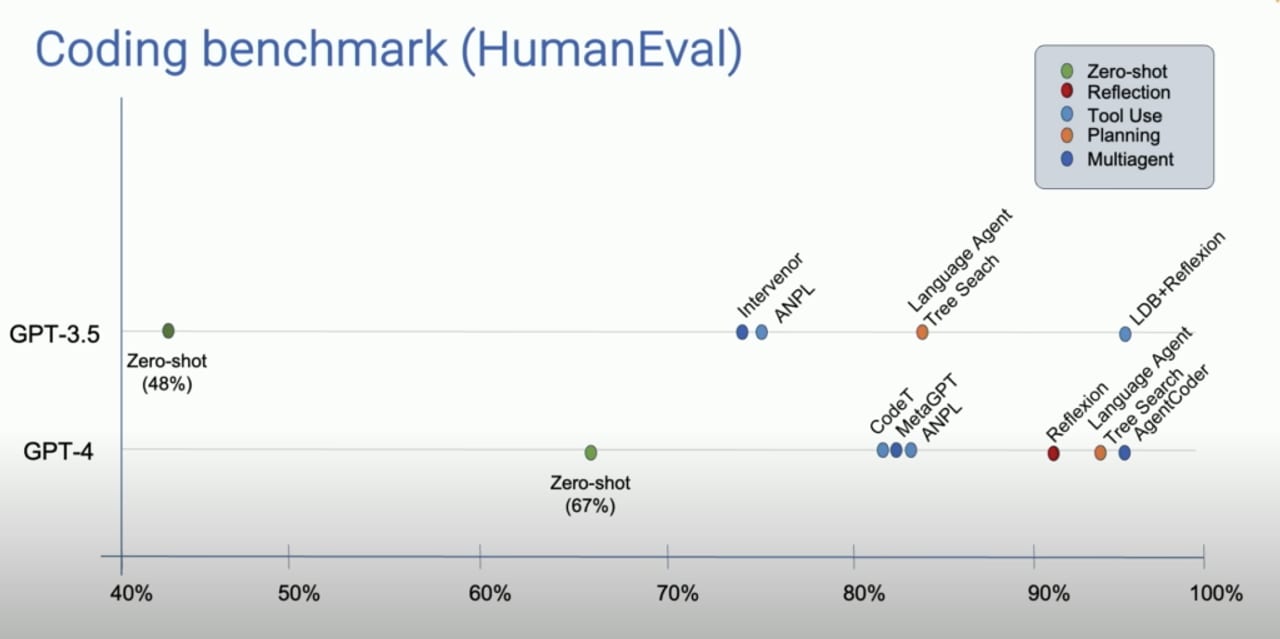
Think of it like the difference between a written driving test and an actual road test. A written test checks whether you know the rules. A road test checks whether you can get from A to B without crashing. Agent benchmarks are the road test version of AI evaluation.
In practice, every agent benchmark shares three ingredients: a sandboxed environment the agent can take actions inside, a set of tasks expressed as natural-language goals, and a verifiable success criterion that does not rely on a human reading the output. A script checks whether the bug is fixed, whether the email was sent, or whether the web form was submitted correctly.
Why Agent Benchmarks Matter for Builders
Knowing that a model scores 90% on a reasoning benchmark tells you it is good at answering questions. It tells you almost nothing about whether that same model can autonomously fix a GitHub issue, book a flight through a web UI, or handle a multi-step customer-support conversation. The skills are different.
Agents fail in ways that question-answering never exposes. They get stuck in loops, hallucinate tool arguments, take irreversible actions at the wrong time, or complete 9 out of 10 steps and then give up. Only a task-completion eval catches these failure modes.
For builders, agent benchmarks serve three concrete purposes:
- Model selection: comparing which base model or scaffolding strategy performs best before you commit to a production architecture.
- Regression testing: confirming that a new prompt, tool definition, or agent loop change does not quietly reduce success rates.
- Product-scope calibration: knowing whether today's best agents solve 65% of your task type reliably, or only 25%, shapes what you commit to shipping.
How Agent Benchmarks Work
All major agent benchmarks follow the same core loop: the benchmark provides an environment state and a task description, the agent takes a sequence of actions, and the benchmark checks the resulting environment state against a known correct end-state. There are no partial grades for "almost right" — the task either passes or fails.
Environment types
Different benchmarks instrument different kinds of environments:
- Code repos (SWE-bench): the agent gets a GitHub issue and a cloned repo; success means the existing test suite passes after its patch is applied.
- Web browsers (WebArena): a self-hosted web stack with an e-commerce site, a wiki, a forum, and more; success means the page state or URL matches the expected outcome.
- Desktop OS (OSWorld): a full virtual machine running Ubuntu or Windows; the agent controls the mouse and keyboard, and success is verified by screenshot diffing or application state.
- Tool + user simulation (tau-bench): a customer-service agent must satisfy a simulated user while following policy rules; success is checked by comparing the final database state to a gold annotation.
Verification strategies
The verifier is what makes or breaks an agent benchmark. Three main approaches are used:
- Execution-based — run a test suite or script against the environment. SWE-bench runs Python unit tests; OSWorld runs application-state checks. This is the gold standard because it is objective and automated.
- State diffing — compare the database, DOM, or file system before and after the agent acts. WebArena uses this to verify whether a shopping cart was updated correctly.
- LLM-as-judge — a second model reads the final state and decides whether the goal was achieved. Used when the success criterion is too open-ended for a script to check, but introduces its own reliability concerns.
The Major Agent Benchmarks
Several benchmarks have become de-facto standards in the field. Here is a quick map of the most widely cited ones and what makes each useful.
| Benchmark | Domain | Tasks | Verifier | Key metric |
|---|---|---|---|---|
| SWE-bench Verified | Software engineering | 500 real GitHub issues | Unit test execution | % resolved (pass@1) |
| WebArena | Web browsing | 812 web tasks | DOM/URL state check | Task success rate |
| OSWorld | Desktop computer use | 369 GUI tasks | Screenshot / app state | Task success rate |
| GAIA | General assistant | 450 real-world Q&A | Exact-match answer | Accuracy by level |
| tau-bench | Customer service agent | Live tool + user sim | DB state vs. gold | pass^k reliability |
SWE-bench Verified
SWE-bench is the most cited coding-agent benchmark. Each task is a real GitHub issue from one of 12 popular Python repositories (Django, SymPy, matplotlib, scikit-learn, and others). The agent receives the issue description and the repo at a specific commit, writes a patch, and the benchmark runs the project's own test suite. SWE-bench Verified is a curated 500-task subset validated by 93 professional developers, filtering out tasks with broken test harnesses or ambiguous specifications.
Top models reached roughly 50-65% on SWE-bench Verified by mid-2025. SWE-bench Pro was introduced shortly after to raise the ceiling, since leading systems had begun to show benchmark-specific optimization effects on the Verified set.
WebArena
WebArena provides 812 tasks across a self-hosted web stack: an e-commerce shop, a Reddit-like forum, a GitLab instance, an open street map, and a content-management system. Tasks range from "find the cheapest product in category X" to "open a pull request that fixes issue Y". Success is verified programmatically by checking whether the resulting URL, page content, or server state matches the expected outcome. Gemini 2.5 Pro reached 54.8% on WebArena in 2025, and the IBM CUGA system reached 61.7%.
tau-bench
Developed by Sierra, tau-bench (tool-agent-user benchmark) models a customer-service agent scenario. An agent must help a simulated user — voiced by an LLM — while calling real database tools and following domain-specific policies. The benchmark introduces a metric called pass^k, which measures whether the agent completes the same task successfully across k independent attempts. This directly captures reliability, not just peak performance: an agent that passes 60% on the first try but only 20% consistently is much less useful than its headline score suggests. A successor, tau2-bench, adds a dual-role setup where the agent must also act as the simulated user in alternating turns.
GAIA
GAIA (General AI Assistants benchmark), published at ICLR 2024 by Meta AI and Hugging Face, offers 450 real-world questions at three difficulty levels. Level 1 requires simple tool use; Level 3 requires chaining many steps across web search, document reading, and computation. The questions have deterministic, exact-match answers, so scoring is objective. Humans score around 92%; GPT-4 with plugins scored only 15% at launch — a gap that illustrated how far agents still had to go on open-ended, multi-step tasks.
Common Pitfalls and Measurement Traps
Agent benchmarks are harder to trust than they appear. Several recurring failure modes affect how you should interpret scores.
Benchmark saturation and overfitting
Once a benchmark is public, model providers can train specifically against it. SWE-bench Verified was already showing signs of saturation by early 2025, prompting the introduction of SWE-bench Pro. Every top model drops 18 to 25 percentage points from Verified to Pro scores — not because Pro is unfair but because Verified no longer measures the full difficulty of real software engineering. Watch for benchmarks where industry scores cluster near the ceiling; they often measure benchmark-specific tricks more than general capability.
Binary scores hide partial progress
A task that requires 10 steps counts the same in the final score whether the agent completed 9 steps and failed at the last one or whether it immediately took a destructive action. Trajectory metrics — which score the quality of intermediate steps — provide a richer picture but are harder to compute and standardize. Many published leaderboards show only final pass rates.
Environment setup is expensive
Unlike an MCQ benchmark that runs in seconds, an agent benchmark must reset a full environment between tasks, run the agent until it terminates (often dozens of tool calls), and then run verification. A 500-task eval can take several hours and cost real money in API calls. This means reproducible evaluation requires careful engineering, not just a Python script.
Reliability vs. peak performance
Most leaderboards report pass@1 — the fraction of tasks the agent solves in one attempt. tau-bench's pass^k metric is a notable exception: it exposes that agents often succeed on a task 60% of the time but fail the other 40%. For production use, reliability matters far more than peak scores.
Going Deeper: Building Your Own Agent Evals
Public benchmarks give you a baseline, but the most actionable signal comes from evals built on tasks drawn from your own application domain. Here is how practitioners approach this.
Define tasks with deterministic oracles
The closer your success criterion is to a machine-checkable fact, the more reliable your eval will be. Prefer state checks ("does the database row match this value?") over output checks ("does the response mention the right number?"). If you must use an LLM judge, give it a rubric with binary sub-criteria rather than asking for a single overall score.
Instrument intermediate steps
Log every tool call, every intermediate state, and the full action trajectory for each task run. End-to-end pass/fail is the headline metric, but the trajectory is where you diagnose what went wrong. Common failure patterns include: wrong tool selected for a step, correct tool but hallucinated argument, correct sequence but wrong stopping point, and unnecessary retries on a succeeded step.
Test for reliability, not just accuracy
Run each task multiple times with different random seeds or temperature settings. Report a pass^k-style metric alongside a raw pass rate. A model that solves 70% of tasks but with 30% variance is not production-grade for workflows where retries are expensive or impossible.
Avoid benchmark-specific tuning
Keep a held-out set of tasks that your agent team never uses for prompt iteration. Use the development set for tuning and the held-out set only for final reporting. This is the same discipline as a train/test split in supervised learning, applied to agent evaluation. Without it, you are measuring prompt overfitting, not general capability.
Ultimately, agent benchmarks are still a young discipline. The techniques for building reliable, unbiased, and scalable task-completion evals are evolving rapidly. The core principle — measure whether the task got done, not just whether the answer sounded right — is what separates them from the generation of benchmarks that came before.
FAQ
What is the difference between an LLM benchmark and an agent benchmark?
An LLM benchmark typically asks a model a question and checks the answer — it is a static, single-turn evaluation. An agent benchmark places the model inside an interactive environment, gives it a goal, and measures whether it completes multi-step work. The key difference is that agents take actions that change the environment, so the evaluation must check the resulting state, not just the text output.
What does pass@1 mean in SWE-bench?
pass@1 is the fraction of tasks the agent solves correctly on its first attempt, without retries. For SWE-bench, this means the agent's patch causes the specified failing tests to pass and does not break any existing tests. It is a strict binary metric: partial fixes do not count.
Why do top models score so much lower on agent benchmarks than on question-answering benchmarks?
Agent tasks require sustained multi-step reasoning, error recovery, and correct tool use across a long horizon. Any single mistake can invalidate the whole task. Question-answering benchmarks allow one-shot responses, which masks these weaknesses. A model that gets 90% of questions right might still fail 60% of tasks that require 10 sequential correct actions.
What is tau-bench's pass^k metric?
pass^k measures whether an agent can reliably complete the same task k times in a row. An agent that succeeds 60% of the time on the first try might have a pass^3 score much lower than 60%, because passing three consecutive trials requires consistent behavior. Sierra introduced this metric to highlight that peak task performance overstates real-world reliability.
How is WebArena different from a live web browsing test?
WebArena uses a fully self-hosted web stack — its own e-commerce site, forum, code repository, and map service — so evaluations are reproducible and independent of the real internet. Running agents against live public websites would produce inconsistent results because content changes constantly. The self-hosted environment also allows automated state verification without scraping a production service.
Should I use a public benchmark or build my own to evaluate my agent?
Use public benchmarks like SWE-bench or WebArena to quickly compare models and scaffolding strategies. Then build a small task suite drawn from your real use case for final model selection and regression testing. Public benchmarks show general capability; your own tasks reveal whether the model handles the specific tools, policies, and edge cases your application depends on.