In plain English
Imagine a chef who spent years mastering every cuisine in the world. You hire her and spend six months drilling her exclusively on your restaurant's Thai menu. She becomes extraordinary at Thai food — but when a guest orders a classic French omelette, she's lost. The knowledge didn't vanish from her brain overnight, but intensive focus on one thing crowded out the pathways to everything else. This is exactly what happens to a language model when you fine-tune it on a narrow task. The phenomenon is called catastrophic forgetting.
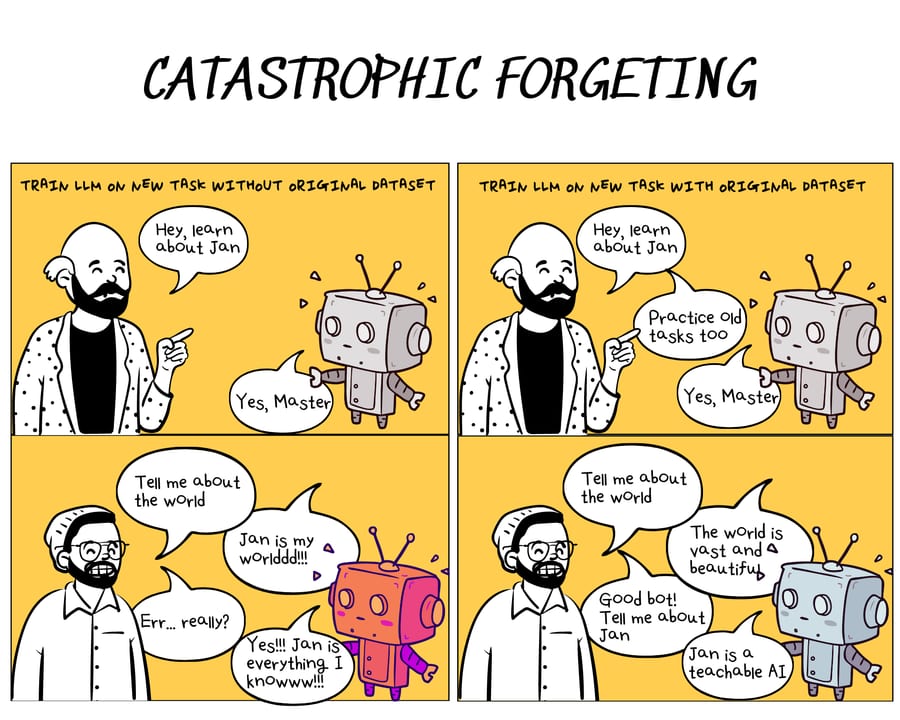
A pretrained model arrives knowing how to write code, answer general knowledge questions, follow complex instructions, translate languages, summarize documents, and much more. When you fine-tune it on your specific task — say, routing customer support tickets — the gradient updates that sharpen it for ticket routing also overwrite some of the weight values that encoded its general abilities. After fine-tuning, it may route tickets brilliantly but stumble on tasks the base model handled effortlessly.
The word "catastrophic" is not hyperbole. Unlike a human who gradually fades on a skill they haven't practiced, a neural network can lose a capability almost entirely after even a small number of gradient steps on unrelated data. The weight values that represented that capability simply get nudged to new positions that optimize for the new task, with no mechanism to preserve the old ones.
Why it matters for builders
For many production use cases, you don't just want a model that's good at your task. You want a model that's good at your task and still has the general intelligence it came with. A customer-support fine-tune that can no longer follow multi-step reasoning chains is a net loss, even if it classifies ticket categories perfectly. This trade-off is what makes catastrophic forgetting one of the most practical concerns in applied fine-tuning.
The problem appears most often in three scenarios:
- Full fine-tuning on a small, narrow dataset. You have a few thousand domain examples, no general-purpose data mixed in, and you train for several epochs. Every epoch tightens the model on your task and loosens it on everything else.
- Sequential fine-tuning on multiple tasks. You first fine-tune for task A, then fine-tune the same checkpoint for task B. Task B's training aggressively overwrites what task A established — even when both were useful.
- Long continual fine-tuning runs. Even a moderately broad dataset can trigger forgetting if the training run is long enough, because later steps accumulate drift away from the pretrained initialization.
Research on models from 1B to 7B parameters found that forgetting severity correlates with model size — larger models show steeper performance drops on held-out general tasks after domain fine-tuning. For BLOOMZ variants, forgetting of domain knowledge measured 9.5% for the 1.1B model and jumped to 18.4% for the 7.1B model under the same fine-tuning conditions.
How it works: the mechanics
A model's knowledge lives as a dense pattern of floating-point numbers across hundreds of millions or billions of weight tensors. During pretraining, those weights settle into a configuration that satisfies a vast number of constraints simultaneously — syntax, facts, reasoning patterns, style registers, and more. When fine-tuning begins, the optimizer follows the gradient of the new loss, which points in whatever direction reduces error on the new examples. That direction is almost never aligned with the directions that preserved the old capabilities.
Visualize the weight space as a high-dimensional landscape with valleys representing good solutions. Pretraining finds a valley that is simultaneously good for thousands of tasks. Fine-tuning rolls the weights downhill toward a new, narrower valley. The problem is that the new valley sits far from the old one — arriving there means climbing out of the original multi-task valley and descending into a domain-specific one. Once you're in the narrow valley, the paths back to the general-task valley are gone.
Not all layers forget equally. Research shows that higher (later) transformer layers — which encode abstract, task-specific behavior — change more during fine-tuning than lower layers, which encode syntax, token-level patterns, and foundational language structure. This asymmetry is why freezing early layers is a useful partial remedy.
Recent work using function vectors found that forgetting in LLMs often stems more from biased task activation patterns than from direct erasure of knowledge. In other words, the model may still have the capability encoded in its weights but loses the ability to activate it consistently because fine-tuning skews the implicit task inference the model performs at the start of each forward pass. This is a subtler form of forgetting — harder to detect, but also addressable with targeted regularization.
The toolkit: how to prevent it
There are four main families of mitigation. They are not mutually exclusive — most production fine-tuning pipelines combine at least two.
1. Data mixing (replay)
The simplest and most effective technique: mix a portion of general pretraining data back into your fine-tuning batch alongside your domain examples. Because the optimizer sees both kinds of examples, the gradient updates must satisfy both constraints, keeping general-capability weights from drifting too far. Recent large-scale training runs use roughly a 50% general / 50% domain mix. Research shows this can improve target-task data efficiency by up to 2x — the general data acts as a regularizer that prevents overfitting to the narrow distribution.
2. Elastic Weight Consolidation (EWC)
Elastic Weight Consolidation adds a penalty term to the training loss that resists moving weights that were important for prior tasks. Importance is measured using the Fisher Information Matrix — a quantity that captures how sensitive the old loss was to each weight. Weights that were highly sensitive (and thus important) get a large spring constant; updates that try to move them far incur a heavy penalty. The result is that the optimizer finds a solution that works for the new task while staying close to the pretrained values on the dimensions that mattered most.
EWC was introduced in DeepMind's landmark 2017 paper on continual learning and remains the conceptual anchor for regularization-based approaches. In a 2025 evaluation on knowledge graph link prediction, EWC reduced measured forgetting from 12.6% to 6.9% — a 45% improvement over naive sequential training — while preserving new-task performance.
3. Parameter-efficient fine-tuning (LoRA / PEFT)
LoRA (Low-Rank Adaptation) and similar PEFT methods dramatically reduce forgetting by design. Instead of updating all weights, LoRA freezes the base model entirely and trains only small, low-rank adapter matrices added alongside each weight tensor. Because the original weights are never touched, the knowledge encoded in them cannot be overwritten. The adapter learns the delta needed for the new task; the pretrained weights hold the general capabilities.
LoRA is not a complete solution — forgetting can still occur at higher ranks where the adapter subspace begins to overlap with directions important for old tasks — but it dramatically narrows the problem compared to full fine-tuning. Variants like OPLoRA (Orthogonal Projection LoRA) explicitly constrain adapter updates to be orthogonal to directions important for prior tasks, nearly eliminating interference.
4. Selective layer freezing
Rather than touching all layers, you can freeze the lower transformer layers (which encode fundamental language patterns) and only fine-tune the upper layers (which encode task-specific behavior). This preserves foundational capabilities at the cost of some adaptation capacity. A common heuristic is to freeze the bottom 25–50% of layers and fine-tune the rest, combined with a lower learning rate than you'd use for a full fine-tune.
| Technique | What it does | Main trade-off |
|---|---|---|
| Data mixing / replay | Adds general data to each training batch | Requires access to general data; slower training |
| EWC regularization | Penalizes moving important weights away from pretrained values | Adds memory overhead (Fisher matrix); complex to tune |
| LoRA / PEFT | Freezes base weights; trains only small adapters | Lower ceiling on adaptation; rank choice matters |
| Layer freezing | Locks lower layers; updates only upper layers | Reduces flexibility; may under-adapt on large domain shifts |
A practical recipe for most fine-tuning jobs
For the typical practitioner fine-tuning a 7B–70B model on a domain task, the combination that causes the least friction is LoRA + data mixing:
- Choose LoRA as your fine-tuning method. This immediately eliminates the biggest source of forgetting — full-weight updates — at essentially no cost in final task quality for most use cases.
- Mix in 10–20% general instruction data alongside your domain examples. Use an existing open dataset if you don't have pretraining data. Shuffle it into every batch uniformly.
- Use a conservative learning rate (1e-4 or lower for the LoRA adapters). Large learning rates amplify weight movement and forgetting, even in LoRA.
- Evaluate on a general-capability held-out set after each checkpoint — not just your task eval. If general scores drop more than ~5% relative, lower the learning rate or increase the replay ratio.
- Stop early if general scores are declining even as task scores improve. Marginal task gains are rarely worth the general capability loss.
# Minimal data-mixing setup with HuggingFace datasets
from datasets import concatenate_datasets, load_dataset

# Your domain fine-tuning data
domain_ds = load_dataset("json", data_files="my_domain_data.jsonl")["train"]

# General replay data (e.g. a public instruction dataset)
general_ds = load_dataset("HuggingFaceH4/no_robots")["train"]

# Subsample general data to ~20% of the domain size
replay_size = int(len(domain_ds) * 0.20)
replay_ds = general_ds.shuffle(seed=42).select(range(replay_size))

# Concatenate and shuffle
mixed_ds = concatenate_datasets([domain_ds, replay_ds]).shuffle(seed=42)
print(f"Mixed dataset size: {len(mixed_ds)} examples")
# Mixed dataset size: 12000 examples (10000 domain + 2000 replay)Going deeper
For teams running continual learning pipelines — where the model is fine-tuned repeatedly on a stream of new tasks — the techniques above are a starting point, not a ceiling. The research frontier has several active directions:
O-LoRA and orthogonal gradient methods
Orthogonal Subspace Learning (O-LoRA) projects each new task's gradient updates into the subspace orthogonal to gradients used by previous tasks. This mathematical constraint guarantees that updates for the new task cannot, by construction, reduce performance on old tasks. OPLoRA (2025) extends this to PEFT settings, computing orthogonal projection matrices per LoRA layer. The cost is extra bookkeeping — you need to store a subspace representation for each prior task — but for multi-task continual pipelines the forgetting reduction is near-total.
Memory-Aware Adaptive Replay (MSSR)
Rather than replaying random samples from a general corpus, MSSR (2025) estimates per-sample "memory strength" — how likely the model is to have forgotten each past example based on loss trajectory — and schedules replay at adaptive intervals, focusing replay budget on the examples that need it most. This achieves better forgetting reduction per replay token than uniform random replay.
Learning Without Forgetting (LwF)
LwF sidesteps the need for replay data entirely by using the model's own prior outputs as soft targets. Before fine-tuning, you run the pretrained model on your new-task inputs and record its output distributions. During fine-tuning, a term in the loss encourages the model to match those original distributions — effectively using the old model as a teacher. LwF works best when old and new tasks share similar input domains; when they don't, the soft targets are less informative and the technique loses effectiveness.
How model scale changes the picture
Larger models forget more in absolute terms under identical fine-tuning conditions — their high-dimensional weight spaces amplify interference. However, they also respond better to mitigation: LoRA at the same rank-to-parameter ratio is more protective for a 70B model than a 7B one, because the frozen base provides more headroom. The practical upshot is that the larger your model, the more important it is to use LoRA rather than full fine-tuning, and to measure forgetting explicitly rather than assuming it's negligible.
FAQ
How do I know if my fine-tuned model has catastrophic forgetting?
Evaluate the fine-tuned checkpoint on a general benchmark like MMLU, HellaSwag, or a custom held-out set that spans tasks outside your training data — not just your target eval. A drop of more than 5% relative on general benchmarks is a signal that forgetting is occurring. Compare against the base model checkpoint as the baseline.
Does LoRA completely prevent catastrophic forgetting?
No, but it reduces it dramatically compared to full fine-tuning. Because LoRA freezes the base weights, the core knowledge encoded there cannot be directly overwritten. However, at higher ranks the adapter subspace can still overlap with task-critical directions, causing some interference. Combine LoRA with replay data for the best protection.
What replay ratio should I use when mixing data?
Research suggests 10–30% general replay data relative to your domain data produces most of the forgetting reduction. Start at 20% and measure your held-out general benchmark scores. Adjust up if scores are falling, or down if training is prohibitively slow. The exact ratio matters less than simply having replay present at all.
Does catastrophic forgetting happen with RAG too, or just fine-tuning?
Catastrophic forgetting is specific to training — it's a consequence of gradient updates overwriting learned weights. Retrieval-Augmented Generation (RAG) doesn't modify the model's weights at all, so it doesn't cause forgetting. If anything, RAG is sometimes used instead of fine-tuning precisely to avoid the forgetting risk.
Why is it called 'catastrophic' — isn't that dramatic?
The name comes from how abrupt and complete the forgetting can be. A human gradually loses an unused skill over months or years. A neural network can lose the ability to perform a task it handled perfectly after just a few thousand gradient steps on unrelated examples — the overwriting is nearly instantaneous by comparison, which is why researchers labeled it catastrophic when first observed in the 1980s.
Can I recover general capabilities after forgetting has occurred?
Partially. You can continue training the fine-tuned model on a mix of general and domain data, which will recover some lost capability — but you're unlikely to fully restore all of the pretrained baseline's strengths. It's far easier to prevent forgetting upfront with replay mixing or LoRA than to rescue a model that's already forgotten.
Further reading
- An Empirical Study of Catastrophic Forgetting in Large Language Models During Continual Fine-tuning (arXiv)
- How to Alleviate Catastrophic Forgetting in LLMs Finetuning? Hierarchical Layer-Wise and Element-Wise Regularization (arXiv)
- OPLoRA: Orthogonal Projection LoRA Prevents Catastrophic Forgetting during Parameter-Efficient Fine-Tuning (arXiv)