In plain English
Three terms dominate AI headlines — LLM, generative AI, and AGI — and most people use them as though they mean the same thing. They don't. Each term operates at a different level of abstraction, and mixing them up leads to real confusion about what today's tools can and can't do.
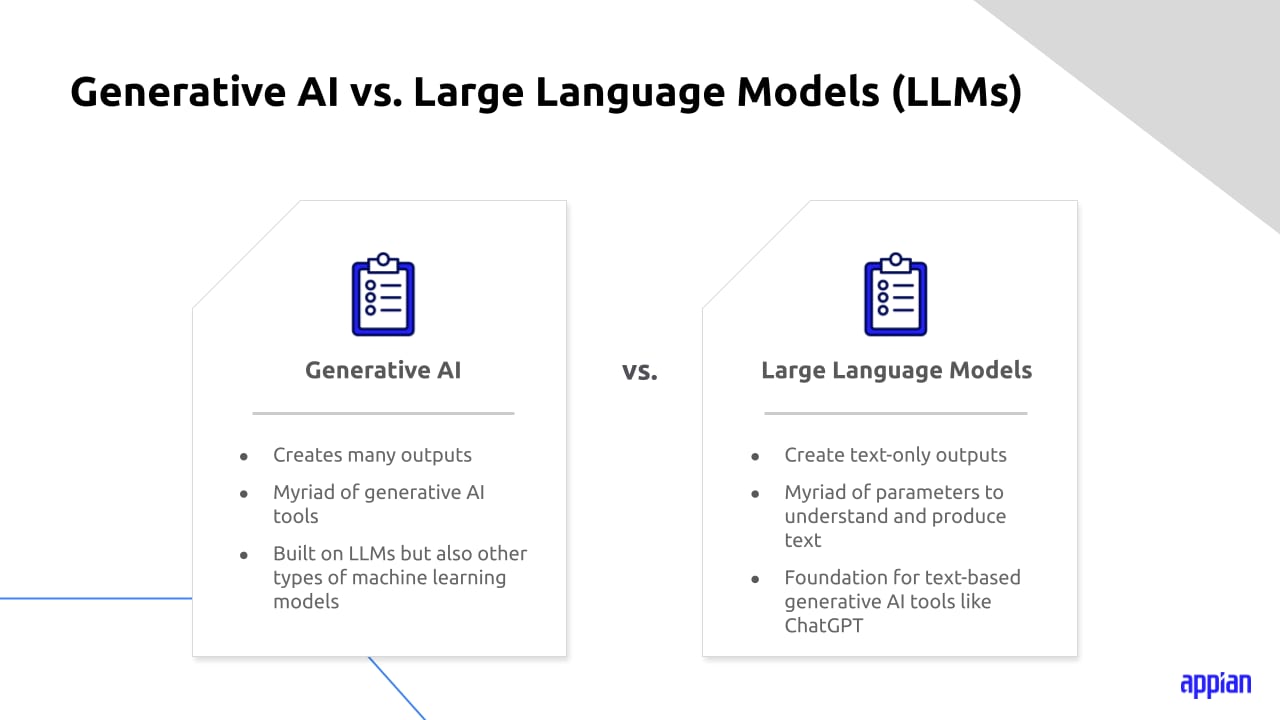
Think of it like the relationship between a sedan, a car, and a flying car. A sedan is a specific type of car. A car is the broader category that includes sedans, trucks, vans, and SUVs. A flying car is a hypothetical future vehicle that doesn't exist in mass production yet. The sedan vs car distinction is real and useful today; the flying car is mostly a vision.
The AI version of that analogy: an LLM (Large Language Model) is a specific type of system trained on text to predict the next token. Generative AI is the broader category that includes LLMs plus image generators, music synthesizers, video models, and more. AGI (Artificial General Intelligence) is the hypothetical future system that doesn't exist yet — one that could match or exceed human-level intelligence across any task.
Why the distinctions matter
If you're building on top of AI tools — or just evaluating them — using these terms precisely protects you from two opposite mistakes.
Overgeneralizing leads to picking the wrong tool. If you assume every generative AI is an LLM, you might reach for a GPT or Claude chat model when you actually need DALL-E for image work, or Suno for music, or Sora for video. These models have completely different architectures and APIs.
Overclaiming leads to misplaced trust. When an LLM answers confidently, it's still doing next-token prediction — not reasoning from first principles, not looking things up in a verified database, and definitely not exhibiting general intelligence. Labeling it "AGI-level" sets expectations the model can't reliably meet.
- Builders need to know which modality fits the job — text, image, audio, video — so they pick the right model family.
- Evaluators need to distinguish narrow task performance from genuine general capability when reading benchmarks.
- Decision-makers need to recognize that no current product is AGI, which affects both risk assessments and timeline planning.
- Anyone reading AI news needs these definitions to parse headlines that routinely conflate the three terms.
How the three layers relate
The cleanest mental model is a nested hierarchy. Each layer sits inside the one above it, with AGI sitting entirely outside the current stack as a future target.
The full AI / Machine Learning field
AI and machine learning form the broadest umbrella. This includes spam filters, recommendation engines, fraud detectors, self-driving car perception systems, voice recognition — anything where software learns patterns from data rather than following explicit hand-coded rules. Most of AI does not generate novel content; it classifies, predicts, or controls.
Generative AI — the creative subset
Generative AI is the slice of machine learning whose output is new synthetic content — text, images, audio, video, 3D models, or code. The shared trick across all generative models is that they learn the underlying distribution of a training dataset and can then sample new examples from it. A text model learns what human writing looks like; an image model learns what photographs look like. Both generate rather than just classify.
Generative AI spans several distinct model families. Transformer-based language models handle text. Diffusion models (used by Stable Diffusion and DALL-E) generate images by iteratively denoising random noise. Autoregressive video models like Sora generate frames sequentially. Music models like Suno generate audio waveforms. These all qualify as generative AI, but they share no architecture — the only common thread is that they produce content rather than label it.
LLMs — the text specialist inside generative AI
An LLM is a generative AI model that works specifically on text tokens. It's trained on massive text corpora — trillions of words from the internet, books, and code — using a transformer architecture. Its core training objective is next-token prediction: given all previous tokens, predict the most likely next one. By doing this well enough at scale, LLMs develop capabilities that feel like reading comprehension, reasoning, and even coding — all as emergent side effects of the prediction task.
Key LLM families you'll encounter: GPT-5 (OpenAI), Claude Opus and Sonnet (Anthropic), Gemini 3 (Google DeepMind), and Llama 4 (Meta). Each is an LLM and therefore also generative AI, but none of them is AGI.
What AGI actually means — and why it doesn't exist yet
AGI stands for Artificial General Intelligence. The core idea is an AI system that can perform any cognitive task a human can do — and do so across completely different domains without being specifically retrained for each one. Not just write text, not just classify images, but learn a new skill by reading about it, transfer knowledge between fields, set its own goals, and reason through genuinely novel problems.
No such system exists today. What we have are narrow AI systems: each one is extraordinarily good at specific things but cannot transfer outside its training domain. An LLM that writes brilliant code cannot drive a car. A chess engine that beats the world champion cannot hold a conversation. A protein-folding model cannot compose music. Every AI product available in 2025–2026 is narrow, regardless of how impressive it feels.
The clearest empirical evidence for how far we are: the ARC-AGI-2 benchmark, released in 2025, tests abstract reasoning tasks that are trivial for humans but highly resistant to pattern-matching. As of mid-2025, AI systems scored roughly 4% on ARC-AGI-2 while humans score near 100%. For all the impressive text and image generation, the gap on flexible general reasoning remains enormous.
Expert timelines vary widely. Researchers in a large-scale survey gave a median estimate of 2047. Industry leaders like Sam Altman (OpenAI) have suggested timelines as short as 2035. Some researchers question whether the current deep-learning paradigm can reach AGI at all. The honest answer is: nobody knows — and anyone with high certainty should be treated with skepticism.
Concrete examples: where each product sits
The fastest way to internalize the hierarchy is to place real products you've heard of:
| Product | Category | What it actually does |
|---|---|---|
| ChatGPT (powered by GPT-5) | LLM + Generative AI | Generates text and code via next-token prediction |
| Claude (Anthropic) | LLM + Generative AI | Text, code, and document analysis via transformer LLM |
| Gemini (Google DeepMind) | LLM + Generative AI (multimodal) | Text, code, and image understanding — still an LLM at its core |
| DALL-E (OpenAI) | Generative AI (image) | Generates images from text prompts — not an LLM |
| Stable Diffusion | Generative AI (image) | Open-source diffusion model for images — not an LLM |
| Sora (OpenAI) | Generative AI (video) | Generates video clips from text prompts — not an LLM |
| Suno | Generative AI (audio/music) | Generates full songs with vocals and instruments |
| ElevenLabs | Generative AI (audio) | Voice cloning and text-to-speech — not an LLM |
| Any current AI product | Narrow AI | No current product qualifies as AGI |
Notice that some models are described as multimodal — they accept or produce more than one type of content. Current GPT, Claude, and Gemini models, for example, can process images as input in addition to text. That makes them multimodal, but their text-output core is still an LLM. Multimodal doesn't mean the LLM classification disappears; it means the model has additional input encoders bolted on.
Common pitfalls and misconceptions
"LLM" used as a synonym for all AI
News articles routinely call image generators, recommendation systems, and fraud detectors "LLMs." They aren't. An LLM specifically processes text tokens with a transformer. Using LLM as shorthand for any modern AI obscures what the technology actually does and leads to bad expectations about capabilities.
Treating benchmark scores as proof of AGI progress
When an LLM scores above human average on the bar exam or a coding benchmark, it doesn't mean it's approaching AGI. It means it performs well on that specific, text-based task that's represented in its training data. Narrow benchmark wins tell you about narrow capabilities. The ARC-AGI-2 result — 4% AI vs. 100% human — is a more honest picture of where generalization actually stands.
Confusing fluency with understanding
LLMs produce text that sounds authoritative. That fluency is a product of scale and next-token prediction, not verified knowledge or genuine comprehension. A model can write a confident, grammatically perfect paragraph about something factually wrong. This is why outputs require human review for high-stakes tasks, and why "sounds right" is not a reliable proxy for "is right."
"AGI is already here" claims
Every year brings breathless headlines claiming a new model has crossed the AGI threshold. Until there is a widely accepted, independently verified benchmark showing human-level performance across diverse, truly novel tasks — not just text tasks where training data overlap is high — these claims should be treated as marketing. The ARC-AGI-2 benchmark was designed specifically to resist pattern-matching; a 4% score is a reality check, not a stepping stone.
Going deeper
Once you have the taxonomy clear, several more nuanced questions open up.
The path from narrow AI to AGI
Current LLMs show sparks of generalization that earlier AI systems lacked. In-context learning — where a model adapts to a new task from just a few examples in the prompt — was not expected from a pure next-token predictor. Chain-of-thought prompting surfaces multi-step reasoning. These emergent capabilities are why some researchers believe scale alone might eventually get us to AGI; others argue the transformer architecture has fundamental limits that no amount of scale can overcome.
Why the AGI definition problem matters for builders
If there's no agreed definition of AGI, it's very hard to know when a system is safe to deploy autonomously. OpenAI's definition — "outperforms humans at most economically useful tasks" — is pragmatic but side-steps questions of self-directed goal-setting and long-horizon planning that most safety researchers consider central to AGI risk. Anthropic frames the AGI threshold as a critical point requiring explicit human oversight decisions, not just a capability milestone. This disagreement is not academic: it shapes how these labs build safety infrastructure.
Multimodal models blur the LLM boundary
As models like GPT-5, Gemini 3, and Claude Opus accept images, audio, and text together, the clean "LLM = text only" definition gets fuzzier. The field is moving toward calling these multimodal large models (MLMs) or frontier models. Their text-generation core is still transformer-based next-token prediction; the multimodal parts are separate encoders that map other modalities into the same token space. The LLM label still fits the output stage, but the category boundaries are genuinely shifting.
Scaling laws and the AGI question
Scaling laws are empirical relationships showing that model performance improves predictably as you scale compute, data, and parameters. Proponents of the scaling hypothesis argue that continuing to scale LLMs will eventually produce AGI as an emergent property. Critics point out that scaling laws are measured on the kinds of benchmarks LLMs already excel at — and that tests like ARC-AGI-2, designed to probe flexible general reasoning, don't follow the same smooth scaling curves. Whether scaling is sufficient for AGI, or whether a new paradigm is needed, is the central unresolved question in AI research today.
FAQ
Is ChatGPT an LLM or generative AI?
It's both. ChatGPT is an application built on GPT-5, which is a large language model. All LLMs are generative AI because they generate new text, but generative AI is a broader category that also includes image, video, and audio models. So 'LLM' and 'generative AI' aren't opposites — one is a subset of the other.
What is the difference between AI, ML, and LLM?
AI (Artificial Intelligence) is the broadest category — any software that performs tasks we'd call intelligent. ML (Machine Learning) is a subset where software learns from data rather than explicit rules. LLM is a specific type of deep-learning ML model trained on text to predict the next token. Every LLM is an ML system and also an AI system, but most AI and ML systems are not LLMs.
Does AGI exist today?
No. As of 2026, every AI system available is narrow AI — excellent at specific tasks but unable to transfer knowledge freely across unrelated domains. The ARC-AGI-2 benchmark, designed to test general reasoning, shows current AI scoring around 4% versus nearly 100% for humans. Expert timelines for AGI range from the 2030s to the 2050s, with no consensus.
Is a diffusion model like Stable Diffusion an LLM?
No. Stable Diffusion is a diffusion model that generates images by iteratively removing noise from a random starting point. It's generative AI, but it uses a completely different architecture from transformer-based LLMs and doesn't work with text tokens. Only models trained to process and generate text tokens qualify as LLMs.
Can an LLM become AGI with more scale?
This is one of the most contested questions in AI research. Proponents of the scaling hypothesis argue that predictable performance gains from more compute and data will eventually produce general intelligence as an emergent property. Skeptics note that tasks requiring flexible abstract reasoning — like those on ARC-AGI-2 — don't follow the same scaling curves as language benchmarks, suggesting the current architecture may have fundamental limits.
Why do people use these three terms interchangeably?
Because LLMs like ChatGPT are by far the most visible face of the generative AI wave, the terms bleed together in casual use. When someone says 'the AI' or 'the LLM' or 'generative AI', they often mean the same chatbot they opened this morning. The distinctions matter more for builders and evaluators than for casual users — but even casual users benefit from knowing that not every AI product is a chatbot, and no chatbot is AGI.