Overview
Apodex 1.1 is the flagship model of Apodex AI, published on 24 August 2026 alongside a technical report and the arXiv paper "Apodex 1.1: Scaling Agentic Intelligence for Complex Work" (arXiv:2608.23283). The model card describes it as "a reasoning-first model for complex, long-horizon research tasks" that, "beyond searching and writing reports, works directly with files, data, code, and tools to complete tasks from input to verifiable deliverables."
The paper frames the target capability as "working capability: sustained, verifiable progress toward a real-world objective", and builds it along two axes. Environment Scaling widens the diversity and verifiability of executable file, search and code environments; Agentic Coordination Scaling trains the model to decompose long-horizon tasks, delegate parallel work, integrate asynchronous results and replan. A shared execution harness and AgentOS keep task state and provenance across tools and agents.
Delivery is verified rather than asserted: the card describes a Statement Review step that "independently checks key claims against their supporting sources, data, and computations before delivery", flags conflicts or missing evidence, corrects the affected conclusion, and keeps the review inspectable.
In Apodex AI's own published evaluations, the Apodex 1.1 Agent Team scores 38.5 on APEX-Agents, 78.8 on GDPVal, 54.3 on FrontierFinance, 63.3 on FrontierScience-Research, 35.3 on BioMysteryBench and 56.1 on Humanity's Last Exam, with the maker noting the highest scores among its compared systems on FrontierFinance and FrontierScience-Research. Apodex says it blocks access to benchmark-hosting websites during evaluation to prevent answer retrieval.
The model is served through the Apodex web app and the Apodex developer platform. A companion 35B open-weight model, Apodex 1.1 Mini, is published on Hugging Face under Apache-2.0, and the Agent Team harness, FrontierAgent, is open-sourced on GitHub.
| Released | 2026-08-24 |
|---|---|
| License | Proprietary |
| Weights | API only |
| Parameters | Not disclosed |
| Architecture | Apodex AI describes Apodex 1.1 as a reasoning-first model driven by an AgentOS harness and an asynchronous Agent Team: the model decomposes a long-horizon task, delegates parallel subagents, merges their results into a shared task state, and replans as new files or feedback arrive. |
| Modalities | Text |
| Status | Generally available |
Benchmarks
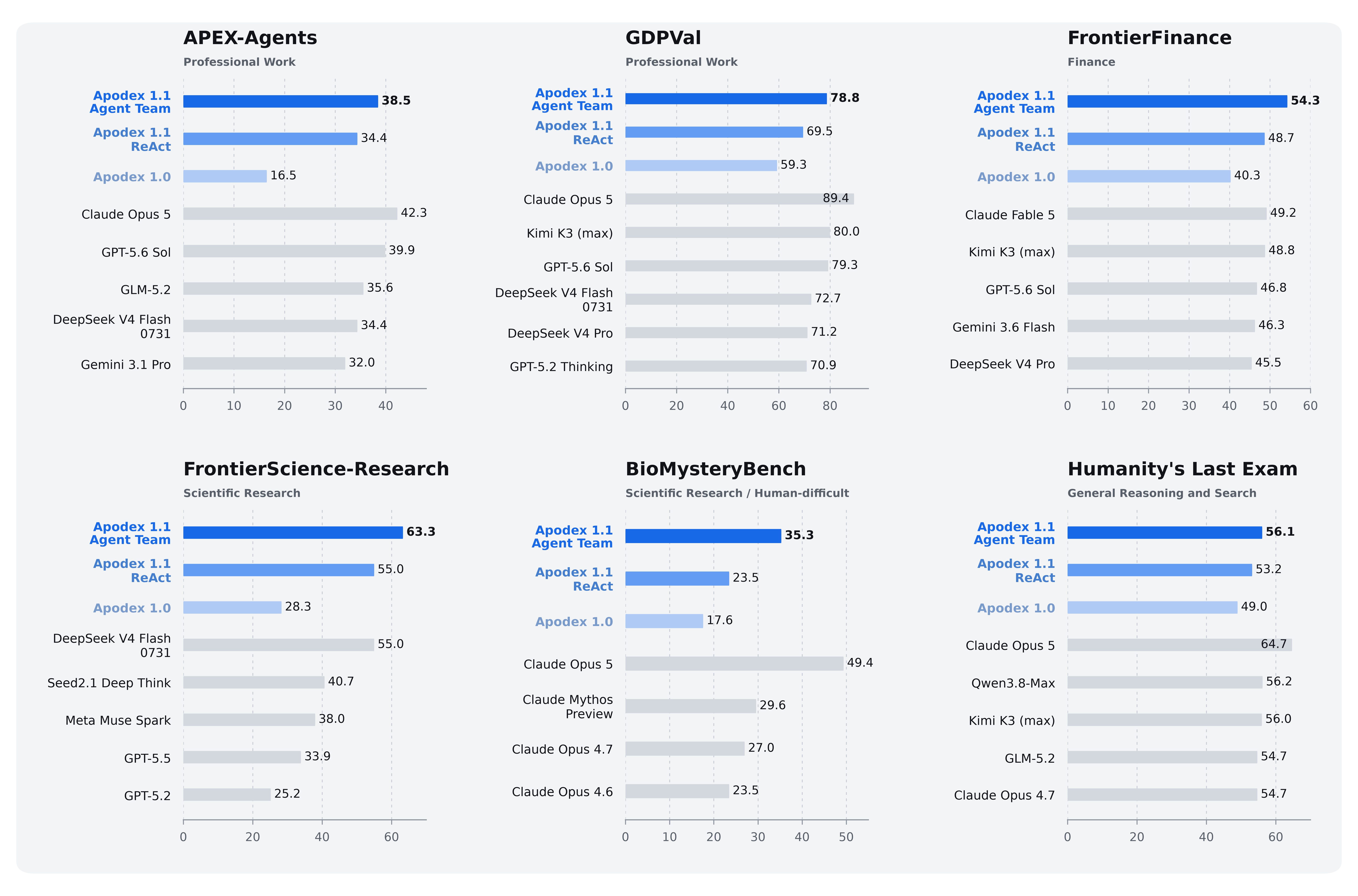
Apodex 1.1 against the field, transcribed from Apodex AI's published launch charts (24 August 2026). Blank cells were not reported for that benchmark.
| Benchmark | Apodex 1.1 Agent Team | Apodex 1.1 ReAct | Claude Opus 5 | GPT-5.6 Sol | Kimi K3 (max) | DeepSeek V4 Pro |
|---|---|---|---|---|---|---|
| APEX-Agents (professional work) | 38.5% | 34.4% | 42.3% | 39.9% | — | — |
| GDPVal (professional work) | 78.8% | 69.5% | 89.4% | 79.3% | 80% | 71.2% |
| FrontierFinance | 54.3% | 48.7% | — | 46.8% | 48.8% | 45.5% |
| FrontierScience-Research | 63.3% | 55% | — | — | — | — |
| BioMysteryBench (human-difficult) | 35.3% | 23.5% | 49.4% | — | — | — |
| Humanity's Last Exam | 56.1% | 53.2% | 64.7% | — | 56% | — |
This model's scores
- APEX-Agents (professional work)38.5%
- GDPVal (professional work)78.8%
- FrontierFinance54.3%
- FrontierScience-Research63.3%
- BioMysteryBench (human-difficult)35.3%
- Humanity's Last Exam56.1%
Scores on a 0–100 scale (25-point gridlines); higher is better. Each benchmark links to its published source.
Strengths
- 54.3 on FrontierFinance and 63.3 on FrontierScience-Research — the highest among the systems Apodex compared against
- 38.5 on APEX-Agents and 78.8 on GDPVal for professional work, in the maker's Agent Team configuration
- The Agent Team setup beats the plain ReAct setup on all six published benchmarks (for example 63.3 vs 55.0 on FrontierScience-Research)
- Statement Review independently checks claims against sources, data and computations before a deliverable is returned
- AgentOS keeps task state and provenance across tools and parallel subagents, so long tasks survive failures and replanning
- An open-weight 35B sibling (Apodex 1.1 Mini) and the FrontierAgent harness make the setup reproducible locally
Best for
- Reach for it for long-horizon research that has to end in a delivered artifact, not a chat answer
- Reach for it for financial and scientific analysis over supplied files and datasets, where the numbers have to be checked
- Reach for it when a task needs many parallel subagents whose results must be merged into one coherent state
- Reach for it when provenance matters — each key claim traced back to the source, data or computation behind it
How to access
| Provider | Model ID |
|---|---|
| Apodex developer platform ↗ | — |
FAQ
What is Apodex 1.1?
Apodex 1.1 is Apodex AI's flagship agentic model, published on 24 August 2026 with a technical report and the arXiv paper "Apodex 1.1: Scaling Agentic Intelligence for Complex Work". It is built for long-horizon work: it operates on files, data, code and tools through an AgentOS harness and an asynchronous Agent Team, and returns a verified deliverable rather than a chat answer.
What is the Agent Team, and how much does it help?
The Agent Team decomposes a task, runs subagents in parallel, and merges their results into a shared task state. In Apodex AI's published charts it beats the same model's plain ReAct setup on all six benchmarks: APEX-Agents 38.5 vs 34.4, GDPVal 78.8 vs 69.5, FrontierFinance 54.3 vs 48.7, FrontierScience-Research 63.3 vs 55.0, BioMysteryBench 35.3 vs 23.5, and Humanity's Last Exam 56.1 vs 53.2.
How does Apodex 1.1 compare with other frontier models?
In the maker's own comparison, Apodex 1.1 Agent Team leads on FrontierFinance (54.3, against 48.8 for Kimi K3 max and 46.8 for GPT-5.6 Sol) and on FrontierScience-Research (63.3). On GDPVal it reports 78.8 against 89.4 for Claude Opus 5 and 79.3 for GPT-5.6 Sol, and on APEX-Agents 38.5 against 42.3 for Claude Opus 5. These are Apodex's published numbers, not independent evaluations.
Are the weights available?
Not for the flagship. Apodex AI publishes a 35B open-weight sibling, Apodex 1.1 Mini, on Hugging Face under Apache-2.0, and open-sources the FrontierAgent Agent Team harness on GitHub. The flagship is served through the Apodex web app and the Apodex developer platform.
How is delivery verified?
The model card describes a Statement Review step that independently checks key claims against their supporting sources, data and computations before delivery. When evidence is insufficient, citations do not match, or results conflict with expectations, the system flags the issue, corrects the affected conclusion, and keeps the review process inspectable.