Overview
Apodex 1.1 Mini is the open-weight companion to Apodex AI's flagship Apodex 1.1, published on Hugging Face as `apodex/Apodex-1.1-mini` on 24 August 2026 under the Apache-2.0 licence. The card lists 36B total parameters built on `Qwen/Qwen3.5-35B-A3B`, English and Chinese, and a 262,144-token context length.
The Apodex 1.1 paper describes it as the model that "further retains strong working capability in a locally deployable form" — the same agentic training target as the flagship (sustained, verifiable progress on file, search and code environments), packaged small enough to self-host.
In Apodex AI's published charts the Mini Agent Team setup scores 27.7 on APEX-Agent, 50.2 on FrontierFinance and 51.7 on FrontierScience-Research, and beats its own ReAct setup on all three. Apodex notes that the Mini leads FrontierFinance and nearly matches the best compared result on APEX-Agent.
Apodex recommends serving it with SGLang or vLLM behind an OpenAI-compatible endpoint at the full 262,144-token context, and passing tool schemas through the `tools=` parameter rather than inlining them in the system prompt so the chat template emits parseable tool calls. Its suggested inference settings are temperature 1.0, top-p 0.95, repetition penalty 1.05 and 32,768 max output tokens. The matching Agent Team harness, FrontierAgent, is open-sourced separately.
| Released | 2026-08-24 |
|---|---|
| License | Apache-2.0 |
| Weights | Open weights |
| Parameters | 36B total, built on Qwen/Qwen3.5-35B-A3B |
| Context | 262K |
| Max output | 32K |
| Architecture | Fine-tuned from Qwen/Qwen3.5-35B-A3B and served with the Qwen3.5 chat template: tool calls are emitted as `<tool_call><function=…>` and reasoning as `<think>…</think>`, so the server needs the `qwen3_coder` tool-call parser and the `qwen3` reasoning parser to return OpenAI-style `tool_calls` and `reasoning_content`. |
| Modalities | Text |
| Status | Generally available |
Benchmarks
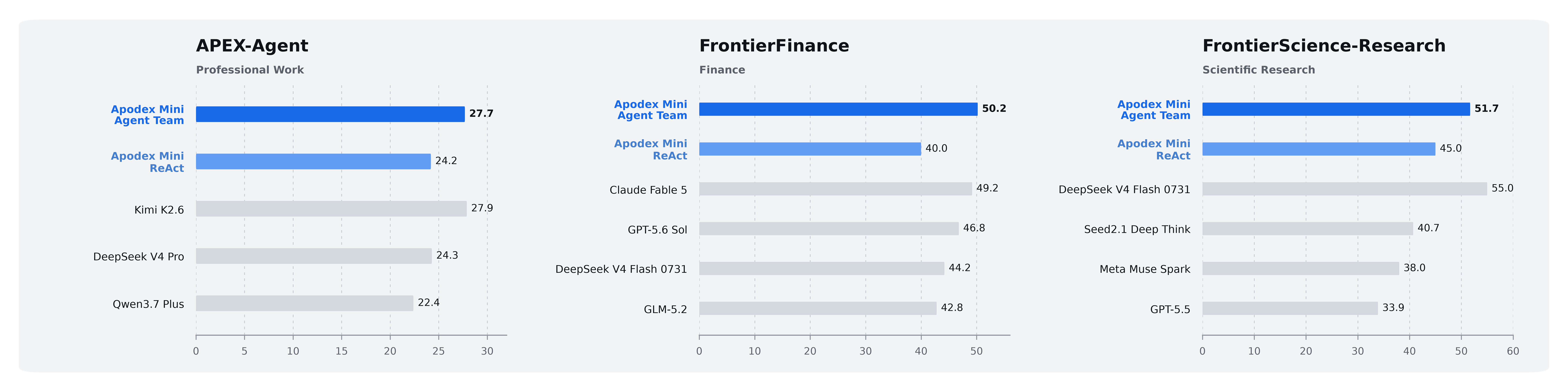
Apodex 1.1 Mini against the field, transcribed from Apodex AI's published launch charts (24 August 2026). Blank cells were not reported for that benchmark.
| Benchmark | Apodex Mini Agent Team | Apodex Mini ReAct | Claude Fable 5 | GPT-5.6 Sol | Kimi K2.6 | DeepSeek V4 Pro | DeepSeek V4 Flash 0731 |
|---|---|---|---|---|---|---|---|
| APEX-Agent (professional work) | 27.7% | 24.2% | — | — | 27.9% | 24.3% | — |
| FrontierFinance | 50.2% | 40% | 49.2% | 46.8% | — | — | 44.2% |
| FrontierScience-Research | 51.7% | 45% | — | — | — | — | 55% |
This model's scores
- APEX-Agent (professional work, Agent Team)27.7%
- FrontierFinance (Agent Team)50.2%
- FrontierScience-Research (Agent Team)51.7%
Scores on a 0–100 scale (25-point gridlines); higher is better. Each benchmark links to its published source.
Strengths
- Apache-2.0 open weights at 36B total parameters — self-hostable on a single node with tensor parallelism
- 50.2 on FrontierFinance, the leading score in Apodex AI's own compared set (Claude Fable 5 49.2, GPT-5.6 Sol 46.8)
- 27.7 on APEX-Agent, close behind Kimi K2.6 at 27.9 and ahead of DeepSeek V4 Pro at 24.3
- 262,144-token context, with 32,768 recommended max output tokens
- Native function calling via the Qwen3.5 chat template, with documented SGLang and vLLM launch commands
- The Agent Team setup improves over ReAct on all three published benchmarks (for example 51.7 vs 45.0 on FrontierScience-Research)
Best for
- Reach for it when you want the Apodex agent behaviour on your own hardware rather than through an API
- Reach for it for long-context file and data work that has to stay inside your own network
- Reach for it as the model behind the open FrontierAgent harness for local research and file workflows
- Reach for it when you need an Apache-2.0 licence for a commercially deployed agent
How to access
| Provider | Model ID |
|---|---|
| Hugging Face (weights) ↗ | apodex/Apodex-1.1-mini |
FAQ
What is Apodex 1.1 Mini?
Apodex 1.1 Mini is the open-weight companion to Apodex AI's flagship Apodex 1.1, published on Hugging Face as apodex/Apodex-1.1-mini on 24 August 2026 under Apache-2.0. The card lists 36B total parameters built on Qwen/Qwen3.5-35B-A3B, English and Chinese, and a 262,144-token context.
How do I run it?
Apodex recommends SGLang or vLLM behind an OpenAI-compatible endpoint. Its documented commands are `python3 -m sglang.launch_server --model-path apodex/Apodex-1.1-mini --tp 8 --context-length 262144 --tool-call-parser qwen3_coder --reasoning-parser qwen3` and `vllm serve apodex/Apodex-1.1-mini --tensor-parallel-size 8 --max-model-len 262144 --enable-auto-tool-choice --tool-call-parser qwen3_coder --reasoning-parser qwen3`.
What settings does Apodex recommend?
Temperature 1.0, top-p 0.95, repetition penalty 1.05, max context length 262,144 and max output 32,768 tokens. Tool schemas should be passed via the `tools=` parameter of the chat-completions API rather than inlined in the system prompt, so the Qwen3.5 chat template emits parseable tool calls.
How does it score against larger models?
In Apodex AI's published charts the Mini Agent Team reaches 50.2 on FrontierFinance — the leading score in that panel, ahead of Claude Fable 5 at 49.2 and GPT-5.6 Sol at 46.8 — 27.7 on APEX-Agent against 27.9 for Kimi K2.6, and 51.7 on FrontierScience-Research against 55.0 for DeepSeek V4 Flash 0731. These are the maker's own numbers.
What licence is it under?
Apache-2.0, per the model card and the LICENSE file in the Hugging Face repository. The FrontierAgent Agent Team harness is open-sourced separately on GitHub.