

Overview
DaisyRose-27B is an open-weight model from RadixArk, the team behind the SGLang serving engine and the Miles reinforcement learning framework, published on Hugging Face on November 18, 2026. It starts from Qwen3.8-27B and is trained with reinforcement learning only, on long-horizon agent tasks: each attempt gets up to 1.5 hours in a sandbox, more than 100 tool calls and more than 256K output tokens, in agent sessions of up to 1M tokens.
The weights are released under Apache-2.0 in BF16, FP8 and NVFP4 (Blackwell-only) checkpoints, with a 262,144-token context. The model takes text and images and returns text, and thinks before answering by default, returning its reasoning separately from the final answer. RadixArk also publishes a DSpark draft model for speculative decoding with SGLang.
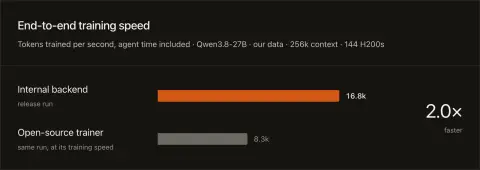
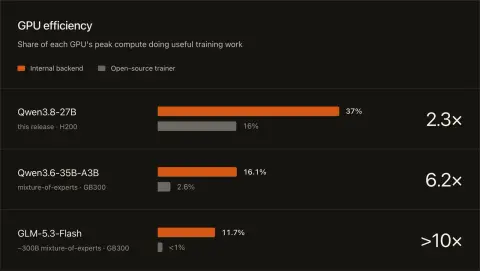
Training ran for 18 days on 144 H200 GPUs — 128 running the agent and 16 running the trainer — for 63,000 GPU-hours, on about 1,200 curated tasks built with Eigent AI. RadixArk reports that its internal Miles backend reached 37% model FLOPs utilisation against 16% for the open-source trainer, about 16,800 against 8,300 tokens per second on the same GPUs.
In RadixArk's launch table DaisyRose-27B scores higher than its Qwen3.8-27B base on all seven benchmarks listed. The largest gain is on the long-horizon Terminal Bench 4.1, from 5.6 to 12.0; the smaller ones include DeepSWE v1.1 (42.2 to 46.2), IFBench (79.5 to 82.4) and GPQA Diamond (89.2 to 90.7).
| Released | 2026-11-18 |
|---|---|
| License | Apache-2.0 |
| Weights | Open weights |
| Parameters | 27.8B (incl. a 0.46B vision encoder and a 0.42B multi-token-prediction head) |
| Context | 262,144 tokens |
| Architecture | Fine-tune of Qwen3.8-27B: 64 decoder layers in a 3:1 pattern of Gated DeltaNet linear-attention and full-attention layers |
| Modalities | Text, Vision |
| Status | Generally available |
Benchmarks
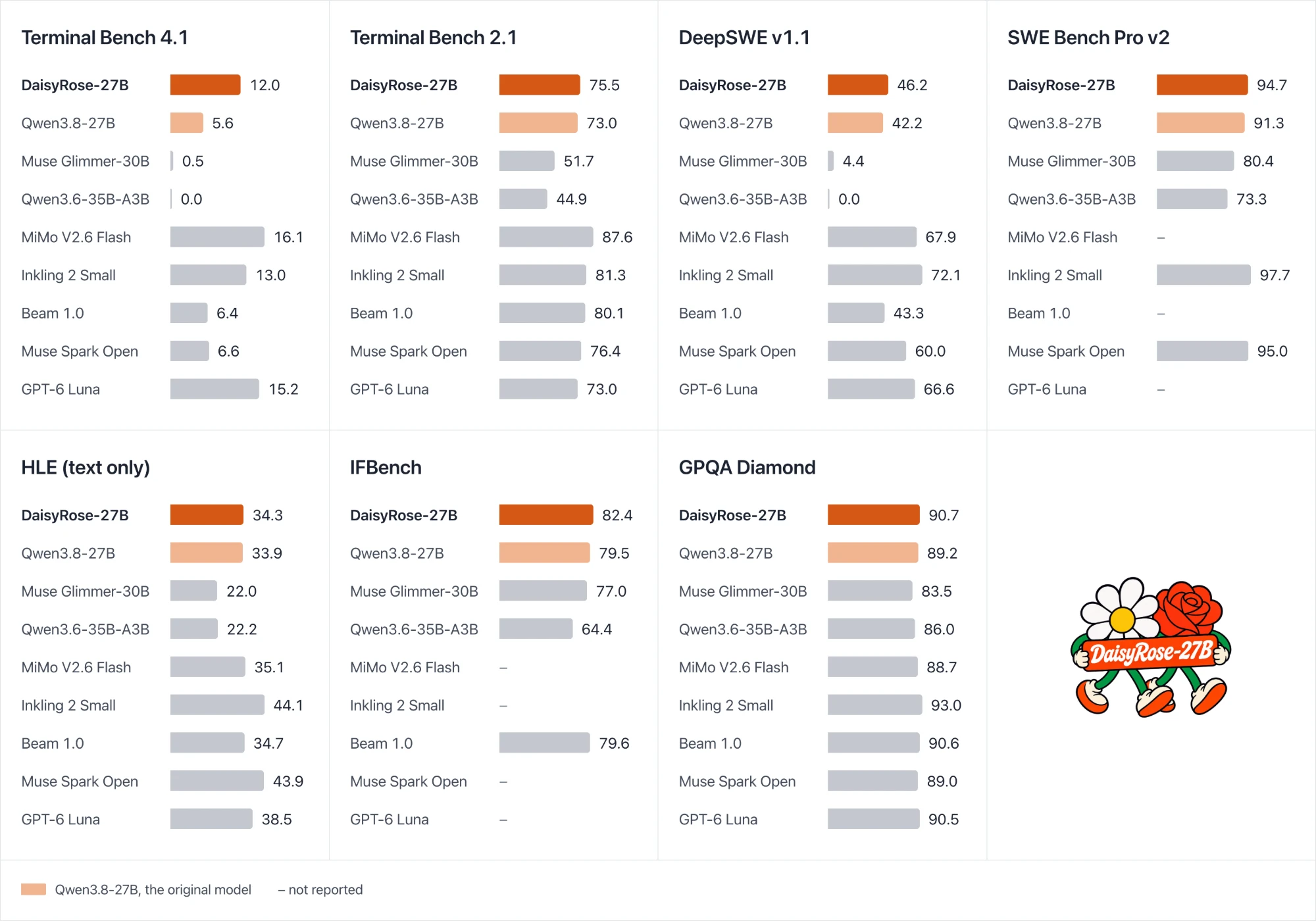
DaisyRose-27B against its Qwen3.8-27B base and seven other models, as published on the model card. Blank cells were not reported.
| Benchmark | DaisyRose-27B | Qwen3.8-27B (base) | Muse Glimmer-30B | Qwen3.6-35B-A3B | MiMo V2.6 Flash | Inkling 2 Small | Beam 1.0 | Muse Spark Open | GPT-6 Luna |
|---|---|---|---|---|---|---|---|---|---|
| Terminal Bench 4.1 | 12 | 5.6 | 0.5 | 0 | 16.1 | 13 | 6.4 | 6.6 | 15.2 |
| Terminal Bench 2.1 | 75.5 | 73 | 51.7 | 44.9 | 87.6 | 81.3 | 80.1 | 76.4 | 73 |
| DeepSWE v1.1 | 46.2 | 42.2 | 4.4 | 0 | 67.9 | 72.1 | 43.3 | 60 | 66.6 |
| SWE Bench Pro v2 | 94.7 | 91.3 | 80.4 | 73.3 | — | 97.7 | — | 95 | — |
| HLE (text only) | 34.3 | 33.9 | 22 | 22.2 | 35.1 | 44.1 | 34.7 | 43.9 | 38.5 |
| IFBench | 82.4 | 79.5 | 77 | 64.4 | — | — | 79.6 | — | — |
| GPQA Diamond | 90.7 | 89.2 | 83.5 | 86 | 88.7 | 93 | 90.6 | 89 | 90.5 |
This model's scores
- Terminal Bench 4.112%
- Terminal Bench 2.175.5%
- DeepSWE v1.146.2%
- SWE Bench Pro v294.7%
- HLE (text only)34.3%
- IFBench82.4%
- GPQA Diamond90.7%
Scores on a 0–100 scale (25-point gridlines); higher is better. Each benchmark links to its published source.
Strengths
- Terminal Bench 4.1 more than doubles over the base model, from 5.6 to 12.0, in RadixArk's 8-runs-per-task evaluation
- 82.4 on IFBench, the highest score in RadixArk's nine-model comparison table, ahead of Beam 1.0 (79.6) and the Qwen3.8-27B base (79.5)
- 94.7 on SWE Bench Pro v2 and 90.7 on GPQA Diamond at 27B dense, close to Muse Spark Open (95.0 and 89.0) at 816B total parameters
- Apache-2.0 weights in BF16 (about 52 GB), FP8 (about 29 GB) and NVFP4 (about 23 GB), with a 262,144-token context
- Ready-made serving recipes for SGLang, vLLM and Docker Model Runner, with an OpenAI-compatible endpoint
Best for
- Reach for it when you self-host an open model behind a coding or terminal agent and want a stronger long-horizon variant of Qwen3.8-27B.
- Reach for it when you need permissively licensed weights: Apache-2.0 allows commercial use without a separate agreement.
- Reach for it as a reference point for what a public RL recipe of about 63,000 H200 GPU-hours adds to a strong open base model.
- Look elsewhere when the top agentic scores matter more than size: in the same table MiMo V2.6 Flash leads Terminal Bench 4.1 (16.1) and Terminal Bench 2.1 (87.6), and Inkling 2 Small leads DeepSWE v1.1 (72.1).
How to access
| Provider | Model ID |
|---|---|
| Hugging Face (BF16 weights) ↗ | RadixArk/DaisyRose-27B |
| Hugging Face (FP8 weights) ↗ | RadixArk/DaisyRose-27B-FP8 |
| Hugging Face (NVFP4 weights) ↗ | RadixArk/DaisyRose-27B-NVFP4 |
FAQ
What is DaisyRose-27B built on?
DaisyRose-27B is Qwen3.8-27B trained further with reinforcement learning only, on about 1,200 curated long-horizon agent tasks. The model card lists 27.8B parameters including the vision encoder and a multi-token-prediction head, and a 262,144-token context.
Can I use DaisyRose-27B commercially?
Yes. The weights are released under Apache-2.0, which allows commercial use. BF16, FP8 and NVFP4 checkpoints are on Hugging Face under the RadixArk organisation.
How much better is DaisyRose-27B than Qwen3.8-27B?
In RadixArk's launch table it is higher on all seven benchmarks listed. Terminal Bench 4.1 rises from 5.6 to 12.0, DeepSWE v1.1 from 42.2 to 46.2, SWE Bench Pro v2 from 91.3 to 94.7, IFBench from 79.5 to 82.4 and GPQA Diamond from 89.2 to 90.7.
How do I run DaisyRose-27B?
The model card gives an SGLang recipe (python3 -m sglang.launch_server --model-path RadixArk/DaisyRose-27B, with the qwen3 reasoning parser and optional DSpark speculative decoding), plus vllm serve "RadixArk/DaisyRose-27B" and docker model run hf.co/RadixArk/DaisyRose-27B. Each exposes an OpenAI-compatible endpoint; the model's thinking arrives in reasoning_content.
How was DaisyRose-27B trained?
With RadixArk's Miles framework in fully asynchronous mode, for 18 days on 144 H200 GPUs (128 running the agent, 16 the trainer), about 63,000 GPU-hours. RadixArk says its sandbox service ran about 944,000 sandboxes for the agent tasks.