
Overview
Gemini 3.5 Transcribe is the speech-to-text pair Google announced on 26 August 2026: `gemini-3.5-transcribe` for pre-recorded audio and `gemini-3.5-transcribe-live` for real-time streaming. The Gemini API model list describes it as a "Low-latency speech-to-text model with utterance-based language detection, speaker diarization, and word timestamps." Google says the models automatically detect and transcribe over 85 languages.
The pitch is transcription that survives real speech rather than dictation. Google says the model "seamlessly handles self-corrections", "removes filler words" and "auto-formats text", identifies up to 3 speakers (more is experimental), returns word-level timestamps, and accepts a custom vocabulary for names and jargon. It also supports function calling, so a transcribed voice command can hand work to other Gemini models in the same flow.
On accuracy, Google reports an average word error rate of 4.0% for streaming and 2.6% for non-streaming use cases across noisy, real-world audio measured against Artificial Analysis benchmarks. On the multilingual FLEURS set across a group of top languages and locales it reports 5.50% WER streaming and 5.04% non-streaming. Against its predecessor Chirp 3, Google says time to final transcription improves by 70%.
Google launched the models in public preview in the Gemini API via Google AI Studio and Google Antigravity, and in public preview on the Gemini Enterprise Agent Platform. The same model powers the Gemini app on macOS (English), Rambler on Android in select countries and languages, with Chrome listed as coming soon. Google names Agora, Fishjam, LangChain, LiveKit, Pipecat, Vercel and Vision Agents as launch partner platforms.
Pricing on the Gemini API is $2.00 per 1M input tokens (or $0.003 per minute of audio) and $12.00 per 1M output tokens (or $0.002 per minute of text) for the batch model. The live model is $3.50 per 1M input tokens (or $0.005 per audio minute) and $21.00 per 1M output tokens (or $0.004 per text minute). Both list a free-of-charge tier.
| Released | 2026-08-26 |
|---|---|
| License | Proprietary |
| Weights | API only |
| Parameters | Not disclosed |
| Architecture | Google describes the pair as two dedicated speech-to-text models based on Gemini's audio understanding, served as `gemini-3.5-transcribe` for pre-recorded audio through the Interactions API and `gemini-3.5-transcribe-live` for streaming audio through the Live API. |
| Modalities | Audio, Text |
| Status | Public preview |
Benchmarks
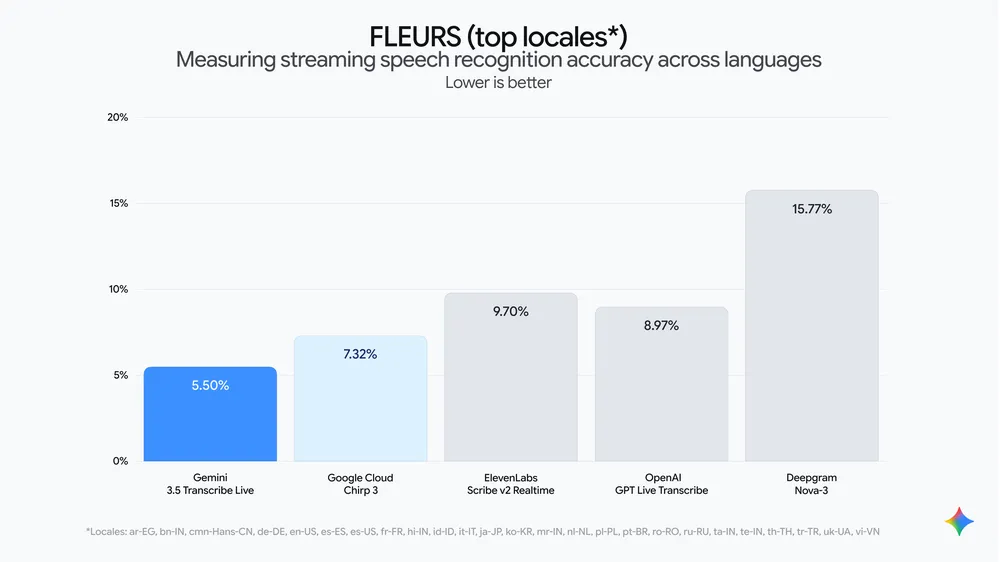
FLEURS (top locales) streaming word error rate, as published by Google at launch (26 August 2026). Lower is better.
| Benchmark | Gemini 3.5 Transcribe Live | Google Cloud Chirp 3 | OpenAI GPT Live Transcribe | ElevenLabs Scribe v2 Realtime | Deepgram Nova-3 |
|---|---|---|---|---|---|
| FLEURS (top locales) word error rate | 5.5% | 7.32% | 8.97% | 9.7% | 15.77% |
Pricing
| Input | $2.00 / 1M tokens |
|---|---|
| Output | $12.00 / 1M tokens |
Rates for gemini-3.5-transcribe; Google also lists $0.003 per minute of audio input and $0.002 per minute of text output. The streaming model gemini-3.5-transcribe-live is $3.50 input / $21.00 per 1M tokens ($0.005 and $0.004 per minute). Both have a free-of-charge tier.
Strengths
- 5.50% word error rate on FLEURS (top locales) streaming — the lowest in Google's published launch comparison, ahead of Chirp 3 at 7.32%
- 2.6% average WER on pre-recorded audio and 4.0% streaming across noisy real-world audio, per Google's Artificial Analysis measurements
- Automatic language detection and transcription across more than 85 languages
- Speaker diarization for up to 3 speakers, word-level timestamps, and custom-vocabulary biasing for names and jargon
- Cleans up natural speech: handles self-corrections, removes filler words, auto-formats the transcript
- 70% faster time to final transcription than Chirp 3, by Google's measurement
- Function calling, so a transcribed command can trigger other Gemini capabilities in the same workflow
Best for
- Reach for it for live captioning and voice agents, where the streaming endpoint runs through the Live API
- Reach for it for meeting and interview transcripts that need speaker labels and word-level timestamps
- Reach for it for multilingual audio where the language is not known in advance
- Reach for it for dictation flows that should read as clean prose rather than a literal transcript
How to access
| Provider | Model ID |
|---|---|
| Gemini API (Google AI Studio) ↗ | gemini-3.5-transcribe |
| Gemini API — Live API (streaming) ↗ | gemini-3.5-transcribe-live |
FAQ
What is Gemini 3.5 Transcribe?
Gemini 3.5 Transcribe is a pair of dedicated speech-to-text models Google announced on 26 August 2026, based on Gemini's audio understanding. `gemini-3.5-transcribe` handles pre-recorded audio through the Interactions API and `gemini-3.5-transcribe-live` streams live audio through the Live API.
How accurate is Gemini 3.5 Transcribe?
Google reports an average word error rate of 2.6% for non-streaming and 4.0% for streaming use cases across noisy real-world audio measured against Artificial Analysis benchmarks. On the multilingual FLEURS set it reports 5.04% WER non-streaming and 5.50% streaming.
How does it compare with Chirp 3 and other speech-to-text APIs?
In Google's published FLEURS chart for top locales, streaming word error rate is 5.50% for Gemini 3.5 Transcribe Live against 7.32% for Google Cloud Chirp 3, 8.97% for OpenAI GPT Live Transcribe, 9.70% for ElevenLabs Scribe v2 Realtime and 15.77% for Deepgram Nova-3. Lower is better. Google also says time to final transcription improves by 70% over Chirp 3.
How many languages does it support?
Google says the model automatically detects and transcribes over 85 languages, with utterance-based language detection so the language does not have to be declared up front.
What does Gemini 3.5 Transcribe cost?
The Gemini API pricing page lists $2.00 per 1M input tokens and $12.00 per 1M output tokens for gemini-3.5-transcribe, or $0.003 per minute of audio and $0.002 per minute of text. The live model is $3.50 / $21.00 per 1M tokens, or $0.005 and $0.004 per minute. Both list a free-of-charge tier.
Where can I use it?
Google launched it in public preview in the Gemini API via Google AI Studio and Google Antigravity, and on the Gemini Enterprise Agent Platform. It also powers the Gemini app on macOS in English and Rambler on Android in select countries and languages, with Chrome listed as coming soon.