
Overview
Gemini 4 Argon is the frontier model Google announced on 30 September 2026, in a post by Koray Kavukcuoglu, SVP of Google DeepMind and Google's Chief AI Architect. Google says it is "built to sustain deep reasoning across complex, long-horizon workflows" and delivers frontier performance in real-world software engineering, enterprise knowledge work such as legal and finance, and cybersecurity defence.
The headline technical change is output length. Google raised the model's output token limit to 1M tokens, up from the previous 64K, so a single response can carry far longer work such as large code migrations. Google engineers already use Argon internally for debugging, codebase migrations of up to 800K+ lines (C/C++ to Rust) and algorithm design, and Google credits it with freeing 300 TiB of memory across its data centres.
Release was phased. Argon rolled out first to trusted cyber defenders through the Fairwind Program, where Google says it ships without cyber guardrails, while the public model keeps refusals for cyber and CBRN attacks. On 13 October 2026 it became generally available as gemini-4-argon on the Gemini API paid tier and in Google AI Studio, and reached Google AI Pro and Ultra subscribers in the Gemini app. The API uses the Interactions API, defaults to a 65,536-token response and can decode up to 1M tokens in background mode.
| Released | 2026-09-30 |
|---|---|
| License | Proprietary |
| Weights | API only |
| Parameters | Undisclosed |
| Modalities | Text, Vision, Video |
| Status | Generally available since 13 October 2026 — Gemini API paid tier and Google AI Studio (not the free tier), Google Antigravity for Google AI Ultra, and the Gemini app for Google AI Pro and Ultra subscribers. |
Benchmarks
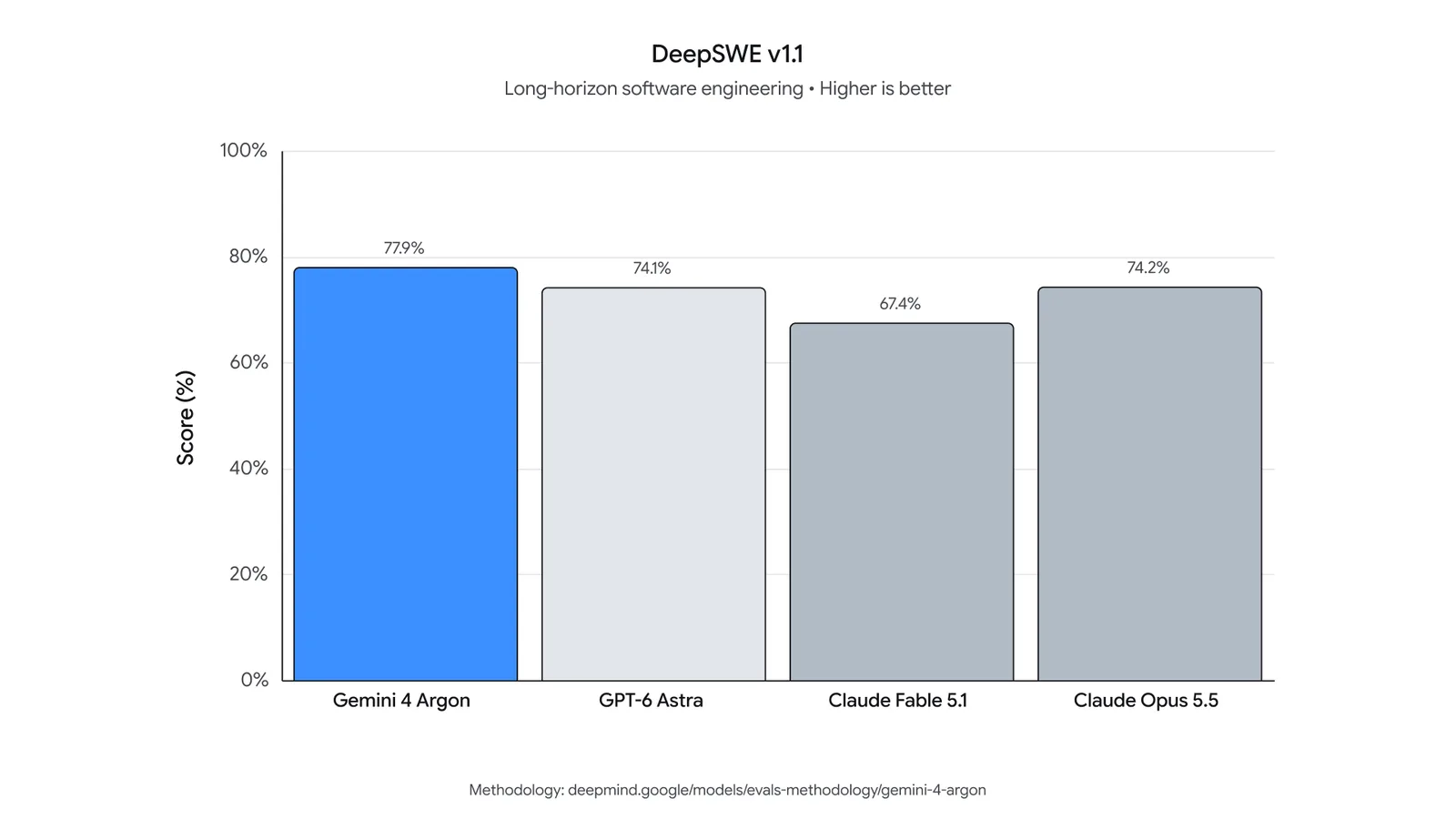
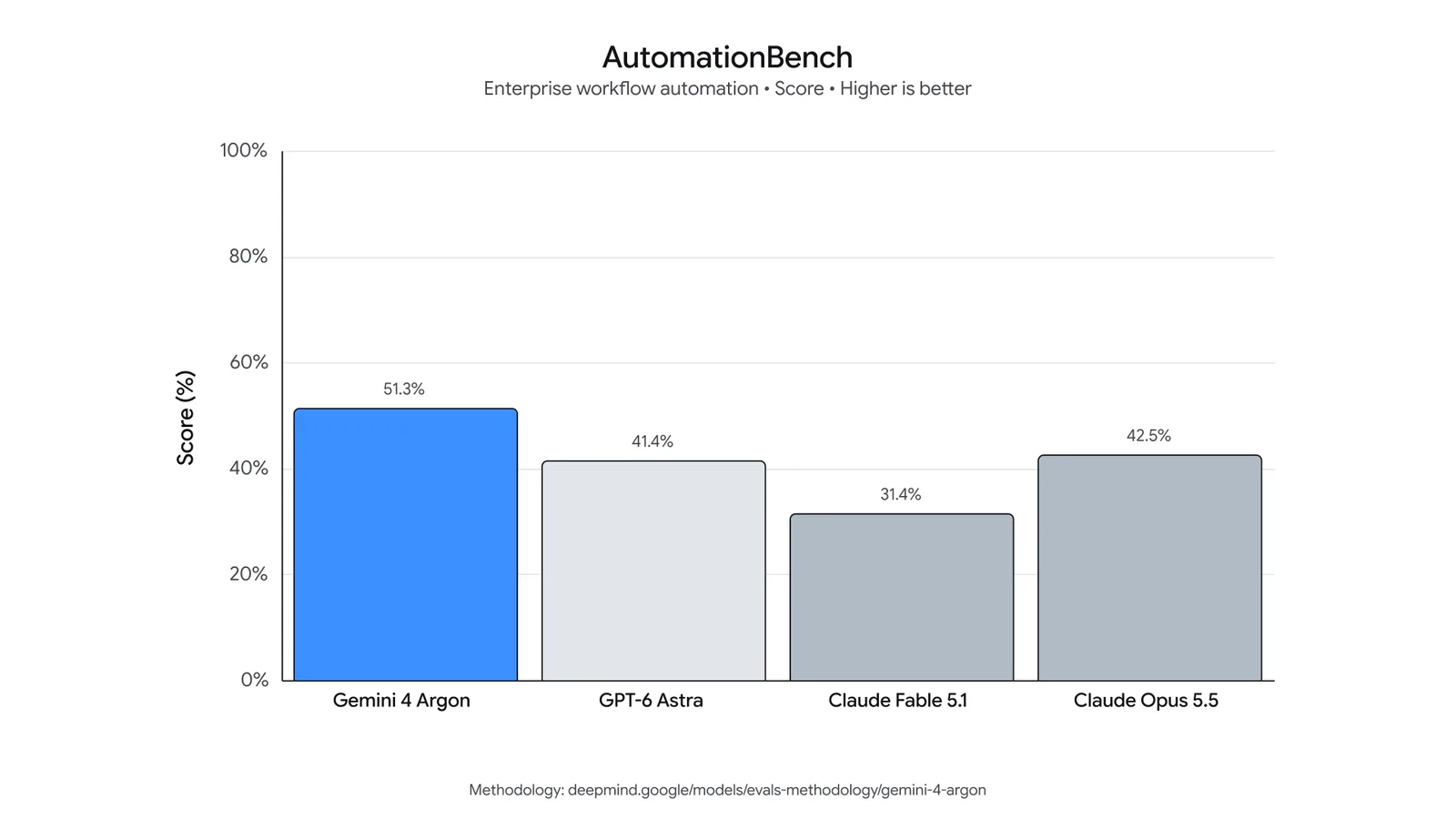
Scores from Google's launch charts for Gemini 4 Argon.
| Benchmark | Gemini 4 Argon | GPT-6 Astra | Claude Fable 5.1 | Claude Opus 5.5 |
|---|---|---|---|---|
| DeepSWE v1.1 | 77.9% | 74.1% | 67.4% | 74.2% |
| AutomationBench | 51.3% | 41.4% | 31.4% | 42.5% |
This model's scores
- DeepSWE v1.177.9%
- AutomationBench51.3%
- LVBench91.7%
- CWE-bench v168%
Scores on a 0–100 scale (25-point gridlines); higher is better. Each benchmark links to its published source.
Pricing
| Input | $2.00 / 1M tokens |
|---|---|
| Output | $10.00 / 1M tokens |
Introductory price through 30 November 2026; from 1 December 2026 it rises to $4 input and $20 output per 1M tokens. Implicit caching cuts cached input 95%, to $0.10 per 1M during the introductory period.
Strengths
- 77.9% on DeepSWE v1.1 long-horizon software engineering, ahead of Claude Opus 5.5 (74.2%) and GPT-6 Astra (74.1%) in Google's chart
- 51.3% on Zapier's AutomationBench for enterprise workflow automation, ranked #1 by Google
- 1M-token output limit, up from 64K in earlier Gemini models
- 91.7% on LVBench long-video understanding
- Tied for first on CWE-bench v1 vulnerability remediation with 68%
Best for
- Reach for it for long-horizon software engineering, such as large codebase migrations that need very long outputs
- Reach for it for multi-step enterprise work in legal, finance and tax research
- Reach for it for defensive security work if your organisation qualifies for the Fairwind Program
- Not on the free tier: the Gemini API offers Argon on the paid tier only, and the Gemini app on Google AI Pro and Ultra plans
FAQ
Who can use Gemini 4 Argon?
Gemini 4 Argon became generally available on 13 October 2026. Developers reach it as gemini-4-argon on the paid tier of the Gemini API and in Google AI Studio; it is not on the free tier. Google AI Ultra subscribers can use it in Google Antigravity, and Google AI Pro and Ultra subscribers get it in the Gemini app.
How much does Gemini 4 Argon cost?
Google set an introductory price for Gemini 4 Argon of $2 per million input tokens and $10 per million output tokens, with cached input tokens 95% off the input price. After the introductory period the price rises to $4 per million input tokens and $20 per million output tokens.
How does Gemini 4 Argon compare with Claude Opus 5.5 and GPT-6 Astra?
In Google's launch charts, Gemini 4 Argon scores 77.9% on DeepSWE v1.1 against 74.2% for Claude Opus 5.5, 74.1% for GPT-6 Astra and 67.4% for Claude Fable 5.1. On AutomationBench, Argon scores 51.3% against 42.5% for Opus 5.5 and 41.4% for GPT-6 Astra.
How long can a Gemini 4 Argon response be?
Gemini 4 Argon has an output token limit of 1M tokens, up from 64K in earlier Gemini models. Google raised the limit so the model can finish longer, more complex tasks in one response, such as large codebase migrations; Google reports internal C/C++-to-Rust migrations of up to 800K+ lines.
Does Gemini 4 Argon have cyber safeguards?
The general Gemini 4 Argon release refuses harmful requests such as cyber and CBRN attacks, and Google adds activation monitoring and chain-of-thought monitoring for misuse and misalignment. For vetted defenders in the Fairwind Program, Google says Argon is released without cyber guardrails so they can use its full capabilities.