
Overview
Hy-Memory-30B-A3B is a specialised language model from Tencent Hunyuan, published on Hugging Face with its technical report on 15 October 2026. It does one job: the write path of an external memory system. Agent memory frameworks normally call a general-purpose LLM, steered by framework-specific prompts, to decide what to keep from a conversation or coding session, how to phrase it and how new evidence should update what is already stored. Hy-Memory-30B-A3B replaces that call inside Mem0, MemOS and Tencent's own Hy Memory framework (its Chat, Working and Coding scenarios), with about 3B active parameters per token.
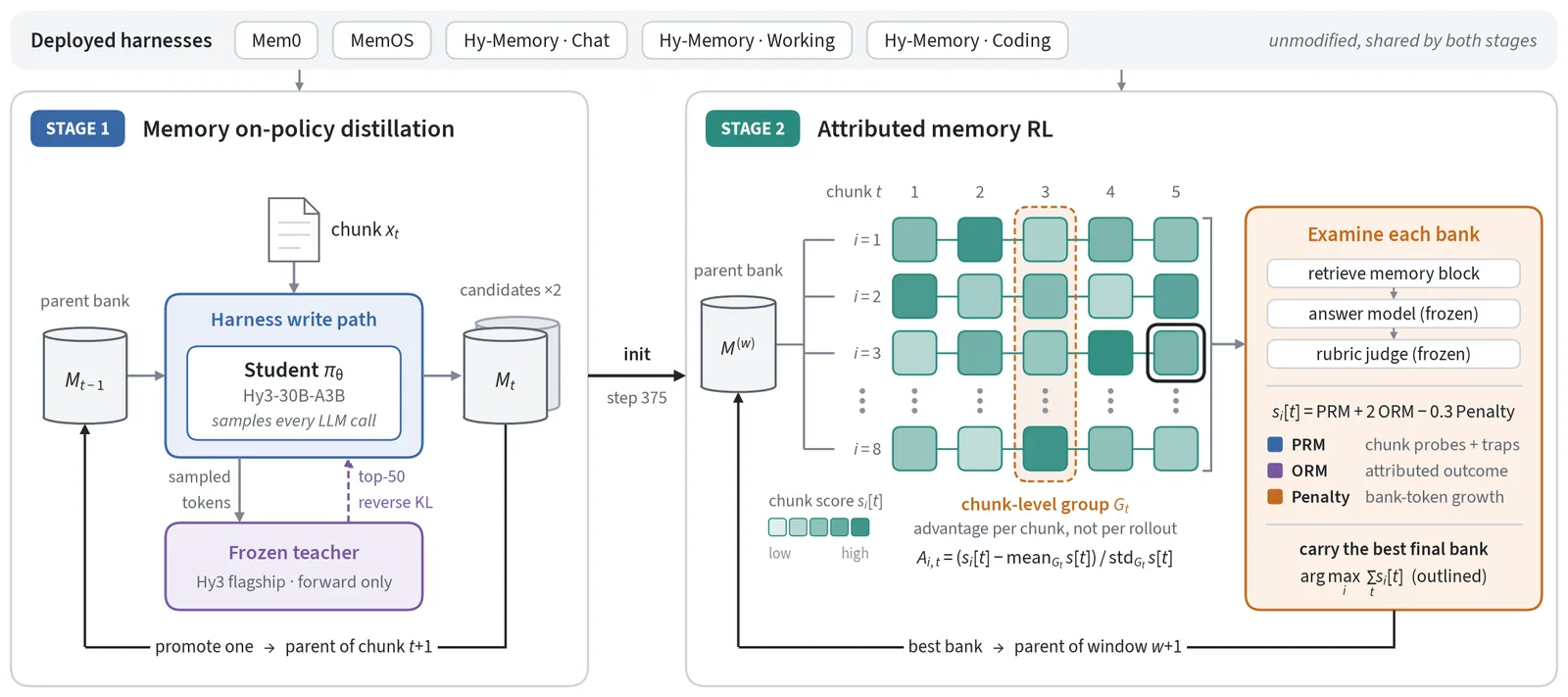
Training runs in two stages inside the same unmodified harness configurations the model is deployed in. Memory on-policy distillation first teaches each framework's write protocol, with a frozen teacher scoring the memory states the student itself writes. Attributed memory reinforcement learning then rolls out several candidate memory banks, probes each chunk for how well the bank answers later questions, assigns chunk-level credit with a GRPO-style advantage, penalises over-storage and carries the best final bank into the next window, so the model learns from memory that accumulates the way it does in production.
Tencent evaluates it by swapping only the memory writer while the harness, prompts, retrieval, answer model and judge stay fixed, on fixed 20% subsamples of six benchmarks: LoCoMo, LongMemEval, PersonaMem-v2, Travel, Shopping and Code Memory Bench. Averaged across the four harnesses it scores 55.49, against 54.62 for Claude Opus 5, 53.64 for DeepSeek V4.1 Flash, 51.63 for Hy3 and 50.37 for the similarly sized Qwen3.6-35B-A3B. It ranks first on each harness, including EverMemOS, which was held out of training — though on Hy Memory (60.55 vs 60.53) and MemOS (50.51 vs 50.50) its lead over Claude Opus 5 is within a few hundredths of a point.
The weights are Apache-2.0 in BF16 and FP8, and the model card gives vLLM, SGLang, Transformers and Docker Model Runner instructions, serving it behind an OpenAI-compatible API with no-think mode for extraction. The Hy Memory framework it was built for is open-source in Tencent-Hunyuan's GitHub repository.
| Released | 2026-10-15 |
|---|---|
| License | Apache-2.0 |
| Weights | Open weights |
| Parameters | 30B total · about 3B active (Mixture-of-Experts) |
| Architecture | Mixture-of-Experts transformer; the training diagram shows a Hy3-30B-A3B student distilled from the Hy3 flagship |
| Modalities | Text |
| Status | Generally available — Apache-2.0 open weights on Hugging Face (BF16 and FP8), with a technical report on arXiv |
Benchmarks
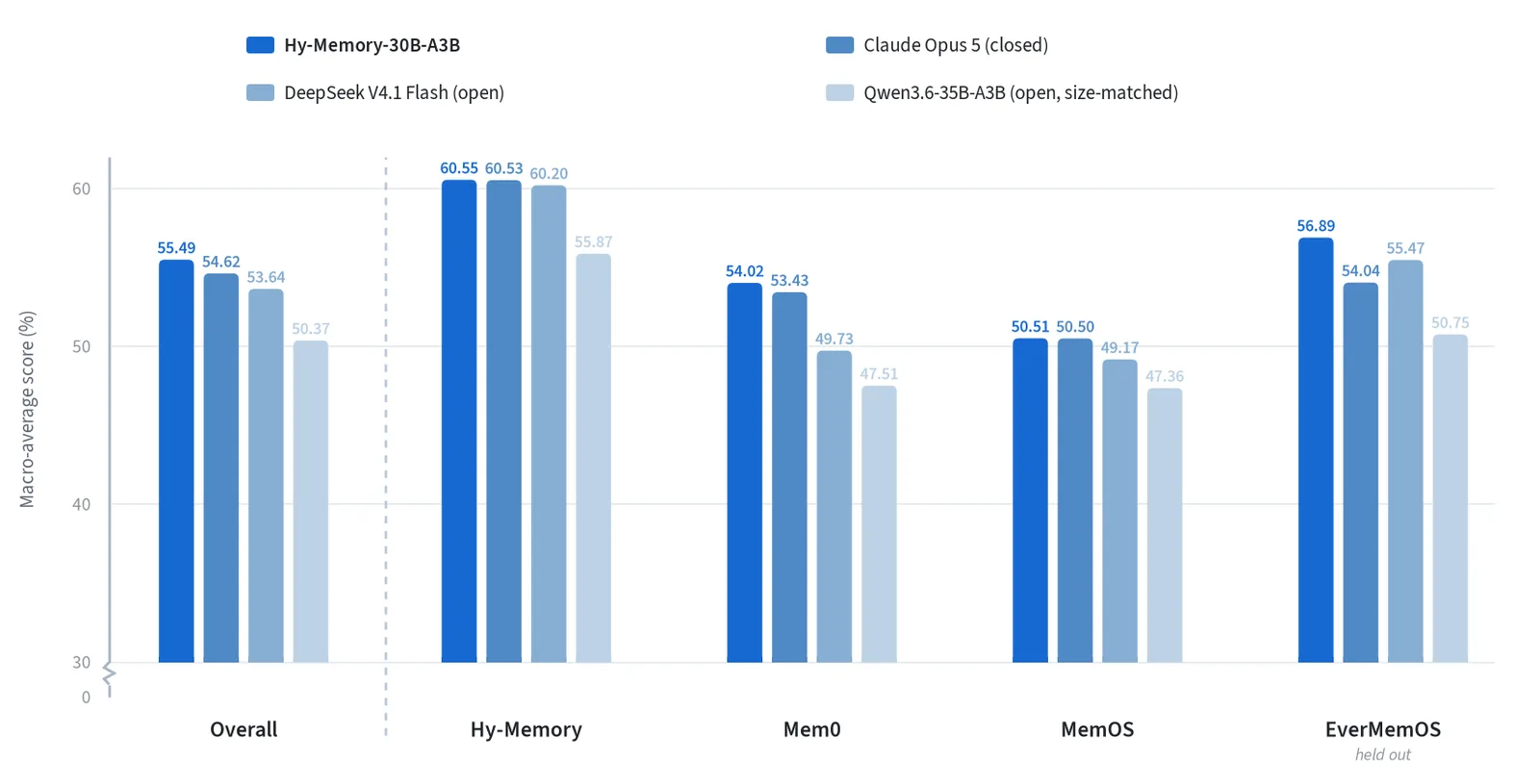
Tencent's cross-harness table (model card, 15 October 2026): only the memory writer changes; each cell is the mean of six metrics on fixed 20% benchmark subsamples. EverMemOS was held out of training.
| Benchmark | Hy-Memory-30B-A3B | Claude Opus 5 | DeepSeek V4.1 Flash | Hy3 | Qwen3.6-35B-A3B | Hy3-A3B Base | Qwen3-30B-A3B |
|---|---|---|---|---|---|---|---|
| Mem0 | 54.02 | 53.43 | 49.73 | 45.99 | 47.51 | 40.2 | 39.81 |
| Hy Memory | 60.55 | 60.53 | 60.2 | 58.06 | 55.87 | 50.39 | 45.67 |
| MemOS | 50.51 | 50.5 | 49.17 | 50.19 | 47.36 | 49.05 | 45.44 |
| EverMemOS (held out) | 56.89 | 54.04 | 55.47 | 52.3 | 50.75 | 50.98 | 46.57 |
| Macro average | 55.49 | 54.62 | 53.64 | 51.63 | 50.37 | 47.66 | 44.37 |
This model's scores
- Hy Memory harness (six-metric mean)60.55%
- EverMemOS harness, held out (six-metric mean)56.89%
- Cross-harness macro average55.49%
- Mem0 harness (six-metric mean)54.02%
- MemOS harness (six-metric mean)50.51%
- LongMemEval (Mem0 harness)73%
Scores on a 0–100 scale (25-point gridlines); higher is better. Each benchmark links to its published source.
Strengths
- Purpose-trained to write agent memory: what to retain, how to represent it and how to reconcile it with existing memories
- Drops into existing frameworks — Mem0, MemOS and Hy Memory — in place of a general-purpose LLM
- Ranks first on all four harnesses in Tencent's table, including the held-out EverMemOS (56.89 vs 54.04 for Claude Opus 5)
- About 3B active parameters, so the memory write path runs on a small open model instead of a frontier API
- Apache-2.0 open weights in BF16 and FP8
Best for
- Self-hosted long-term memory for chat assistants built on Mem0 or MemOS
- Coding-agent memory that tracks facts and reusable experience across long, interleaved sessions in Hy Memory
- Cutting the serving cost of memory extraction by replacing a frontier-model call with a 3B-active open model
- Research on reinforcement learning for memory writing, using the released weights and technical report
How to access
| Provider | Model ID |
|---|---|
| Hugging Face (weights) ↗ | tencent/Hy-Memory-30B-A3B |
FAQ
What is a memory-writer model?
In an external memory system for agents, the writer is the model that reads new conversation or coding traces and decides what to store, how to represent it and how to update or reconcile existing memories. Hy-Memory-30B-A3B is trained for that role only, in place of the general-purpose LLM frameworks usually call.
Which frameworks does it work with?
It was trained inside Mem0, MemOS and Tencent's Hy Memory (Chat, Working and Coding scenarios), and Tencent reports it transfers to EverMemOS, which was held out of training.
How does it compare with Claude Opus 5?
In Tencent's table, with only the writer swapped, it averages 55.49 across the four harnesses against 54.62 for Claude Opus 5. Its largest lead is on the held-out EverMemOS (56.89 vs 54.04); on Hy Memory and MemOS the two are within 0.02 and 0.01 points.
How do I run it?
The model card shows serving it with vLLM (tested with v0.31.0) under --served-model-name hy-memory and calling the OpenAI-compatible API, with SGLang, Transformers and Docker Model Runner instructions as alternatives.