

Overview
Kolibri 1.1 is the successor to Kolibri, the German-English Mixture-of-Experts reasoning model from the Heidelberg company Aleph Alpha. It was released on November 23, 2026 with weights on Hugging Face under the Apache 2.0 license. It has 75.1B total parameters, of which 3.44B are active per token, keeps Kolibri's explicit reasoning mode and tool calling, and has a native context of 262,144 tokens that can be extended to 1,048,576. Aleph Alpha densified the first layers, which brought the model down from Kolibri 1.0's 78B total parameters.
The main architectural change is sparse attention. Most layers still attend to a sliding window of nearby text, while every fifth layer now selects the parts of the whole context most relevant to each token instead of attending to all of it. Aleph Alpha's launch post says decode throughput on four B300 GPUs is up to 14× faster than Kolibri 1.0 at a context of one million tokens, and that each request needs less memory, so the same GPUs serve three times as many concurrent requests.
Kolibri 1.1 was not trained from scratch. Aleph Alpha continued from a Kolibri 1 checkpoint taken after 20T pre-training and 3.42T mid-training tokens, then added 805B tokens of sparse-attention mid-training and 201B tokens of long-context training before new supervised fine-tuning and reinforcement learning. The launch post says the release came out of a 7-week iteration cycle, and that across Aleph Alpha's benchmarks the model uses 41% fewer output tokens per task on average than Kolibri 1.0.
In the model card's post-training table, Kolibri 1.1 scores 73.2 overall against 66.6 for Kolibri 1.0, with 87.1 on GPQA Diamond, 98.3 on AIME 2025, 93.0 on LiveCodeBench v6 and 70.4 on SWE-Bench Verified. Aleph Alpha models serving cost as GPU-hours per 1,000 evaluation tasks: Kolibri 1.1 needs 0.21 against 0.72 for Kolibri 1.0, 3.4 times less. The same table also shows where it trails: Qwen3.8 Flash Next (80.1 overall) and Qwen3.8 27B (77.2) score higher, at several times the modelled cost.
Serving uses Aleph Alpha's aleph-alpha-inference package, a vLLM plugin, with an OpenAI-compatible API. The FP8 checkpoint takes about 77.6 GB of memory; the model card lists 2× H100 SXM5, 2× H200, or one B200 or B300 as the minimum. New with this release are official GGUF quantizations for llama.cpp on CPU, CUDA and Apple Metal, and the launch post says the smallest build runs on GPUs with 24 GB of VRAM.
| Released | 2026-11-23 |
|---|---|
| License | Apache-2.0 |
| Weights | Open weights |
| Parameters | 75.1B total · 3.44B active |
| Context | 262,144 tokens native; up to 1,048,576 tokens |
| Architecture | Mixture-of-Experts transformer: 2 dense layers followed by 48 MoE layers (384 routed experts, 6 selected per token, 1 shared expert), with sliding-window and sparse attention layers at a 4:1 ratio, trained with Muon and Exact Quantile Balancing |
| Knowledge cutoff | June 18, 2026 (English and German) |
| Modalities | Text |
| Status | Generally available — open weights on Hugging Face |
Benchmarks
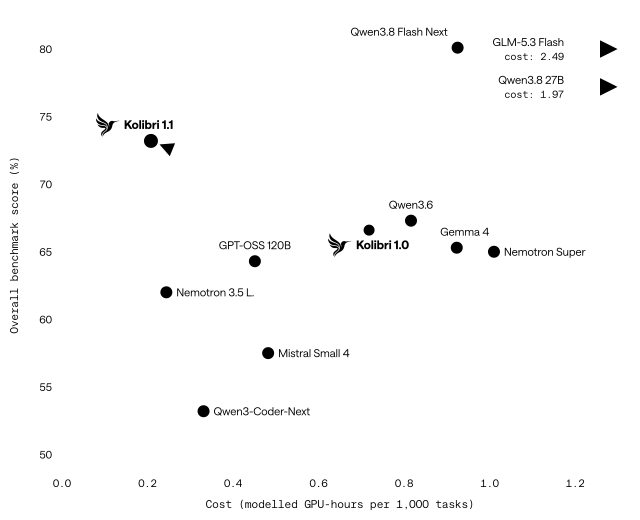
Kolibri 1.1 against Kolibri 1.0 and other open models, from the post-training table in Aleph Alpha's model card (November 23, 2026). Higher is better except the AgentDojo attack success rate; a dash means no published score.
| Benchmark | Kolibri 1.1 | Kolibri 1.0 | Qwen3.6 35B-A3B | Gemma 4 26B-A4B | GPT-OSS 120B | Mistral Small 4 | Nemotron 3 Super | Qwen3.8 27B |
|---|---|---|---|---|---|---|---|---|
| Overall | 73.2 | 66.6 | 67.3 | 65.3 | 64.3 | 57.5 | 65 | 77.2 |
| Overall (DE) | 74.2 | 69.2 | 67.4 | 66.1 | 65.1 | 58.3 | 66.1 | 79.2 |
| GPQA Diamond (EN) | 87.1 | 84.7 | 82.7 | 81.2 | 78.6 | 75.6 | 78.6 | 88.7 |
| GPQA Diamond (DE) | 82.1 | 81.7 | 82.1 | 79.9 | 75.1 | 72.9 | 78.2 | 89.1 |
| AIME 2025 (EN) | 98.3 | 95.6 | 86.5 | 87.3 | 91.2 | 80 | 93.1 | 97.9 |
| AIME 2026 (EN) | 95.8 | 95.6 | 89.2 | 87.5 | 92.9 | 80.8 | 90.4 | 97.9 |
| LiveCodeBench v6 | 93 | 85.4 | 81.6 | 82 | 88.6 | 72.6 | 81.6 | 93.9 |
| SWE-Bench Verified | 70.4 | 64 | 70.2 | 58.6 | 57.8 | 62.2 | 58.2 | 70.8 |
| TerminalBench 2.1 | 35.6 | 25.8 | — | — | 27.3 | 22.1 | 38.6 | 76.8 |
| Tau2-Bench (Airline) | 76 | 75.3 | 75.3 | 78 | 72 | 40.7 | 79.3 | 77.3 |
| BFCL v4 (overall) | 62.7 | 60 | 67.1 | 67 | 55.7 | 58.1 | 60.8 | 71.6 |
| BrowseComp | 34.8 | 31.9 | 31 | 27.5 | 30.1 | 21.2 | 30.8 | 49.4 |
| IFBench (loose-prompt) | 82.7 | 78.8 | 67.3 | 80.1 | 70.3 | 47.7 | 73.9 | 80.9 |
| AA-LCR | 71 | 64 | 72.7 | 66.7 | 56.3 | 47 | 70 | 80.3 |
| AgentDojo targeted ASR (lower is better) | 0.9 | 69.7 | 21.1 | 11.6 | 32.5 | 14.1 | 42.4 | 0.8 |
This model's scores
- AIME 202598.3%
- LiveCodeBench v693%
- GPQA Diamond87.1%
- GPQA Diamond (German)82.1%
- IFBench (loose-prompt)82.7%
- SWE-Bench Verified70.4%
Scores on a 0–100 scale (25-point gridlines); higher is better. Each benchmark links to its published source.
Strengths
- Open weights under Apache 2.0, built for German and English with a German-tuned tokenizer
- Only 3.44B of 75.1B parameters active per token; 0.21 modelled GPU-hours per 1,000 tasks against 0.72 for Kolibri 1.0
- Sparse attention: up to 14× faster decode than Kolibri 1.0 at a one-million-token context, per Aleph Alpha
- 87.1 on GPQA Diamond, 98.3 on AIME 2025 and 93.0 on LiveCodeBench v6 in the model card
- Prompt-injection resistance: 0.9% targeted attack success on AgentDojo, down from 69.7% for Kolibri 1.0
- Official GGUF quantizations for llama.cpp, the smallest running on a 24 GB GPU
Best for
- Reach for it for German- and English-language assistants, document processing and drafting that must run on your own hardware.
- Reach for it for retrieval-augmented question answering and agentic search over an organisation's own documents, where it scores 71.2 on Aleph Alpha's English agentic-retrieval average.
- Reach for it for agent workflows that call tools on untrusted content, where its AgentDojo and CyberSecEval 2 injection results are its strongest gains over Kolibri 1.0.
- Look elsewhere for image or audio input, for languages beyond German and English, or for the hardest terminal-agent work, where larger compared models score far higher on TerminalBench 2.1.
How to access
| Provider | Model ID |
|---|---|
| Hugging Face (weights) ↗ | Aleph-Alpha/Kolibri-1.1 |
| Hugging Face (GGUF for llama.cpp) ↗ | Aleph-Alpha/Kolibri-1.1-GGUF |
| Self-hosted vLLM (aleph-alpha-inference) ↗ | Aleph-Alpha/Kolibri-1.1 |
Kolibri — every version
The full lineage of the Kolibri line, newest first. Every version has its own page — click any to compare specs, benchmarks and pricing.
| Version | Released | Context | License |
|---|---|---|---|
| Kolibri 1.1current | 2026-11-23 | 1M | Apache-2.0 |
| Kolibri | 2026-10-03 | 1M | Apache-2.0 |
FAQ
What is Kolibri 1.1?
Kolibri 1.1 is an open-weight Mixture-of-Experts language model from Aleph Alpha, released on November 23, 2026 under Apache 2.0. It has 75.1B total and 3.44B active parameters, focuses on German and English, supports a reasoning mode and tool calling, and adds sparse attention for cheaper long contexts.
What changed from Kolibri 1.0?
Kolibri 1.1 continues from a Kolibri 1 checkpoint with sparse attention, a new long-context phase and new post-training. Aleph Alpha reports a higher overall score (73.2 against 66.6), 3.4 times less modelled GPU time per task, 41% fewer output tokens per task, up to 14× faster decode at a one-million-token context, and much stronger prompt-injection resistance. Total parameters fell from 78B to 75B.
How long is Kolibri 1.1's context window?
The native context length is 262,144 tokens, and the model can process up to 1,048,576 tokens. Aleph Alpha notes that quality on complex tasks may drop beyond the native length and recommends at most 262,144 tokens for such tasks.
What hardware does Kolibri 1.1 need?
The full checkpoint takes about 77.6 GB of memory. The model card lists a minimum of 2× H100 SXM5, 2× H200, or one B200 or B300. For local experiments, Aleph Alpha publishes official GGUF quantizations for llama.cpp, and the launch post says the smallest runs on GPUs with 24 GB of VRAM.
How do I run Kolibri 1.1?
Install the aleph-alpha-inference vLLM plugin (pip install 'aleph-alpha-inference>=2', or use the ghcr.io/aleph-alpha/aleph-alpha-inference container) and run vllm serve Aleph-Alpha/Kolibri-1.1 with the kolibri1 reasoning and tool-call parsers. The server exposes an OpenAI-compatible API. The recommended sampling settings are temperature 1.0, top_p 0.99 and top_k 128.