
Overview
MiniMax M3.1 Flash is the general release of MiniMax's M3.1 Flash model, announced on October 19, 2026. It follows MiniMax M3.1-Flash-Preview, which debuted in MiniMax Code on September 28, 2026 and was limited to the M Plan subscription. The general release adds the pay-as-you-go MiniMax API with published per-token prices, and MiniMax's model list describes it as a "Frontier multimodal coding model with 1M context window and tunable thinking depth".
MiniMax's launch post is about speed and cost. The company says it made inference faster with more aggressive sparsity, so online inference is nearly three times faster than before, at 200+ output tokens per second in everyday use and a median (P50) of 170+. It also says agentic tasks cost 70% less than with the model's predecessor. The price is $0.15 per million input tokens and $0.60 per million output tokens.
On MiniMax's own benchmark table, M3.1 Flash leads its comparison set on Automation-Bench v1.0.6 (62.8) and LOCA-Bench 256K (60.3), and ties Claude Opus 5 on BankerToolBench (76.2). Claude Opus 5 stays ahead on most coding and computer-use tests, including Terminal Bench 4.0, OSWorld 2.0 and NL2Repo-Bench. MiniMax says the weights will be released later and that a larger Pro model is coming.
| Released | 2026-10-19 |
|---|---|
| License | Proprietary |
| Weights | API only |
| Context | 1M |
| Modalities | Text, Vision |
| Status | Generally available through the MiniMax API, the M Plan subscription and MiniMax Code; MiniMax says the weights will be released later |
Benchmarks
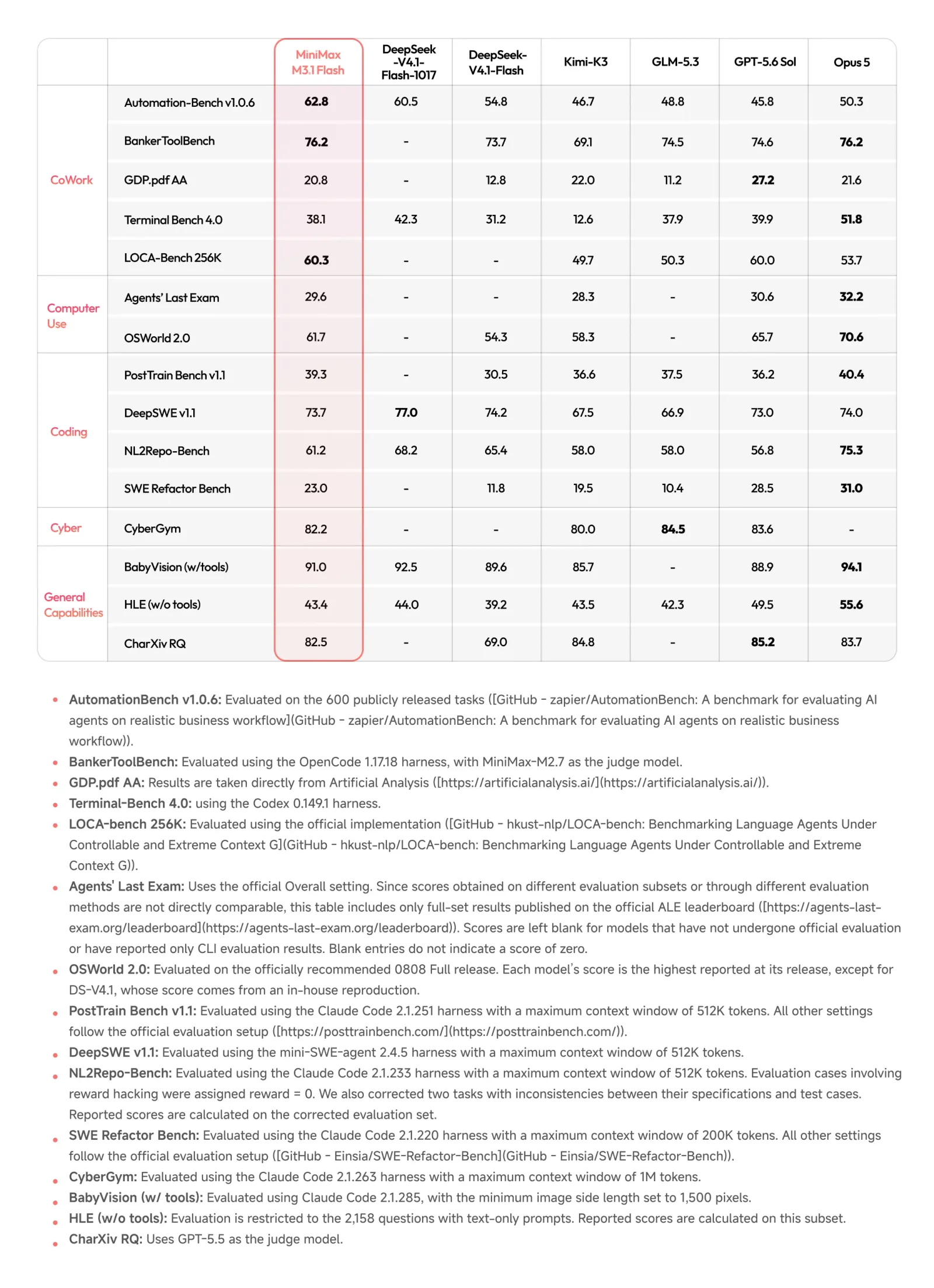
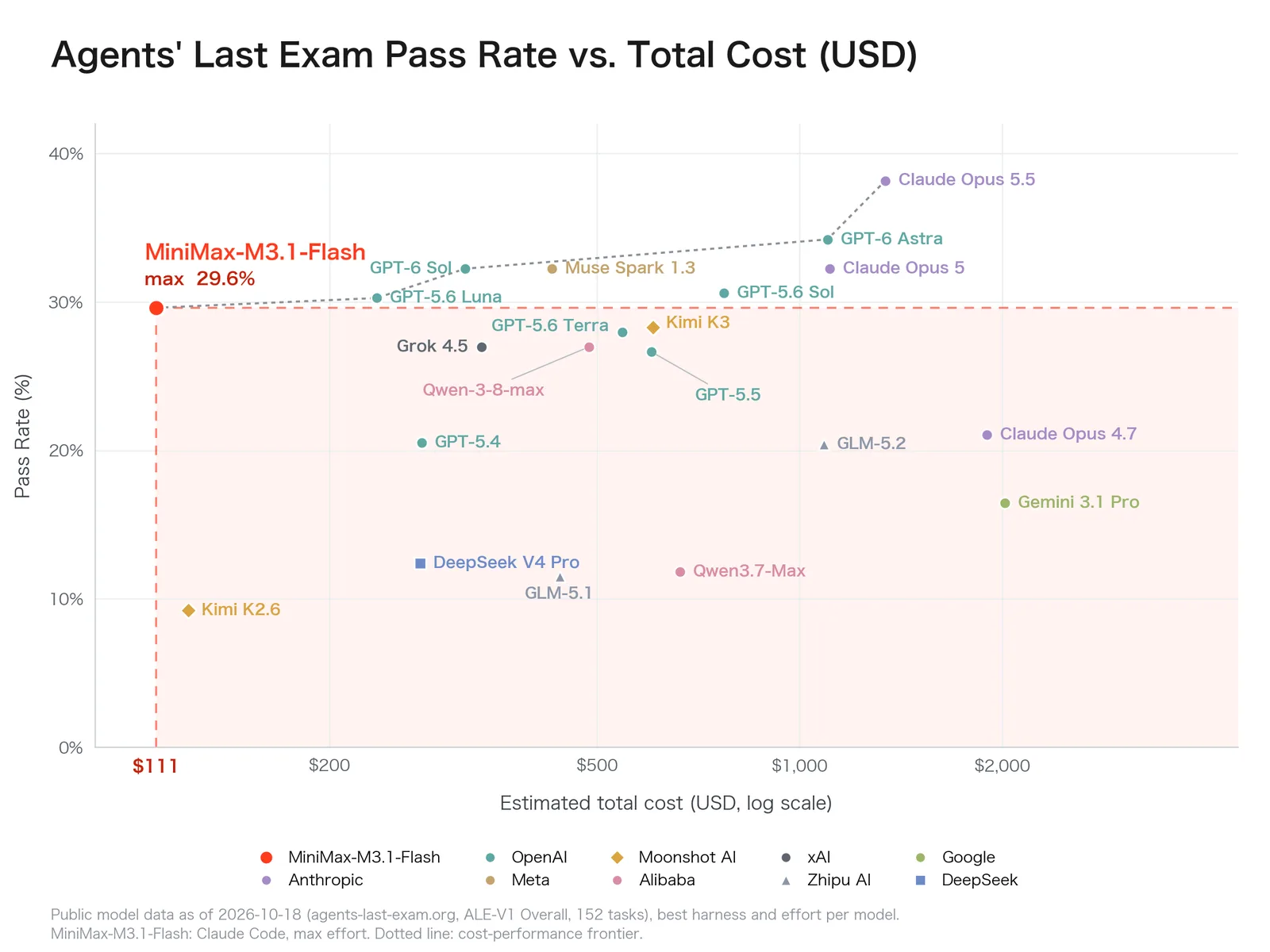
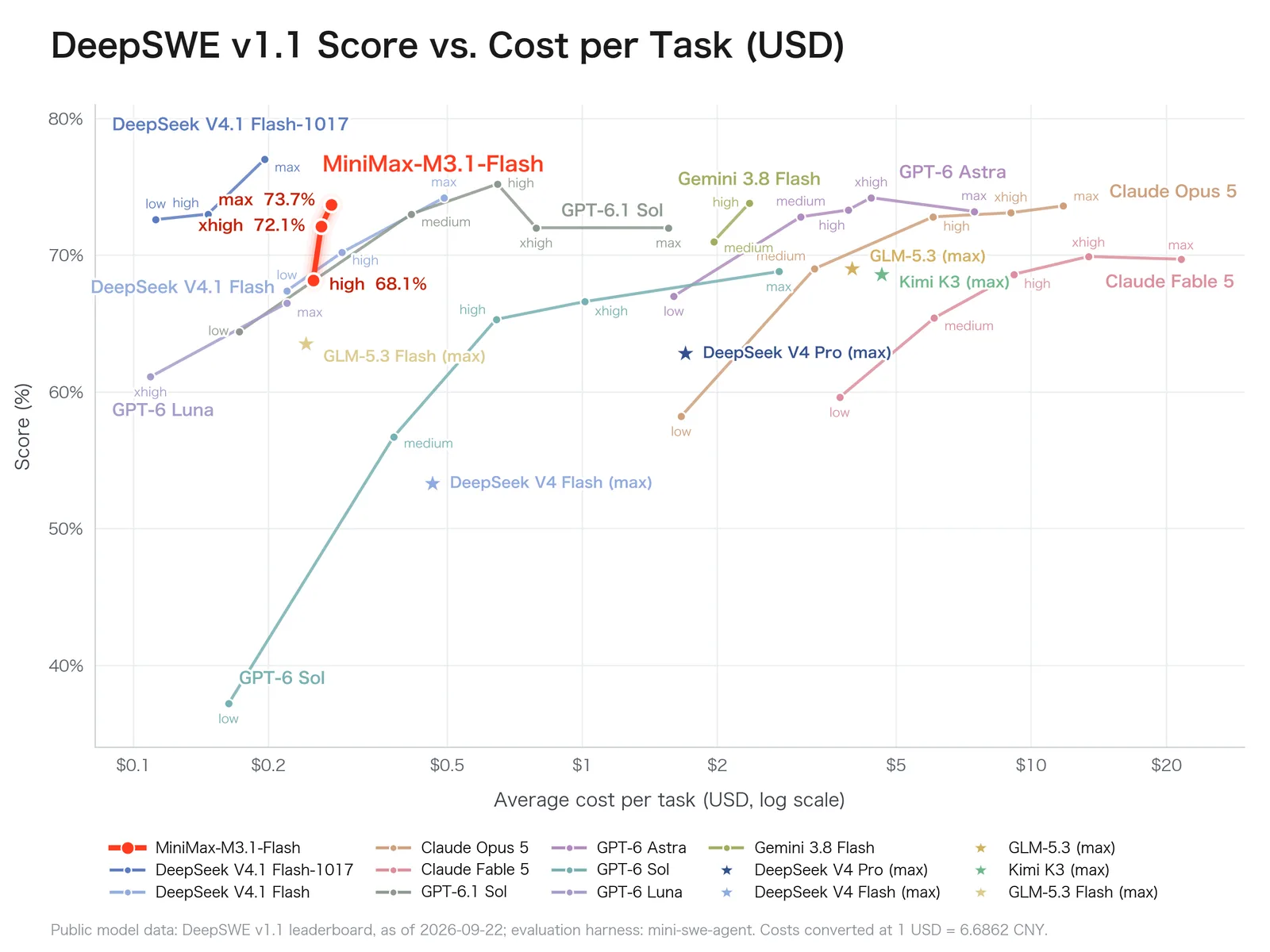
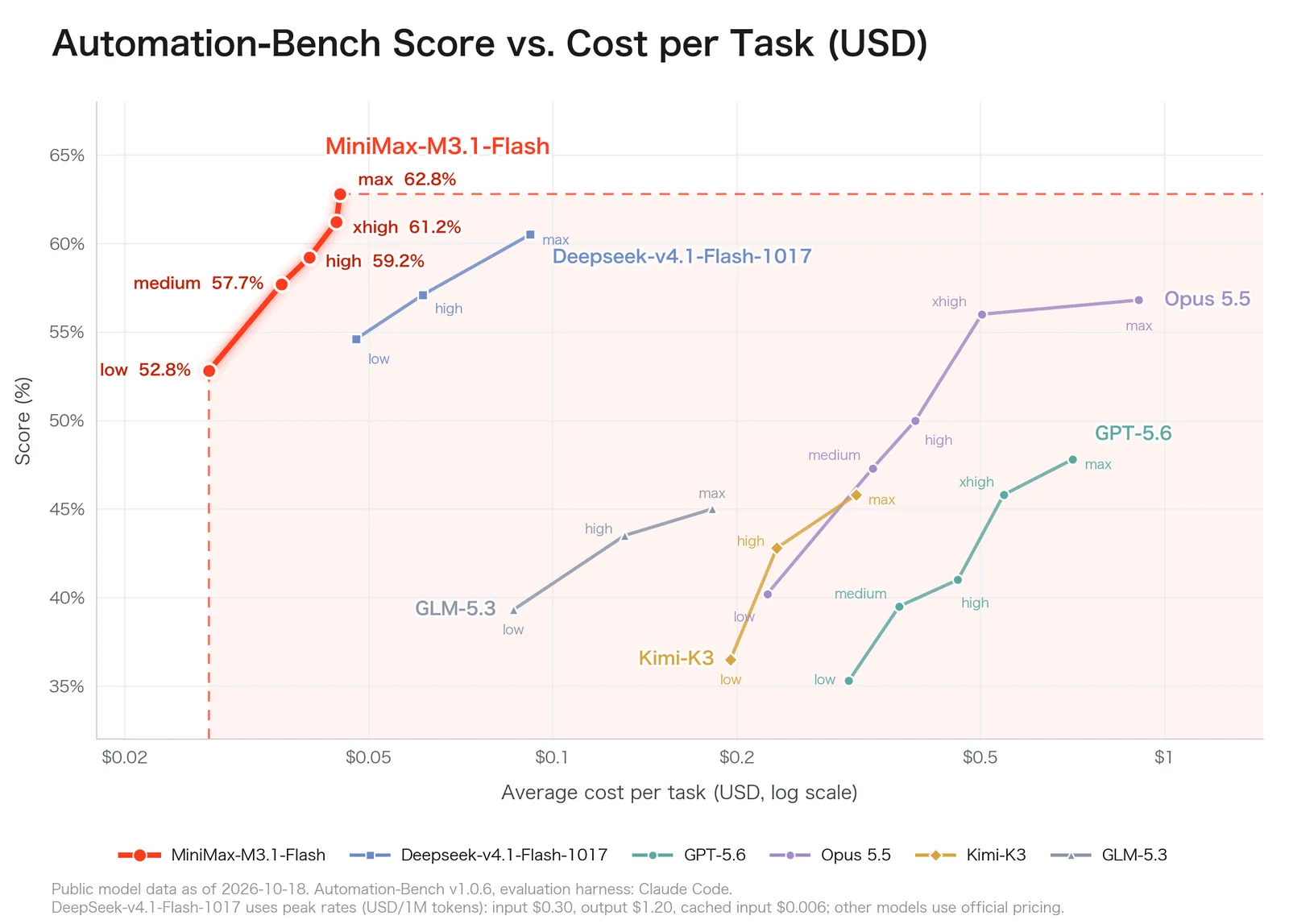
MiniMax M3.1 Flash vs peers, transcribed from the benchmark table in MiniMax's launch post. A blank cell (null) means MiniMax listed no score.
| Benchmark | MiniMax M3.1 Flash | DeepSeek V4.1 Flash 1017 | DeepSeek V4.1 Flash | Kimi K3 | GLM-5.3 | GPT-5.6 Sol | Claude Opus 5 |
|---|---|---|---|---|---|---|---|
| Automation-Bench v1.0.6 | 62.8 | 60.5 | 54.8 | 46.7 | 48.8 | 45.8 | 50.3 |
| BankerToolBench | 76.2 | — | 73.7 | 69.1 | 74.5 | 74.6 | 76.2 |
| GDP.pdf AA | 20.8 | — | 12.8 | 22 | 11.2 | 27.2 | 21.6 |
| Terminal Bench 4.0 | 38.1 | 42.3 | 31.2 | 12.6 | 37.9 | 39.9 | 51.8 |
| LOCA-Bench 256K | 60.3 | — | — | 49.7 | 50.3 | 60 | 53.7 |
| Agents' Last Exam | 29.6 | — | — | 28.3 | — | 30.6 | 32.2 |
| OSWorld 2.0 | 61.7 | — | 54.3 | 58.3 | — | 65.7 | 70.6 |
| PostTrain Bench v1.1 | 39.3 | — | 30.5 | 36.6 | 37.5 | 36.2 | 40.4 |
| DeepSWE v1.1 | 73.7 | 77 | 74.2 | 67.5 | 66.9 | 73 | 74 |
| NL2Repo-Bench | 61.2 | 68.2 | 65.4 | 58 | 58 | 56.8 | 75.3 |
| SWE Refactor Bench | 23 | — | 11.8 | 19.5 | 10.4 | 28.5 | 31 |
| CyberGym | 82.2 | — | — | 80 | 84.5 | 83.6 | — |
| BabyVision (w/ tools) | 91 | 92.5 | 89.6 | 85.7 | — | 88.9 | 94.1 |
| HLE (w/o tools) | 43.4 | 44 | 39.2 | 43.5 | 42.3 | 49.5 | 55.6 |
| CharXiv RQ | 82.5 | — | 69 | 84.8 | — | 85.2 | 83.7 |
This model's scores
- BankerToolBench76.2%
- DeepSWE v1.173.7%
- Automation-Bench v1.0.662.8%
- OSWorld 2.061.7%
- Agents' Last Exam29.6%
Scores on a 0–100 scale (25-point gridlines); higher is better. Each benchmark links to its published source.
Pricing
| Input | $0.15 / 1M tokens |
|---|---|
| Output | $0.60 / 1M tokens |
Cached input is $0.015 per million tokens.
Strengths
- 200+ output tokens per second in everyday use, with a 170+ median, per MiniMax
- Low published price: $0.15 input, $0.60 output and $0.015 cached input per million tokens
- 1M-token context window and tunable thinking depth
- Top score in MiniMax's comparison table on Automation-Bench v1.0.6 (62.8) and LOCA-Bench 256K (60.3)
- 29.6% on Agents' Last Exam at an estimated total cost of $111 in MiniMax's cost chart
Best for
- High-volume coding agents where cost per task matters more than a top leaderboard score
- Business workflow automation, the area where MiniMax's table shows its best scores
- Computer-use agents on a budget
- Long-context work across codebases and documents with the 1M-token window
How to access
| Provider | Model ID |
|---|---|
| MiniMax API ↗ | MiniMax-M3.1-Flash |
MiniMax M-Series — every version
The full lineage of the MiniMax M-Series line, newest first. Every version has its own page — click any to compare specs, benchmarks and pricing.
| Version | Released | Context | License |
|---|---|---|---|
| MiniMax M3.1 Flashcurrent | 2026-10-19 | 1M | Proprietary |
| MiniMax M3.1-Flash-Preview | 2026-09-28 | 1M | Proprietary |
| MiniMax M3 | 2026-06-01 | 1M | MiniMax Community |
| MiniMax M2.7 / M2.7-highspeed | 2026-03-18 | — | Open weights |
| MiniMax M2.5 / M2.5-Lightning | 2026-02-12 | — | Open weights |
| MiniMax M2.1 | 2025-12-23 | — | Open weights |
| MiniMax M2 | 2025-10-27 | — | MIT |
FAQ
How much does MiniMax M3.1 Flash cost?
$0.15 per million input tokens, $0.60 per million output tokens and $0.015 per million cached input tokens. MiniMax also says agentic tasks cost 70% less than with the model's predecessor.
Are MiniMax M3.1 Flash's weights available?
Not at launch. MiniMax's announcement says the model weights will be released later. At release the model is served through the MiniMax API, the M Plan subscription and MiniMax Code.
How is it different from MiniMax M3.1-Flash-Preview?
The preview, which debuted on September 28, 2026, was available only through the M Plan and MiniMax Code. The October 19 release adds the pay-as-you-go API with published prices, and MiniMax says online inference is nearly three times faster.
How fast is MiniMax M3.1 Flash?
MiniMax reports 200+ output tokens per second in everyday use, with a median (P50) of 170+ tokens per second.