
Overview
Nanbeige4.3-33B is an open-weight language model from Nanbeige LLM Lab, published on Hugging Face on October 24, 2026 under the Apache 2.0 license together with its base checkpoint, Nanbeige4.3-33B-Base. The lab describes it as the flagship teacher model of the Nanbeige4.3 series: a high-capacity agent model built first so that its agentic skills can later be distilled into smaller models, with Nanbeige4.3-3B named as the next step. It is aimed at complex coding and what the lab calls professional cowork tasks — multi-step office, planning and tool-use work.
It is a dense model, not a mixture of experts. Its configuration uses the Llama architecture with 52 layers, a hidden size of 7,168 and grouped-query attention (56 query heads, 8 key-value heads), for about 33.1B parameters in BF16. The model card documents a context length of up to 524,288 tokens (512K). The chat template has a thinking mode that is on by default, a `preserve_thinking` switch that keeps reasoning from earlier turns (recommended for multi-turn tool use, office tasks and code agents), and a tool-use template where the lab recommends an XML tool-call format, with JSON also supported.
The model card compares it with three open models of around 30B parameters — Qwen3.8-27B, Muse-Glimmer-30B and Gemma4-31B — all run at their highest thinking effort with the same harness and settings. Nanbeige4.3-33B scores 80.9 on Terminal-Bench 2.1 against 73.0 for Qwen3.8-27B, 65.5 on DeepSWE against 42.5, and 23.8 on Terminal-Bench 4.0 against 6.3. Qwen3.8-27B stays ahead on SWE-Bench Pro (61.7 to 60.3) and GDPval (86.4 to 84.8), and Gemma4-31B leads on GPQA Diamond (91.3 to 89.5). On the YC-bench business simulation it ends with $1,025,437 against $641,290 for Qwen3.8-27B. All of these are the lab's own measurements.
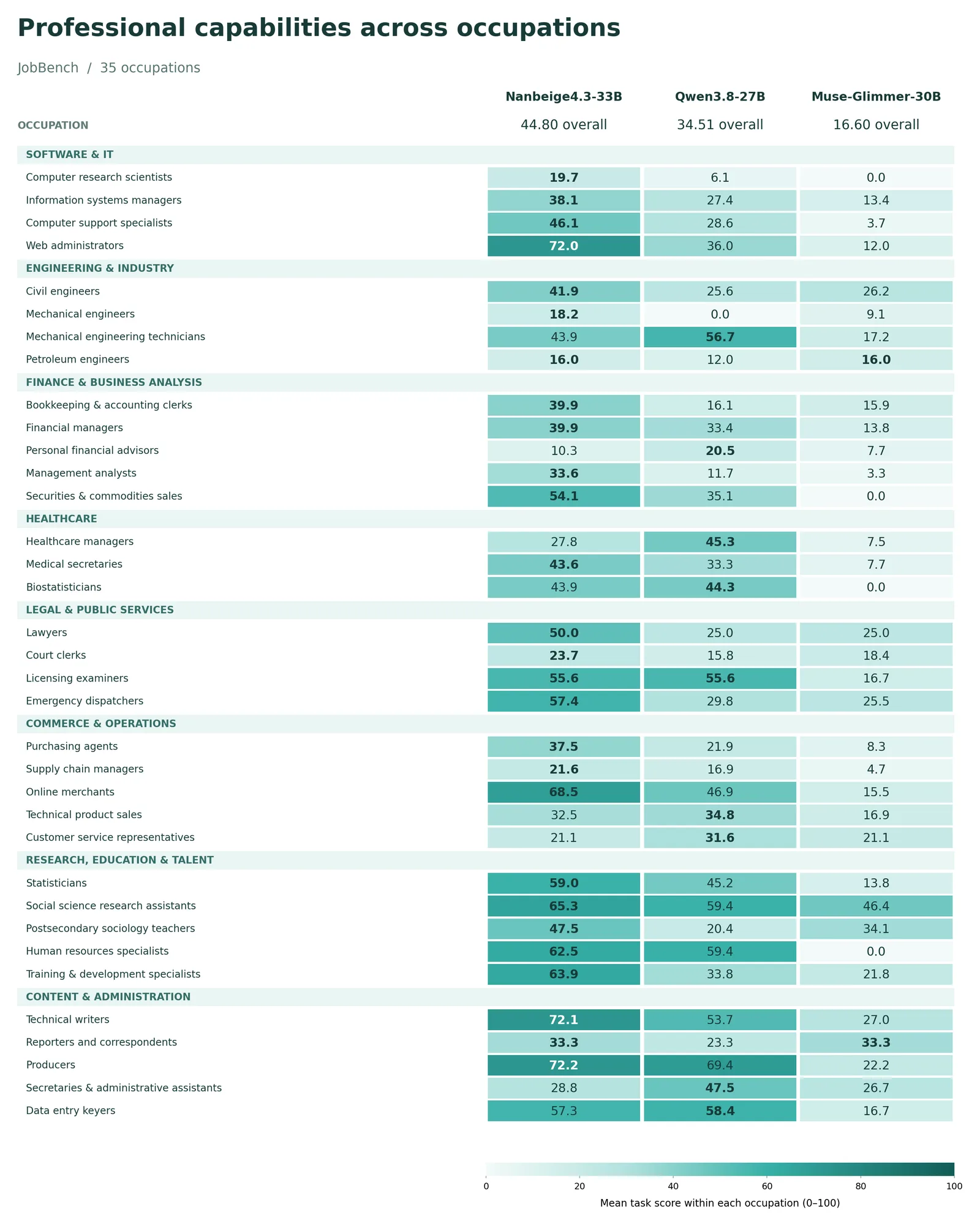
The lab also breaks down JobBench, a set of agent tasks drawn from 35 occupations: Nanbeige4.3-33B averages 44.80 overall against 34.51 for Qwen3.8-27B and 16.60 for Muse-Glimmer-30B, and its highest per-occupation scores are for technical writers, producers and web administrators. The weights run with Hugging Face Transformers (with `trust_remote_code`), SGLang and vLLM; the card's serving examples use four-way tensor parallelism and the qwen3 reasoning and qwen3_coder tool-call parsers.
| Released | 2026-10-24 |
|---|---|
| License | Apache 2.0 |
| Weights | Open weights |
| Parameters | 33.1B (dense) |
| Context | 512K |
| Architecture | Dense decoder-only Transformer in the Llama layout: 52 layers, hidden size 7,168, 56 attention heads with 8 key-value heads (grouped-query attention), 166,912-token vocabulary |
| Modalities | Text |
| Status | Open weights on Hugging Face (instruct and base checkpoints) |
Benchmarks
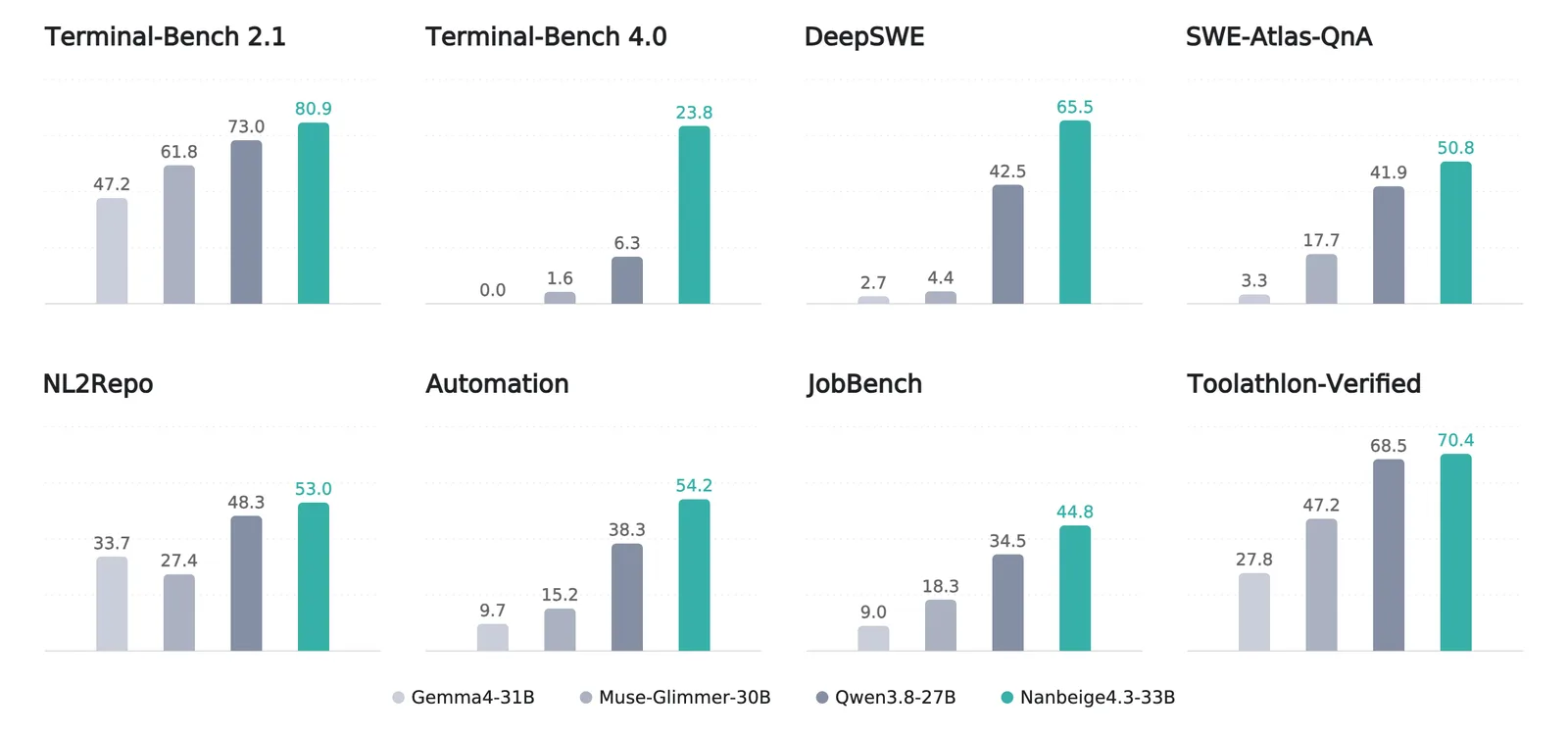
Nanbeige LLM Lab's published comparison with ~30B open models, all at their highest thinking effort with the same harness and settings (table values; the card's bar chart differs in two cells)
| Benchmark | Nanbeige4.3-33B | Qwen3.8-27B | Muse-Glimmer-30B | Gemma4-31B |
|---|---|---|---|---|
| Terminal-Bench 2.1 | 80.9 | 73 | 61.8 | 47.2 |
| Terminal-Bench 4.0 | 23.8 | 6.3 | 1.6 | 0 |
| DeepSWE | 65.5 | 42.5 | 4.4 | 2.7 |
| SWE-Bench Pro | 60.3 | 61.7 | 36.9 | 51.2 |
| SWE-Atlas-QnA | 50.8 | 41.9 | 17.7 | 3.3 |
| NL2Repo | 53 | 48.3 | 27.4 | 33.8 |
| SciCode | 52.6 | 46.7 | 44.9 | 45.5 |
| SkillsBench | 61.1 | 56.4 | 39.7 | 28.9 |
| Automation Bench | 54.2 | 38.3 | 15.2 | 9.7 |
| JobBench | 44.8 | 34.5 | 16.6 | 9 |
| GDPval | 84.8 | 86.4 | 75.8 | 71.4 |
| Claw-Eval (pass^3) | 78.3 | 75.2 | 57.3 | 44.2 |
| Toolathlon-Verified | 70.4 | 68.5 | 47.2 | 27.8 |
| DeepPlanning | 63.3 | 49.2 | 21.4 | 19.4 |
| EnterpriseOps-Gym | 41 | 40.2 | 30.5 | 27.3 |
| Tau3-Bench | 48.8 | 48.5 | 33.7 | 18.6 |
| GPQA Diamond | 89.5 | 89.2 | 83.5 | 91.3 |
| AIME 2026 | 95.2 | 94.5 | 94.7 | 89.2 |
| AA-LCR | 84 | 82 | 83.3 | 72 |
This model's scores
- AIME 202695.2%
- GPQA Diamond89.5%
- GDPval84.8%
- AA-LCR84%
- Terminal-Bench 2.180.9%
- Toolathlon-Verified70.4%
- DeepSWE65.5%
- SWE-Bench Pro60.3%
Scores on a 0–100 scale (25-point gridlines); higher is better. Each benchmark links to its published source.
Strengths
- 80.9 on Terminal-Bench 2.1 in the lab's tests, ahead of Qwen3.8-27B (73.0), Muse-Glimmer-30B (61.8) and Gemma4-31B (47.2)
- Large margins on long agentic tasks: 65.5 on DeepSWE, 54.2 on Automation Bench and 63.3 on DeepPlanning
- A 512K-token context with a thinking mode and an option to keep earlier reasoning across tool-use turns
- Dense 33B weights under Apache 2.0, with a base checkpoint released alongside the instruct model
- Serves in vLLM and SGLang with existing qwen3 reasoning and qwen3_coder tool-call parsers
Best for
- Self-hosted coding agents for terminal work, bug fixing and repository-scale tasks
- Office and business automation agents that plan, call tools and work across many turns
- A teacher model for distilling agentic behaviour into smaller models, the role the lab built it for
- Fine-tuning from the released Nanbeige4.3-33B-Base checkpoint
FAQ
Is Nanbeige4.3-33B a mixture-of-experts model?
No. It is a dense model of about 33.1B parameters in the Llama architecture: 52 layers, a hidden size of 7,168 and grouped-query attention with 56 query heads and 8 key-value heads.
Can I use Nanbeige4.3-33B commercially?
The weights are released under the Apache 2.0 license, which allows commercial use, modification and redistribution.
How long is the context window?
The model card documents a context length of up to 524,288 tokens (512K). For reasoning and chat it recommends up to 262,144 new tokens per response, and 65,536 for agentic and tool-use tasks.
How do I run Nanbeige4.3-33B?
Load `Nanbeige/Nanbeige4.3-33B` with Hugging Face Transformers (with `trust_remote_code=True`), or serve it with vLLM or SGLang. The card's server examples use tensor parallelism across four GPUs and the qwen3 reasoning and qwen3_coder tool-call parsers.
What does preserve_thinking do?
It keeps the reasoning from earlier assistant turns in a multi-turn conversation. The lab recommends turning it off for general chat and question answering and on for multi-turn tool use, office tasks and code-agent workflows; its benchmark scores were measured with it on.