Overview
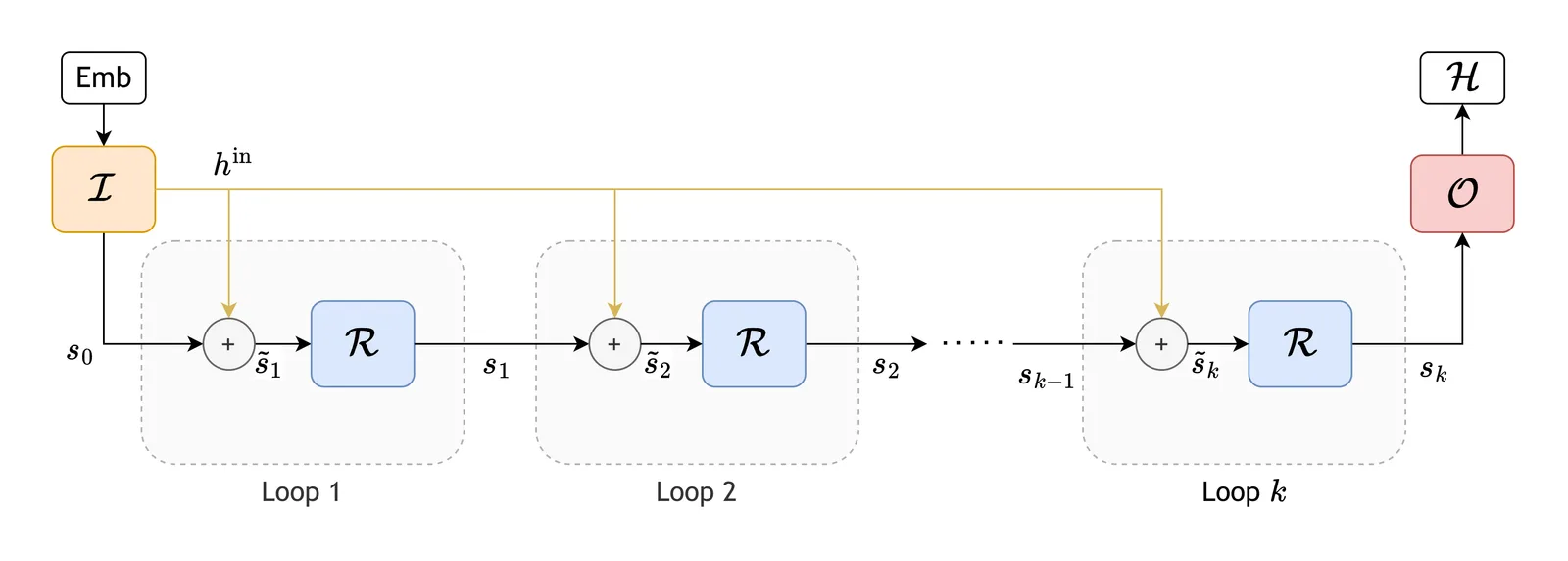
Nemotron Labs Dory 1.0 4B is a small language model NVIDIA released on 16 October 2026 under its Nemotron Labs name. Its distinguishing idea is looping: the 36-layer stack is split into an 8-layer input block, a 20-layer recurrent block and an 8-layer output block, and the recurrent block is applied several times per token with the input re-injected on every pass. More loops mean more compute spent per token without adding parameters, so the same 4B checkpoint can run at one, two or four loops with no retraining or model swap.
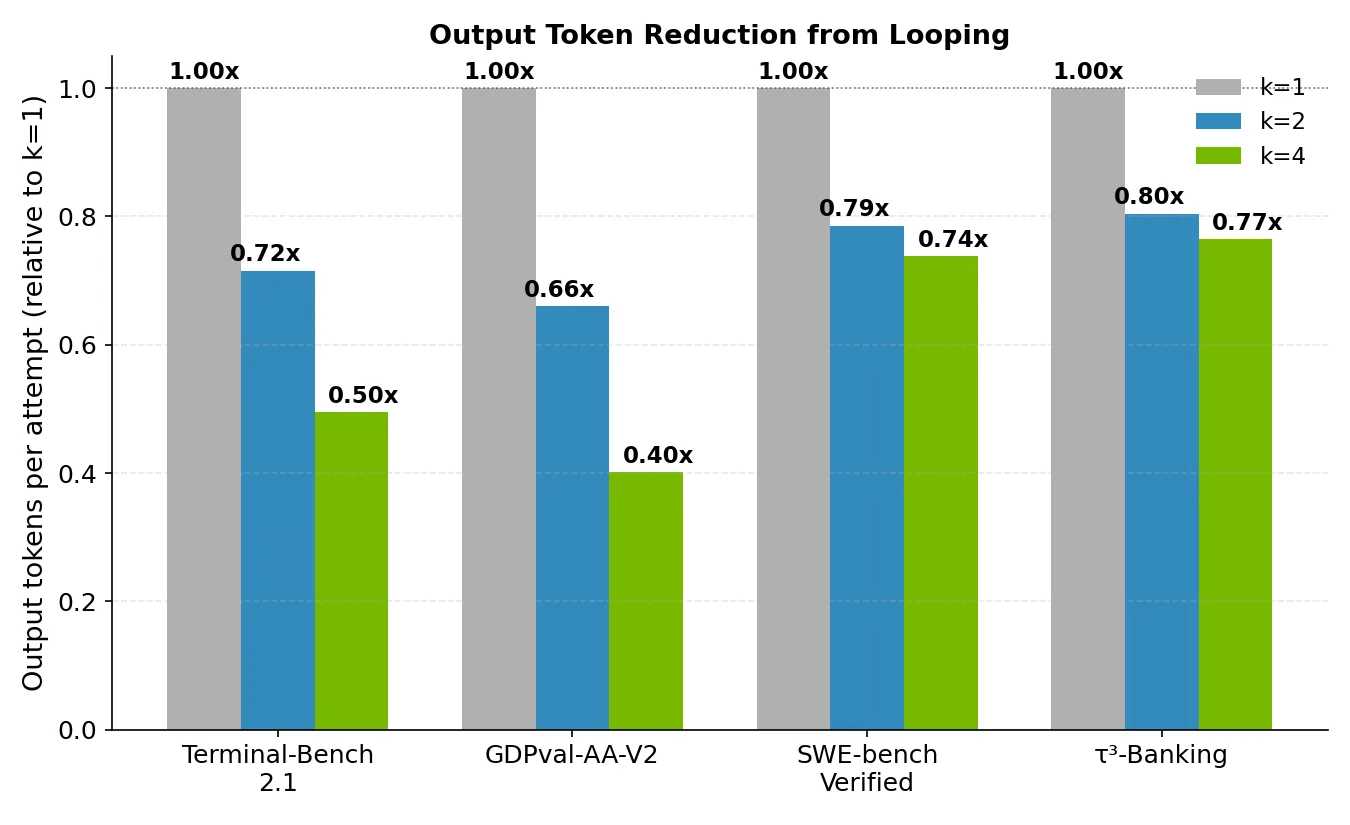
NVIDIA recommends two loops as the default, one loop when compute per token matters most, and four loops for extra accuracy on agentic tasks such as Terminal-Bench and SWE-bench. The model card reports that looping also shortens answers: at four loops Dory generates about half as many output tokens on Terminal-Bench 2.1 and 0.40× as many on GDPval-AA-V2 as at one loop. A last-loop KV-cache mode keeps one cache per recurrent attention layer, so memory stays at the one-loop size whatever the loop count, with accuracy NVIDIA describes as close to the per-loop mode.
Dory is built on a normalized-GPT (nGPT) backbone and was pre-trained natively in NVFP4, NVIDIA's 4-bit floating-point format, for roughly the first 4.5T of its 6T pre-training tokens before continuing in BF16. A 300B-token stage extended context to 256K tokens, followed by supervised fine-tuning and multi-environment GRPO reinforcement learning across math, code, science, instruction following, tool use, multi-turn conversation and structured output. Weights ship under the OpenMDW-1.1 license in BF16, MXFP8, NVFP4 and a Q5_K_M GGUF; at release vLLM and llama.cpp support was still in open pull requests.
In NVIDIA's own table, Dory at two loops scores 59.5 on SWE-bench Verified against 54.7 for Qwen3.5-4B and 61 for Qwen3.5-9B, and 77.94 on IFBench, ahead of all four comparison models. It trails the larger Gemma 4 26B-A4B and Qwen3.6-35B-A3B on Terminal-Bench 2.1, GPQA Diamond and Humanity's Last Exam, and scores lower than every comparison model on AA-Omniscience general knowledge.
| Released | 2026-10-16 |
|---|---|
| License | OpenMDW-1.1 |
| Weights | Open weights |
| Parameters | 4B |
| Context | 256K |
| Architecture | Looped (latent-recurrent) normalized-GPT with interleaved sliding-window and full-attention layers: 8 input layers, a 20-layer shared recurrent block applied 1–4 times, 8 output layers |
| Knowledge cutoff | September 2025 (pre-training data); May 2026 (post-training data) |
| Modalities | Text |
| Status | Generally available — open weights on Hugging Face in BF16, MXFP8, NVFP4 and GGUF (Q5_K_M) formats |
Benchmarks
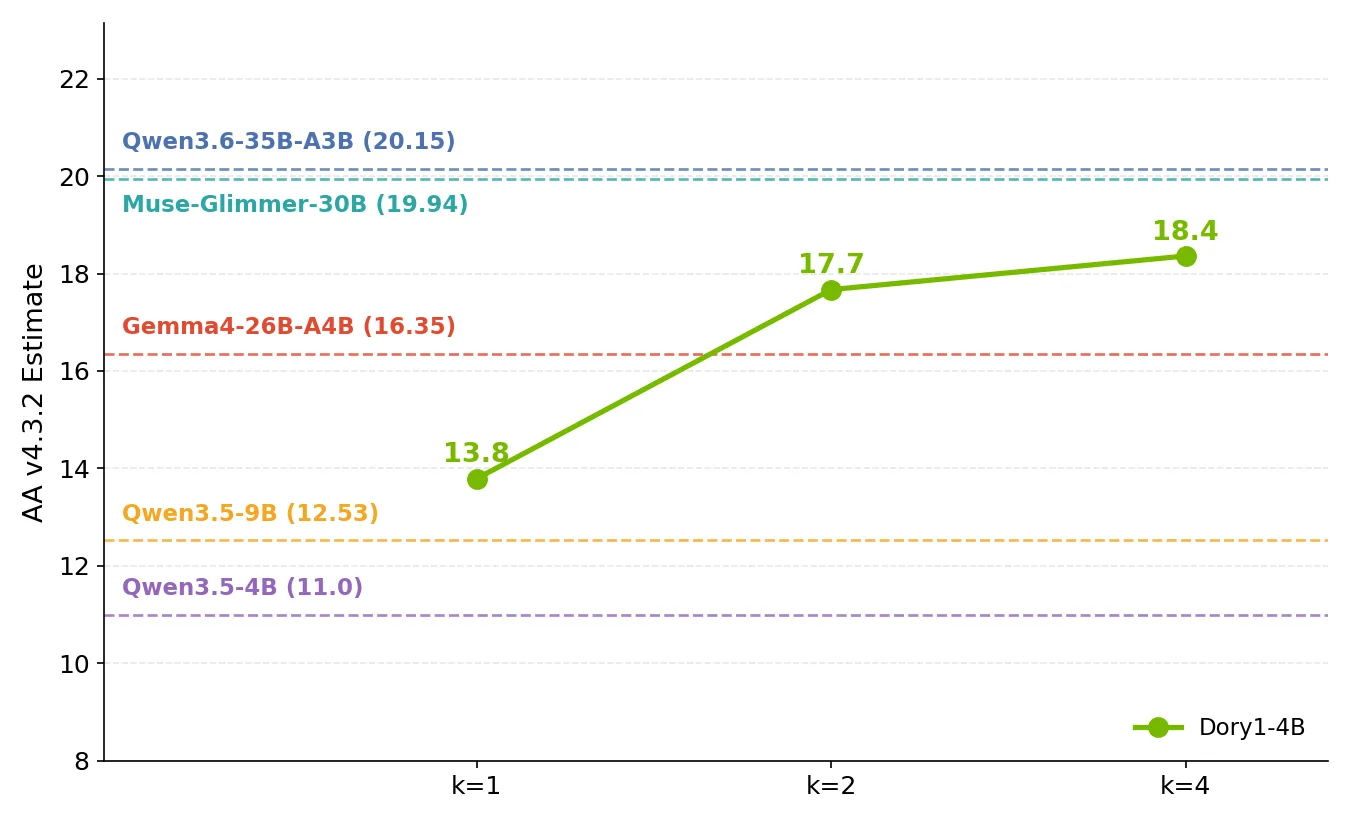
NVIDIA's published comparison from the model card (16 October 2026), measured under one harness (NeMo Gym / NeMo Evaluator SDK); † marks a reported score. GDPval-AA-V2 is an Elo rating, not a percentage.
| Benchmark | Dory 1.0 4B (1 loop) | Dory 1.0 4B (2 loops) | Dory 1.0 4B (4 loops) | Qwen3.5-4B | Qwen3.5-9B | Gemma 4 26B A4B | Qwen3.6-35B-A3B |
|---|---|---|---|---|---|---|---|
| SciCode | 27.3 | 34.94 | 35.11 | 25.82 | 28.21 | 40.32 | 37.24 |
| SWE-bench Verified | 50.3 | 59.5 | 61.8 | 54.7 | 61 | 57.4 | 73.4† |
| Terminal-Bench 2.1 | 12.5 | 18.1 | 22.2 | 15 | 24 | 35 | 43 |
| τ³-bench (Banking) | 11.6 | 12.89 | 14.69 | 5.03 | 7.22 | 13.66 | 9.54 |
| GDPval-AA-V2 | 815 Elo | 946 Elo | 967 Elo | 424 Elo | 546 Elo | 751.6 Elo | 987 Elo |
| GPQA Diamond (no tools) | 69.19 | 72.41 | 72.16 | 77.71 | 80.93 | 80.43 | 85.35 |
| HLE (text-only, no tools) | 8.25 | 10.89 | 10.43 | 11.31 | 15.43 | 17.79 | 19.18 |
| IFBench | 74.29 | 77.94 | 79 | 53.83 | 59 | 77.89 | 57.44 |
| AA-LCR | 63 | 71 | 73 | 64.7 | 68.4 | 64.6 | 68.5 |
| AA-Omniscience (accuracy) | 10.03 | 10.08 | 10.03 | 15.02 | 18.05 | 21.13 | 19.95 |
This model's scores
- IFBench (2 loops)77.94%
- GPQA Diamond (2 loops, no tools)72.41%
- AA-LCR (2 loops)71%
- SWE-bench Verified (2 loops)59.5%
- SciCode (2 loops)34.94%
- Terminal-Bench 2.1 (2 loops)18.1%
- τ³-bench Banking (2 loops)12.89%
- Humanity's Last Exam (2 loops, text-only, no tools)10.89%
Scores on a 0–100 scale (25-point gridlines); higher is better. Each benchmark links to its published source.
Strengths
- One 4B checkpoint serves three compute budgets — 1, 2 or 4 loops of the shared recurrent block — chosen at serving time
- Looping cuts generated tokens: 0.50× output tokens on Terminal-Bench 2.1 and 0.40× on GDPval-AA-V2 at four loops versus one, per NVIDIA
- Last-loop KV caching keeps the KV-cache footprint at the one-loop size for any loop count
- 77.94 on IFBench and 59.5 on SWE-bench Verified at two loops, ahead of Qwen3.5-4B on both in NVIDIA's table
- 256K-token context, validated at 256K in vLLM
- OpenMDW-1.1 open weights in BF16, MXFP8, NVFP4 and GGUF formats
Best for
- Small-footprint coding and tool-calling agents where loop count can be raised for harder tasks
- Long-context work up to 256K tokens on a single GPU or DGX Spark
- Research into looped and latent-reasoning architectures from a released, trained checkpoint
- Local inference on Apple Silicon through the GGUF export and the Dory-enabled llama.cpp branch
How to access
| Provider | Model ID |
|---|---|
| Hugging Face (weights) ↗ | nvidia/NVIDIA-Nemotron-Labs-Dory1.0-4B-BF16 |
| Hugging Face (GGUF) ↗ | nvidia/NVIDIA-Nemotron-Labs-Dory1.0-4B-GGUF |
FAQ
What is a looped language model?
Instead of passing each token once through a fixed stack of layers, a looped model reapplies a shared block of layers several times. In Dory the 20-layer recurrent block sits between 8 input and 8 output layers and can run one to four times, with the input re-injected each loop, so the model spends more compute per token without more parameters.
How many loops should I use?
NVIDIA recommends two loops as the default, one loop to minimise compute per token, and four loops when accuracy matters more, especially on agentic tasks like Terminal-Bench and SWE-bench. The loop count is set with n_recurrent_loops in vLLM's --hf-overrides.
Does looping multiply memory use?
Not with last-loop KV caching. The default per-loop mode stores a KV cache for every loop, but setting recurrent_kv_cache_mode to last_loop keeps one cache per recurrent attention layer, so the cache stays at the one-loop size for any loop count.
How does it compare with Qwen3.5-4B?
In NVIDIA's table Dory at two loops beats Qwen3.5-4B on SWE-bench Verified (59.5 vs 54.7), Terminal-Bench 2.1 (18.1 vs 15), IFBench (77.94 vs 53.83) and AA-LCR (71 vs 64.7), but scores lower on GPQA Diamond (72.41 vs 77.71), Humanity's Last Exam (10.89 vs 11.31) and AA-Omniscience (10.08 vs 15.02).
What license is it under?
The OpenMDW License Agreement, version 1.1. The model card states it is ready for commercial or non-commercial use.