
Overview
Ornith-1.5-35B-A3B is the mid-size member of the Ornith-1.5 family released on 18 August 2026, sitting between the 397B flagship and the 9B dense model. It is a Mixture-of-Experts model of roughly 36 billion total parameters that routes 8 of its 256 experts per token, so about 3 billion parameters are active on any given token — the source of the "A3B" in its name. The weights are published on Hugging Face under the MIT License in bf16, alongside FP8, NVFP4, MLX and GGUF builds.
It shares the family's training recipe: an end-to-end self-improvement loop in which the model proposes its own training tasks, constructs a task-specific scaffold for each, and learns from the resulting solution rollouts by reinforcement learning, on top of a Qwen3.5 base. Native context is 262,144 tokens, extendable to roughly one million with YaRN RoPE scaling at a factor of 4.0. Ornith's quickstart serves it with vLLM ≥ 0.19.1 across two 80 GB GPUs or with SGLang ≥ 0.5.9, using the qwen3 reasoning parser and an XML or qwen3_coder tool-call parser; the GGUF build runs under Ollama and llama.cpp.
On Ornith's published evaluations the 35B model scores 79.0 on SWE-bench Verified and 68.5 on Terminal-Bench 2.1 under its better harness, ahead of Qwen3.6-35B-A3B, Gemma-4-31B and Meta's Muse-Glimmer-30B at comparable size, and ahead of the much larger Qwen3.5-397B on several coding rows (SWE-bench Verified 79.0 vs 76.4, NL2Repo 46.2 vs 36.8). It trails that larger model on breadth-of-knowledge and search rows such as HLE with tools, WideSearch and BrowseComp.
| Released | 2026-08-18 |
|---|---|
| License | MIT |
| Weights | Open weights |
| Parameters | ~36B total · ~3B active (256 experts, 8 routed per token) |
| Context | 262K (≈1M with YaRN) |
| Architecture | Mixture-of-Experts on a Qwen3.5 base, 40 layers with interleaved linear and full attention |
| Modalities | Text |
| Status | Generally available — open weights on Hugging Face |
Benchmarks
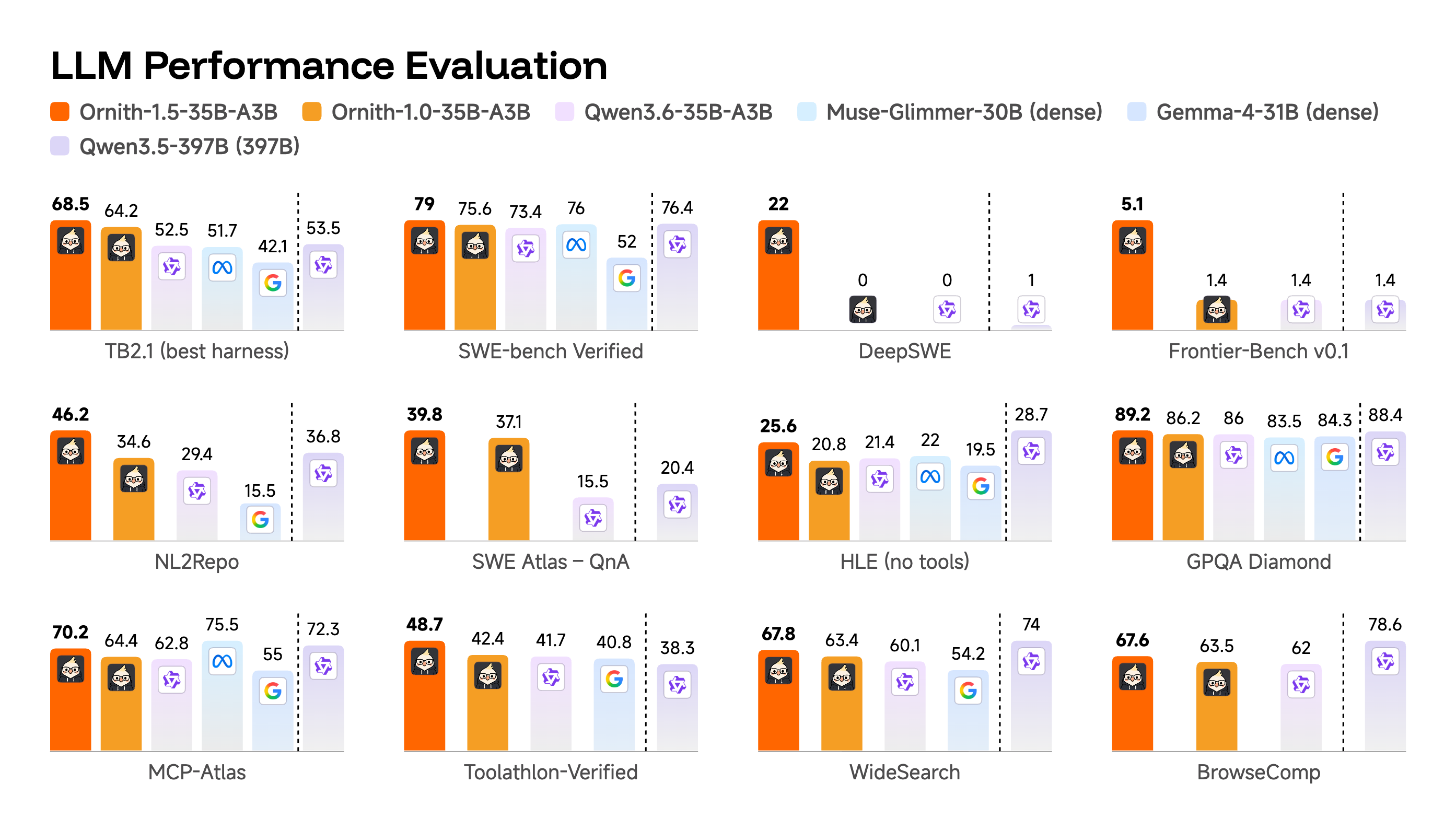
Ornith's published launch comparison for Ornith-1.5-35B-A3B (18 August 2026). A dash means the source left the cell blank.
| Benchmark | Ornith-1.5-35B-A3B | Ornith-1.0-35B-A3B | Qwen3.6-35B-A3B | Gemma-4-31B | Muse-Glimmer-30B | Qwen3.5-397B |
|---|---|---|---|---|---|---|
| Terminal-Bench 2.1 (Terminus-2) | 67.8 | 64.2 | 52.5 | 42.1 | 51.7 | 53.5 |
| Terminal-Bench 2.1 (Claude Code) | 68.5 | 62.8 | 49.2 | — | — | 48.6 |
| SWE-bench Verified | 79 | 75.6 | 73.4 | 52 | 76 | 76.4 |
| SWE-bench Pro | 59.6 | 50.4 | 49.5 | 35.7 | 51.2 | 51.6 |
| SWE-bench Multilingual | 71.4 | 69.3 | 67.2 | 51.7 | — | 69.3 |
| DeepSWE | 22 | 0 | 0 | — | — | 1 |
| Frontier-Bench v0.1 | 5.1 | 1.4 | 1.4 | — | — | 1.4 |
| NL2Repo | 46.2 | 34.6 | 29.4 | 15.5 | — | 36.8 |
| SWE Atlas – QnA | 39.8 | 37.1 | 15.5 | — | — | 20.4 |
| HLE (no tools) | 25.6 | 20.8 | 21.4 | 19.5 | 22 | 28.7 |
| HLE (with tools) | 33.4 | 30.1 | 28.9 | 26.5 | — | 48.3 |
| GPQA Diamond | 89.2 | 86.2 | 86 | 84.3 | 83.5 | 88.4 |
| MCP-Atlas | 70.2 | 64.4 | 62.8 | 55 | 75.5 | 72.3 |
| Toolathlon-Verified | 48.7 | 42.4 | 41.7 | 40.8 | — | 38.3 |
| WideSearch | 67.8 | 63.4 | 60.1 | 54.2 | — | 74 |
| BrowseComp | 67.6 | 63.5 | 62 | — | — | 78.6 |
| ClawEval | 72.5 | 69.8 | 68.7 | 48.5 | — | 70.7 |
This model's scores
- GPQA Diamond89.2%
- SWE-bench Verified79%
- ClawEval72.5%
- SWE-bench Multilingual71.4%
- MCP-Atlas70.2%
- Terminal-Bench 2.1 (Claude Code)68.5%
- WideSearch67.8%
- BrowseComp67.6%
- SWE-bench Pro59.6%
- Toolathlon-Verified48.7%
- NL2Repo46.2%
- HLE (with tools)33.4%
- HLE (no tools)25.6%
- DeepSWE22%
Scores on a 0–100 scale (25-point gridlines); higher is better. Each benchmark links to its published source.
Strengths
- MIT-licensed open weights with FP8, NVFP4, MLX and GGUF builds published on day one
- ~3B active parameters per token, so inference cost tracks a small model while quality tracks a much larger one
- SWE-bench Verified 79.0 and Terminal-Bench 2.1 68.5 on Ornith's evaluations — ahead of same-size open models and of Qwen3.5-397B on coding rows
- 262K native context, documented to extend to roughly 1M tokens with YaRN scaling
- Runs on two 80 GB GPUs under vLLM, or locally through the GGUF and MLX builds
Best for
- Self-hosted coding and terminal agents where a 397B model is too expensive to serve
- Workstation and Apple-silicon local inference through the MLX and GGUF builds
- Fine-tuning a permissively-licensed agentic base on domain-specific tool use
- High-throughput batch agent workloads where the 3B active-parameter footprint sets the cost
Ornith (open-weight) — every version
The full lineage of the Ornith (open-weight) line, newest first. Every version has its own page — click any to compare specs, benchmarks and pricing.
| Version | Released | Context | License |
|---|---|---|---|
| Ornith-1.5-397Bcurrent | 2026-08-18 | 262K | MIT |
| Ornith-1.5-35B-A3B | 2026-08-18 | 262K | MIT |
| Ornith-1.5-9B | 2026-08-18 | 262K | MIT |
FAQ
What does "A3B" mean in Ornith-1.5-35B-A3B?
It is the number of ACTIVE parameters per token. The model holds 256 experts and routes 8 of them for each token, so roughly 3 billion of its ~36 billion parameters do work on any given token. That is what keeps inference cost close to a small dense model.
Is Ornith-1.5-35B-A3B open source?
Yes — the weights are on Hugging Face under the MIT License, free for commercial use, fine-tuning and self-hosting. Ornith also publishes FP8, NVFP4, MLX and GGUF builds of the same checkpoint.
What hardware does it need?
Ornith's quickstart serves the bf16 weights with vLLM ≥ 0.19.1 across two 80 GB GPUs at a 262,144-token context, or with SGLang ≥ 0.5.9. The GGUF build runs under Ollama and llama.cpp, and MLX builds down to 4-bit are published for Apple silicon.
How does it compare with other ~30B open models?
On Ornith's own evaluations it leads Qwen3.6-35B-A3B, Gemma-4-31B and Meta's Muse-Glimmer-30B on SWE-bench Verified (79.0 vs 73.4 / 52.0 / 76.0), Terminal-Bench 2.1 (67.8 vs 52.5 / 42.1 / 51.7) and GPQA Diamond (89.2 vs 86.0 / 84.3 / 83.5). Muse-Glimmer-30B leads it on MCP-Atlas (75.5 vs 70.2).