Overview
Raon-1 mini preview is a language model designed and trained from scratch by KRAFTON AI, the research unit of the Seoul-based game developer KRAFTON. Its open weights were published on Hugging Face on October 21, 2026 under the Apache 2.0 license; the repositories are gated, and access is granted on request. KRAFTON calls it a preview release, not a final model, and says specs and results may change before the final version. The model card highlights Korean conversation and agentic tasks, and lists training languages of Korean, English, Japanese, Chinese, Spanish, French and Thai.
It is a sparse mixture-of-experts model of 28.8B total parameters, of which 4.3B are active per token (6 of 128 routed experts plus a shared expert), sized as 30B-A4B. Attention is hybrid: 18 of its 25 layers use Raon Delta Attention, a linear-attention variant that decouples the erase and write gates of Kimi Delta Attention and keeps a fixed-size state, and only the 7 gated MLA layers keep a KV cache, about 8 KiB per token in BF16. It uses no positional encoding, Raon-mHC (a cheaper version of DeepSeek's manifold-constrained hyper-connections) for its residual stream, a 259,840-token vocabulary and a native context of 262,144 tokens. Thinking is built in and intended to stay on.
KRAFTON compares it with two MoE models of similar active size, Qwen3.6-35B-A3B and Gemma 4 26B-A4B, and two dense models, Qwen3.8-27B and Muse Glimmer 30B. It scores 70.8 on SWE-bench Verified (with mini-SWE-agent) against 63.2 and 61.6 for the two MoE models, 84.2 on IFBench and 55.7 on BrowseComp Plus, and posts the only clearly positive AA-Omniscience score in the table (3.5). The dense Qwen3.8-27B leads it on most coding, reasoning and long-context rows, and on MMLU Pro (76.5) and Terminal-Bench Lite (47.0) it trails all four comparison models. On KRAFTON's internal Korean chatbot benchmark it scores 92.9, the highest in the table.
The release includes NVFP4 weights for a single 32 GB NVIDIA RTX 5090, an MXFP8 checkpoint, MLX and GGUF builds, and a DFlash2 draft model for speculative decoding that KRAFTON measured at up to 2.18× higher output throughput on one NVIDIA B300. It runs with Hugging Face Transformers (with `trust_remote_code`), KRAFTON's forks of vLLM and llama.cpp (upstream support was pending at release) and mlx-lm, and connects to Hermes Agent, Pi and OpenCode through an OpenAI-compatible endpoint. The Apache 2.0 license covers the weights only; KRAFTON's hosted API and playground run under separate terms.
| Released | 2026-10-21 |
|---|---|
| License | Apache 2.0 |
| Weights | Open weights |
| Parameters | 28.8B total · 4.3B active |
| Context | 262K |
| Architecture | Hybrid mixture-of-experts Transformer: 25 layers, 18 Raon Delta Attention (linear attention, fixed-size state) and 7 gated MLA full-attention layers, no positional encoding, 128 routed experts with 6 selected per token plus 1 shared expert, Raon-mHC residual connections with 4 streams |
| Modalities | Text |
| Status | Preview — open weights on Hugging Face (gated, access granted on request), plus a free-for-a-limited-time playground |
Benchmarks
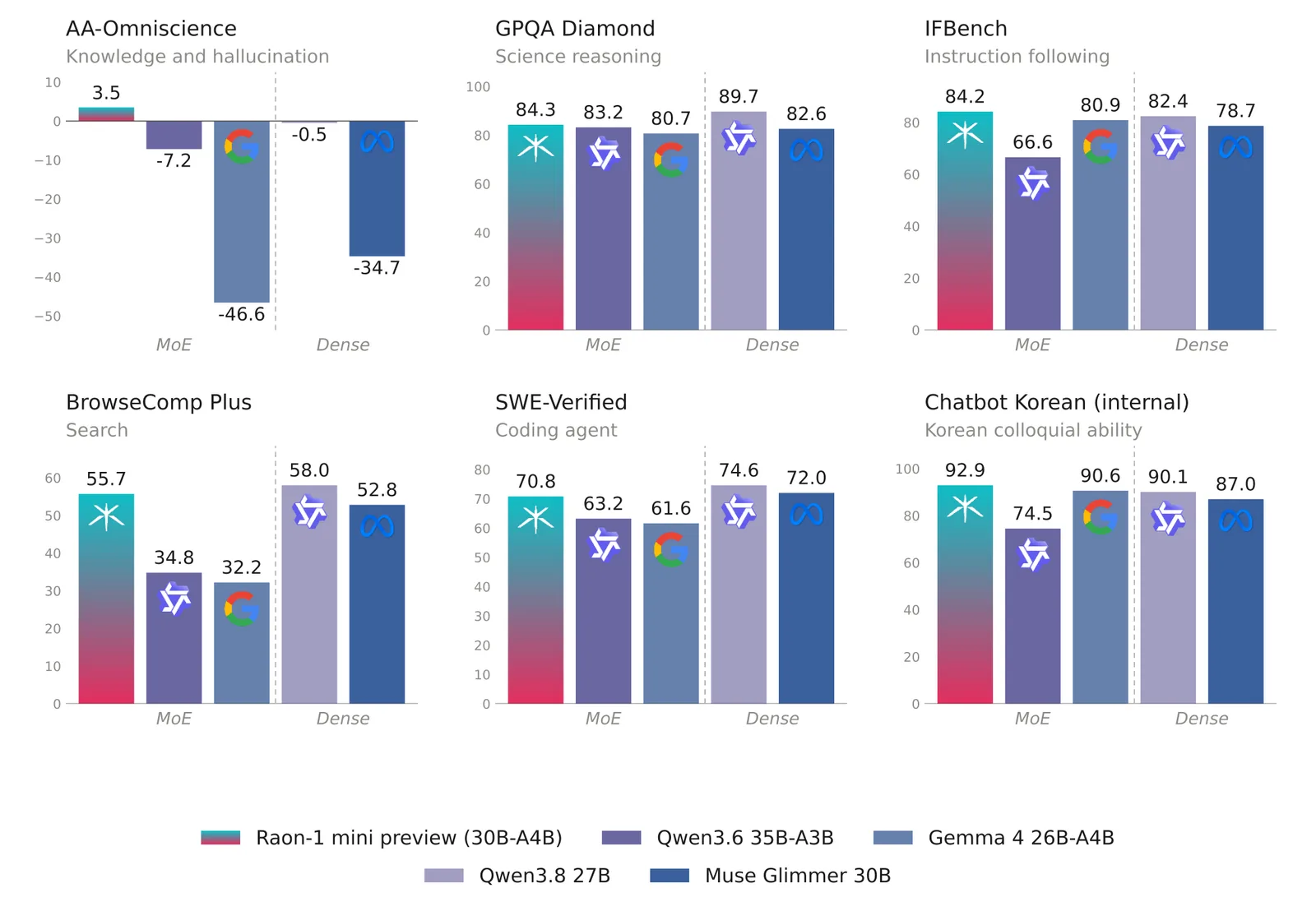
KRAFTON's published comparison with MoE (Qwen3.6-35B-A3B, Gemma 4 26B-A4B) and dense (Qwen3.8-27B, Muse Glimmer 30B) models; SWE-Verified uses mini-SWE-agent, GDPVal is a judge score (not Elo), AutomationBench uses the public split, and Chatbot Korean is an unreleased internal benchmark
| Benchmark | Raon-1 mini preview | Qwen3.6-35B-A3B | Gemma 4 26B-A4B | Qwen3.8-27B | Muse Glimmer 30B |
|---|---|---|---|---|---|
| MMLU Pro | 76.5 | 85.9 | 82.9 | 85.7 | 84 |
| AA-Omniscience | 3.5 | -7.2 | -46.6 | -0.5 | -34.7 |
| GPQA Diamond | 84.3 | 83.2 | 80.7 | 89.7 | 82.6 |
| AIME 2026 | 93.3 | 92.9 | 87.1 | 98.8 | 92.9 |
| HMMT Feb 2026 | 84.1 | 84.5 | 79.9 | 95.8 | 74.6 |
| IFBench | 84.2 | 66.6 | 80.9 | 82.4 | 78.7 |
| MultiChallenge | 59 | 58.2 | 58.4 | 63.6 | 63.4 |
| LiveCodeBench v6 | 81.6 | 81.2 | 83.4 | 79.3 | 77.4 |
| SciCode | 38.7 | 35.6 | 39.6 | 44.6 | 43.6 |
| SWE-Verified | 70.8 | 63.2 | 61.6 | 74.6 | 72 |
| Terminal-Bench Lite | 47 | 63.3 | 52 | 67 | 70.7 |
| GDPVal | 66 | 67.4 | 57.5 | 63.5 | 67.3 |
| AutomationBench | 29.7 | 24.9 | 36.2 | 58.7 | 32.1 |
| BrowseComp Plus | 55.7 | 34.8 | 32.2 | 58 | 52.8 |
| BFCL v4 Overall | 59.8 | 64.7 | 65.8 | 72.4 | 51.8 |
| AA-LCR | 67.3 | 69.3 | 67 | 80.3 | 81.3 |
| GDP.pdf | 5.8 | 6.6 | 3.6 | 11.2 | 8.4 |
| Chatbot Korean (internal) | 92.9 | 74.5 | 90.6 | 90.1 | 87 |
This model's scores
- AIME 202693.3%
- Chatbot Korean (internal)92.9%
- GPQA Diamond84.3%
- IFBench84.2%
- LiveCodeBench v681.6%
- MMLU Pro76.5%
- SWE-bench Verified70.8%
- BrowseComp Plus55.7%
Scores on a 0–100 scale (25-point gridlines); higher is better. Each benchmark links to its published source.
Strengths
- 70.8 on SWE-bench Verified in KRAFTON's tests, ahead of Qwen3.6-35B-A3B (63.2) and Gemma 4 26B-A4B (61.6)
- Strong instruction following: 84.2 on IFBench, the highest score in KRAFTON's comparison table
- Only 7 of 25 layers keep a KV cache, which keeps long-context memory low across its 262K-token window
- 92.9 on KRAFTON's internal Korean colloquial-chat benchmark, the top score in the table
- NVFP4, MXFP8, MLX and GGUF builds plus a DFlash2 speculative-decoding draft model released alongside the weights
Best for
- Korean-language chat assistants and multilingual agents across Korean, English, Japanese and other trained languages
- Self-hosted coding agents with Hermes Agent, Pi or OpenCode over an OpenAI-compatible local endpoint
- Running a 30B-class model on a single 32 GB RTX 5090 with the NVFP4 checkpoint, or on Apple silicon with MLX
- Research on hybrid linear-attention and mixture-of-experts architectures under a permissive license
FAQ
What does 30B-A4B mean for Raon-1 mini?
The model has 28.8B parameters in total, but each token is routed to 6 of 128 experts plus one shared expert, so only about 4.3B parameters are active per token. KRAFTON rounds that to the 30B-A4B size label.
Is Raon-1 mini preview open source?
The weights are released under the Apache 2.0 license, but the Hugging Face repositories are gated: you request access once on the model page and then log in with `hf auth login`. The license does not cover KRAFTON's training data, methods, hosted API or playground.
Can Raon-1 mini run on one consumer GPU?
Yes, with the NVFP4 checkpoint: KRAFTON says it enables inference on a single NVIDIA RTX 5090 with 32 GB of VRAM. MLX and GGUF builds are also published for Apple silicon and llama.cpp.
How do I serve Raon-1 mini?
At release, vLLM and llama.cpp support came from KRAFTON's own forks (github.com/krafton-ai/vllm and github.com/krafton-ai/llama.cpp); after installing the fork, `vllm serve KRAFTON/Raon-1-mini-preview` starts an OpenAI-compatible server with tool calling and DFlash2 speculative decoding. Transformers works with `trust_remote_code=True`.
Why is it called a preview?
KRAFTON describes it as a preview release, not a final model, and says its specs and benchmark results may change before the final version.