
Overview
Flint is the first model from Recursive (Recursive Superintelligence, Inc.), announced on the Recursive blog on October 21, 2026. It is a mixture-of-experts language model for coding agents — investigating codebases, fixing bugs, implementing features and writing tests — with 39.8B total parameters and approximately 2.5B active per token, which Recursive rounds to the size designation 40B-A2.5B. It takes text in and gives text out, supports reasoning and multi-turn, OpenAI-compatible tool calls, and its weights are released under the Apache 2.0 license.
The architecture is built for speed on small machines. Of its 49 layers, the first 2 are dense and the other 47 are MoE layers that each route a token to 6 of 256 experts plus an always-active shared expert. 35 layers use a sliding window of 513 tokens (the current token and the 512 before it) and only 14 use full attention, with RoPE on the sliding-window layers and no positional encoding on the full-attention ones. The model card documents a 262,144-token context shared between prompt and output, a 150,144-token vocabulary and a stated knowledge cutoff of June 2026; Flint was trained from scratch through pretraining, mid-training, supervised fine-tuning and reinforcement learning.
Recursive's model card reports 54.9% on Terminal-Bench 2.1 (with Terminus 2), 89.7% on SWE-bench Pro v2 and 74.2% on SWE-bench Verified (with mini-swe-agent), each the average pass@1 over at least five attempts. Its published chart compares the BF16 and NVFP4 checkpoints with sparse MoE models of 33–35B total and 3B active parameters (Qwen 3.5, Qwen 3.6, Laguna XS 2.1), where the BF16 checkpoint leads on five of the six benchmarks shown (Qwen 3.6 edges it on LiveCodeBench v6, 80.4 to 80.3), and with dense 27–31B models (Qwen 3.8, Muse Glimmer, Gemma 4), which still score higher on some tests — Qwen 3.8 posts 73.0 on Terminal-Bench 2.1 and 90.3 on LiveCodeBench v6 against Flint's 54.9 and 80.3. The NVFP4 checkpoint lands within 0.7 points of the 16-bit model across those benchmarks.
Recursive reports more than 125 tokens/s on an M4 Pro MacBook Pro and more than 150 tokens/s on a 64GB NVIDIA RTX Spark at short contexts, and says its Eureka Machine, an automated research system, proposed and tested ideas at most stages of the build. The weights run in vLLM, SGLang and Docker Model Runner, with quantized builds for llama.cpp, Ollama, LM Studio and Jan, and Recursive's own rec engine targets Apple Silicon Macs. The repository ships an SGLang serving kit for one B300 or H200 GPU per replica; Transformers modeling code was not included at release.
| Released | 2026-10-21 |
|---|---|
| License | Apache 2.0 |
| Weights | Open weights |
| Parameters | 39.8B total · ~2.5B active |
| Context | 256K |
| Architecture | Decoder-only mixture-of-experts Transformer: 49 layers (2 dense + 47 MoE), 256 routed experts with 6 selected per token plus a shared expert, 35 sliding-window (513-token) and 14 full-attention layers |
| Knowledge cutoff | June 2026 |
| Modalities | Text |
| Status | Open weights on Hugging Face (BF16 checkpoint; quantized builds for llama.cpp, Ollama, LM Studio and Apple Silicon) |
Benchmarks
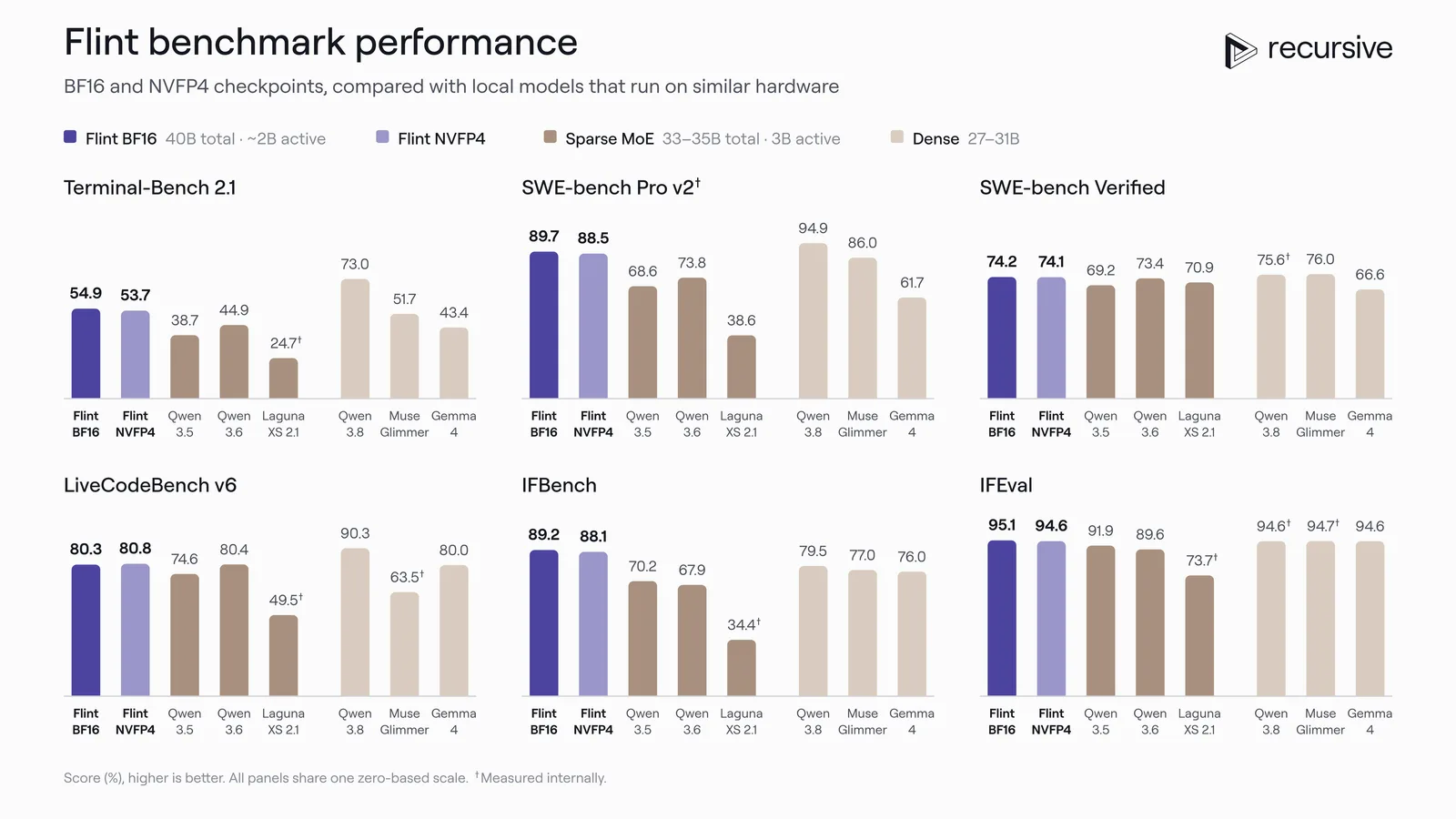
Recursive's published comparison: Flint (BF16 and NVFP4) against sparse MoE (33–35B total, 3B active) and dense 27–31B models; some competitor scores were measured by Recursive, the rest are developer-reported
| Benchmark | Flint (BF16) | Flint (NVFP4) | Qwen 3.5 | Qwen 3.6 | Laguna XS 2.1 | Qwen 3.8 | Muse Glimmer | Gemma 4 |
|---|---|---|---|---|---|---|---|---|
| Terminal-Bench 2.1 | 54.9 | 53.7 | 38.7 | 44.9 | 24.7 | 73 | 51.7 | 43.4 |
| SWE-bench Pro v2 | 89.7 | 88.5 | 68.6 | 73.8 | 38.6 | 94.9 | 86 | 61.7 |
| SWE-bench Verified | 74.2 | 74.1 | 69.2 | 73.4 | 70.9 | 75.6 | 76 | 66.6 |
| LiveCodeBench v6 | 80.3 | 80.8 | 74.6 | 80.4 | 49.5 | 90.3 | 63.5 | 80 |
| IFBench | 89.2 | 88.1 | 70.2 | 67.9 | 34.4 | 79.5 | 77 | 76 |
| IFEval | 95.1 | 94.6 | 91.9 | 89.6 | 73.7 | 94.6 | 94.7 | 94.6 |
This model's scores
- IFEval95.1%
- SWE-bench Pro v289.7%
- IFBench89.2%
- LiveCodeBench v680.3%
- SWE-bench Verified74.2%
- Terminal-Bench 2.154.9%
Scores on a 0–100 scale (25-point gridlines); higher is better. Each benchmark links to its published source.
Strengths
- Ahead of the 33–35B sparse MoE models on Recursive's chart on five of six benchmarks, including 54.9% on Terminal-Bench 2.1 against 44.9% for Qwen 3.6
- Only about 2.5B parameters active per token, with most layers on a 513-token sliding window — Recursive reports 125+ tokens/s on an M4 Pro MacBook Pro
- Strong instruction following for its size: 95.1 on IFEval and 89.2 on IFBench on Recursive's chart
- An NVFP4 checkpoint within 0.7 points of BF16 on the published benchmarks
- Apache 2.0 weights with no usage threshold, plus OpenAI-compatible tool calls and a ready SGLang serving kit
Best for
- Running a private, offline coding agent on a Mac or a 64GB RTX Spark through Ollama, LM Studio, llama.cpp or Recursive's rec engine
- Bug fixing, feature work and test writing inside agent harnesses that speak the OpenAI tool-call format
- Self-hosted coding-agent serving on one B300 or H200 GPU with the bundled SGLang kit
- Fine-tuning or studying a permissively licensed sparse MoE coding model
FAQ
What does 40B-A2.5B mean for Flint?
Flint has 39.8B parameters in total, but each token is routed to 6 of 256 experts plus a shared expert in every MoE layer, so only about 2.5B parameters (including the output head) are active per token. That small active count is what lets it run fast on a laptop.
Can I use Recursive Flint commercially?
Yes. The weights are released under the Apache 2.0 license, which allows commercial use, modification and redistribution. Recursive notes that any hosted API terms are separate from the weight license.
How fast is Flint on a Mac?
Recursive reports more than 125 tokens per second on an M4 Pro MacBook Pro and more than 150 tokens per second on a 64GB NVIDIA RTX Spark, at short contexts.
How do I run Flint?
On a supported Mac, Recursive's docs recommend its rec engine with the Pi harness; Ollama, LM Studio and llama.cpp run quantized builds. On a server, `vllm serve "RecursiveSI/flint"`, SGLang or `docker model run hf.co/RecursiveSI/flint` serve the BF16 checkpoint, and the repository includes an SGLang kit for one B300 or H200 GPU.
How long is Flint's context window?
The model card documents a 262,144-token context configuration, shared between the prompt and the generated output. Recursive's announcement says the model can go up to 512K tokens but recommends staying within 256K for the best results.