
Overview
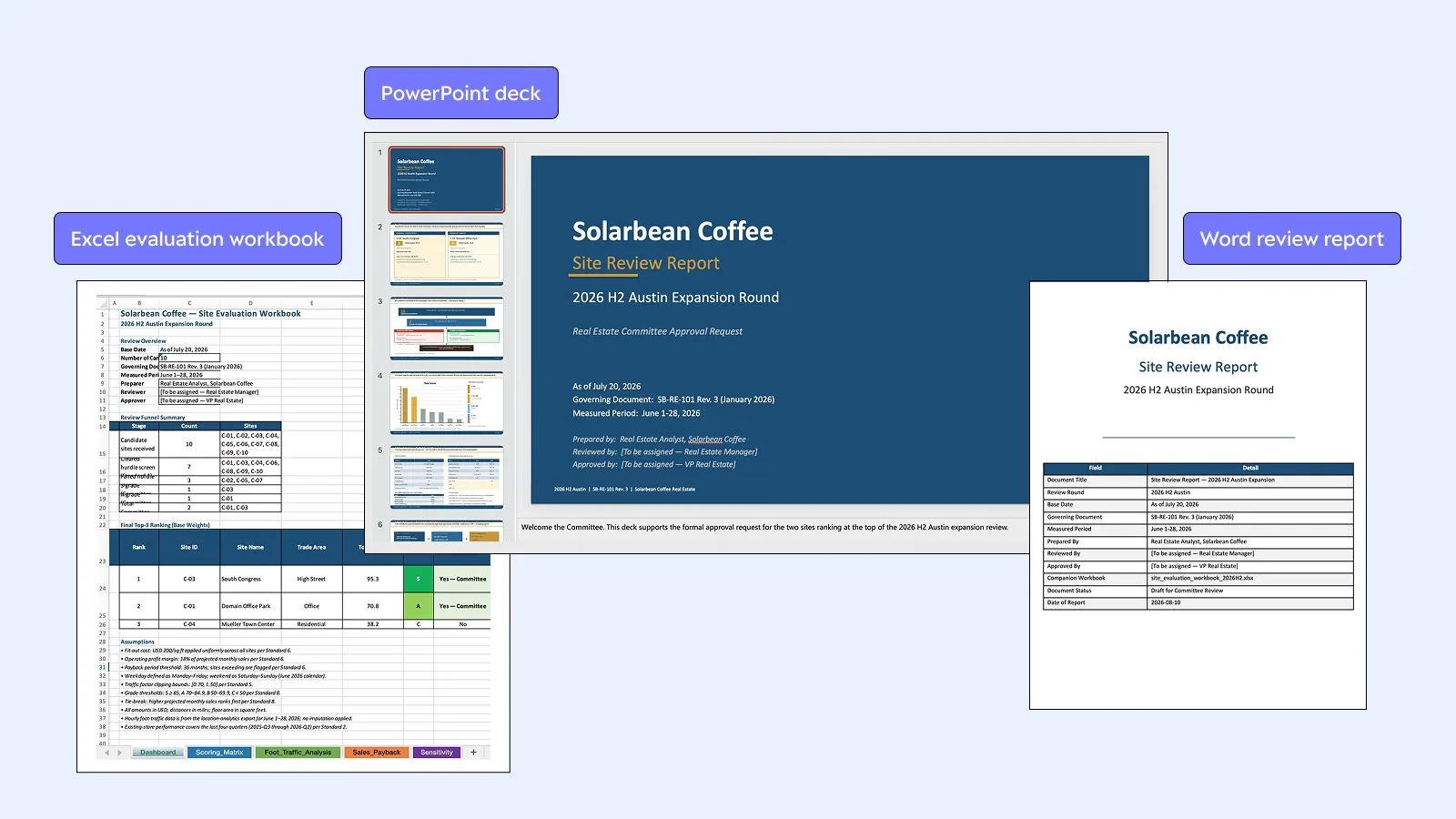
Solar Pro 4 is Upstage's flagship language model for agentic use, released August 6, 2026 as the snapshot solar-pro4-260806 and announced on Upstage's blog on August 11, 2026. Upstage describes it as a closed commercial model built to carry multi-step work through to a finished deliverable: reading documents, running tools and terminal tasks, and saying it cannot verify a claim when the evidence is missing rather than inventing an answer.
The model takes a 512K-token context and can write up to 128K output tokens, with English, Korean and Japanese supported for both input and output. Upstage lists chat, reasoning, structured outputs and tool calling as its capabilities, a training-data cut-off of February 2026, and an undisclosed parameter count. It reasons by default and returns the reasoning trace, with a reasoning-effort setting that trades depth for speed. On the API it is called as solar-pro4, through an OpenAI-compatible endpoint.
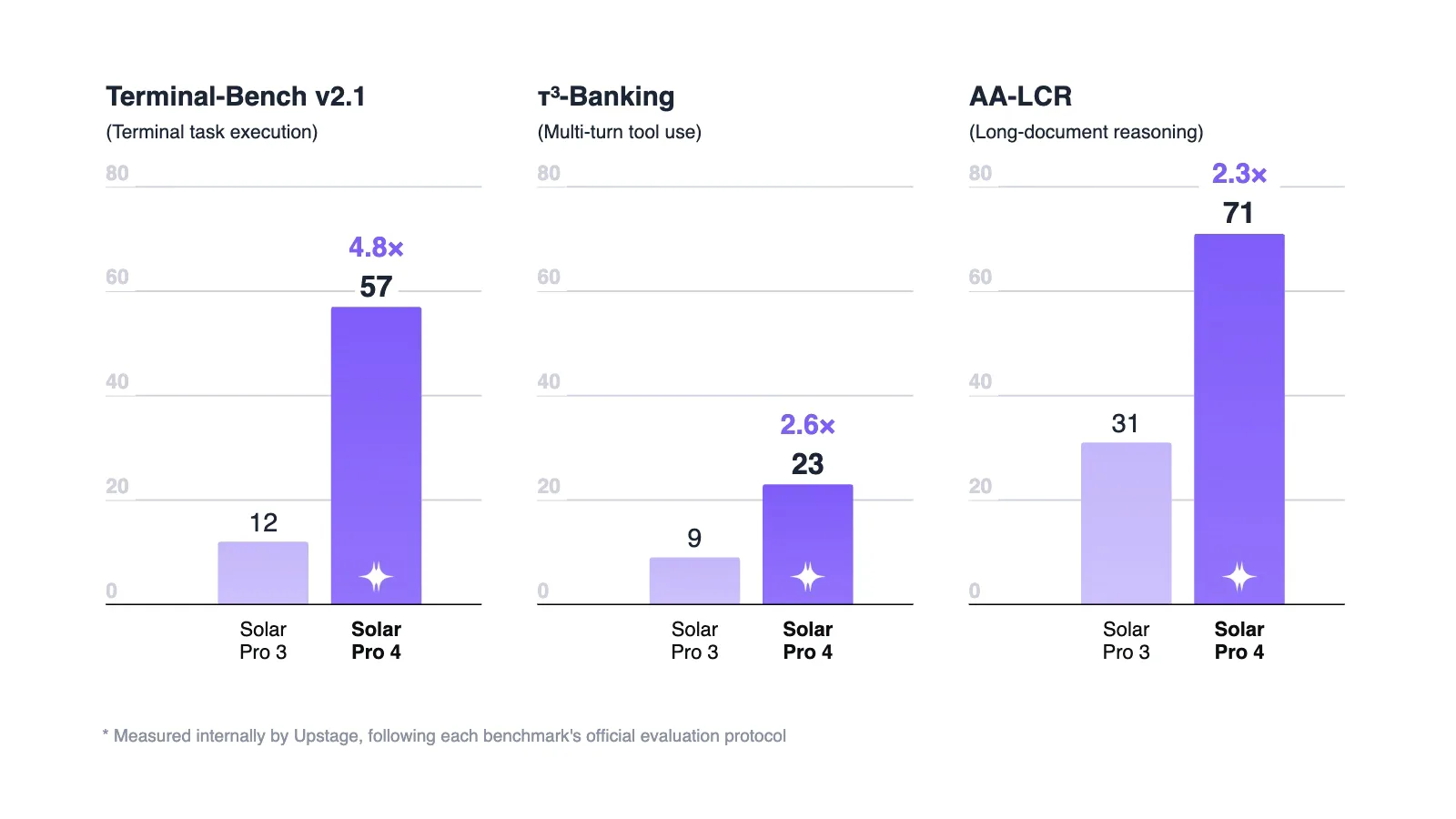
Upstage's launch post sets Solar Pro 4 against its open-weights Solar Open 2: 57.0 vs 43.2 on Terminal-Bench v2.1, 49.2 vs 37.3 on BrowseComp and 71.0 vs 62.7 on AA-LCR, with the two roughly level on knowledge, math and coding (GPQA Diamond 89.0 vs 85.6). Upstage positions Solar Open 2 for self-hosted deployment and Solar Pro 4 for longer, more complex agent workloads served through an API. In an August 20, 2026 announcement Upstage reported a score of 42 on the Artificial Analysis Intelligence Index and more than 370 billion tokens processed on OpenRouter within a week of listing.
Upstage's documentation lists Solar Pro 2 and Solar Pro 3 for full deprecation on October 30, 2026 (KST), with Solar Pro 4 as the model to migrate to.
| Released | 2026-08-06 |
|---|---|
| License | Proprietary (Upstage API and on-premises) |
| Weights | API only |
| Parameters | Undisclosed |
| Context | 512K tokens |
| Max output | 128K tokens |
| Knowledge cutoff | February 2026 |
| Modalities | Text |
| Status | Generally available |
Benchmarks
Solar Pro 4 vs Solar Open 2, as published by Upstage (August 2026). Rows marked * were evaluated in-house by Upstage.
| Benchmark | Solar Open 2 | Solar Pro 4 |
|---|---|---|
| Terminal-Bench v2.1 | 43.2 | 57 |
| GDPval-AA v2 | 31.4 | 38.8 |
| BrowseComp* | 37.3 | 49.2 |
| SWE-Bench Verified (OpenHands)* | 69.2 | 70.6 |
| MCP-Atlas* | 58.2 | 61.4 |
| APEX-Agents* | 16.6 | 18.7 |
| τ³-Banking | 18.1 | 23 |
| AA-LCR | 62.7 | 71 |
| GPQA Diamond | 85.6 | 89 |
| MMLU-Pro* | 86.2 | 86.3 |
| LiveCodeBench* | 87 | 87.8 |
| AIME 2026* | 95.7 | 95.3 |
| KMMLU-Pro* | 78.4 | 79.2 |
| KBL (law)* | 75.5 | 77.5 |
| KorMedMCQA (medicine)* | 93 | 93.2 |
| Ko-GDPval* | 86.8 | 87.3 |
| Arena-Hard v2 (Japanese)* | 75.3 | 81.9 |
| MMLU (Japanese)* | 89.3 | 89.5 |
| IFEval (Japanese)* | 82.5 | 81.6 |
This model's scores
- Terminal-Bench v2.157
- τ³-Banking23
- AA-LCR71
- GPQA Diamond89%
- SWE-Bench Verified (OpenHands)70.6%
- BrowseComp49.2%
Scores on a 0–100 scale (25-point gridlines); higher is better. Each benchmark links to its published source.
Pricing
| Input | $0.30 / 1M tokens |
|---|---|
| Cached input | $0.06 / 1M tokens |
| Output | $1.20 / 1M tokens |
List price on the Upstage API. A launch promotion took 90% off on Upstage Console and OpenRouter through September 10, 2026 (23:59 UTC). Prices exclude 10% VAT.
Strengths
- Built for agent work: 57 on Terminal-Bench v2.1, 23 on τ³-Banking and 71 on AA-LCR in Upstage's launch figures
- 512K-token context window with up to 128K output tokens for multi-document sessions
- English, Korean and Japanese for both input and output
- Chat, reasoning, structured outputs and tool calling, with an adjustable reasoning effort
- Priced at $0.30 per 1M input tokens, $0.06 cached and $1.20 output
- Served through an OpenAI-compatible API, OpenRouter, SolarChat, Upstage Studio and on-premises deployment
Best for
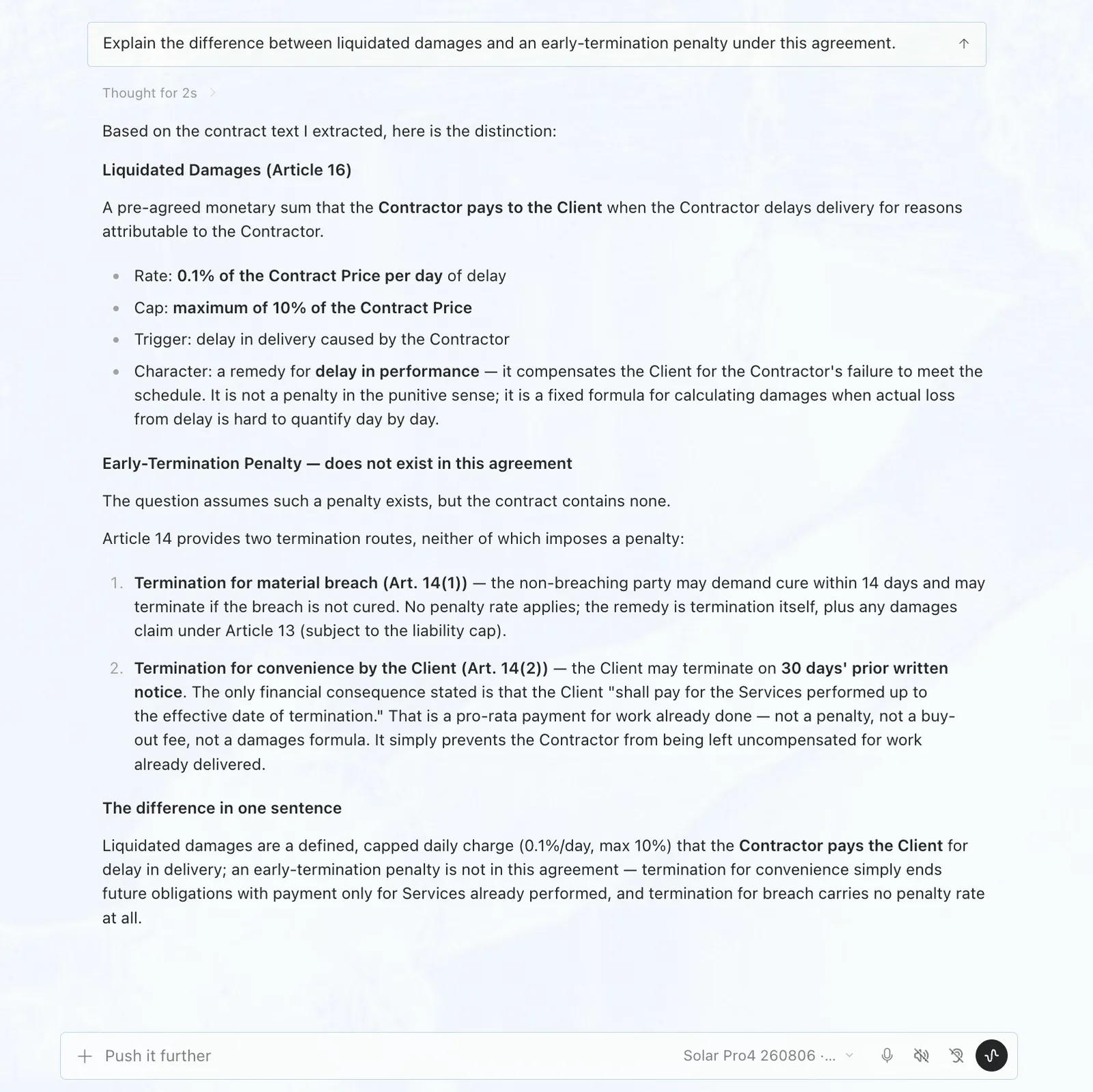
- Reach for it when an agent has to work across several long documents, contracts or data files in one session.
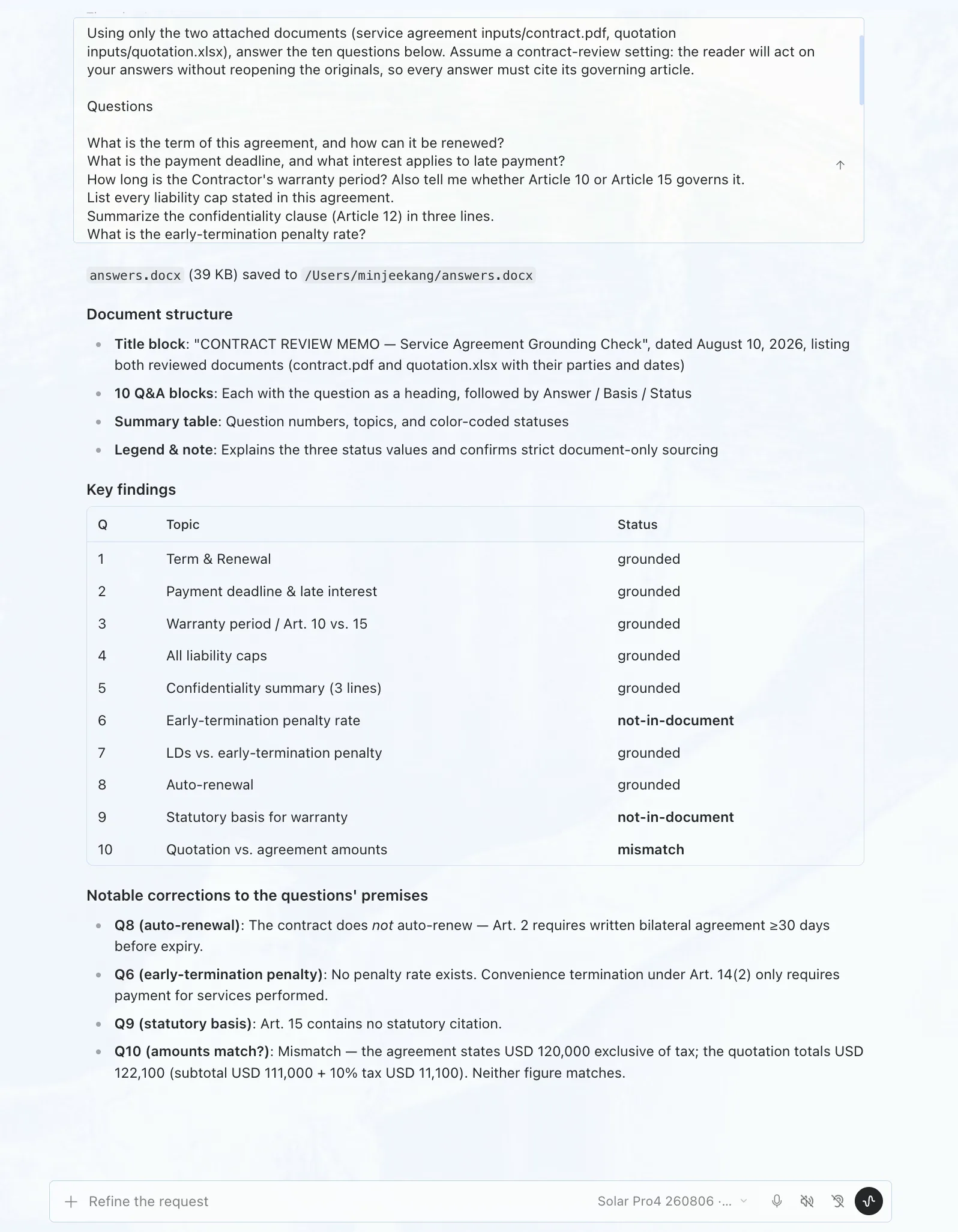
- Reach for it for terminal tasks and multi-turn tool calling where a stalled or wrong step is costly.
- Reach for it when the work is in Korean or Japanese as well as English.
- Look elsewhere if you need to self-host open weights: Upstage points those deployments to Solar Open 2, and Solar Pro 4 has no published weights.
How to access
| Provider | Model ID |
|---|---|
| Upstage API ↗ | solar-pro4 |
| OpenRouter ↗ | upstage/solar-pro4 |
FAQ
When was Solar Pro 4 released?
Upstage's model page lists the solar-pro4-260806 snapshot as released on August 6, 2026. Upstage's launch blog post followed on August 11, 2026 and a newsroom announcement on August 20, 2026.
How much does Solar Pro 4 cost?
On the Upstage API it costs $0.30 per million input tokens, $0.06 per million cached input tokens and $1.20 per million output tokens, excluding VAT. At launch Upstage ran a 90% discount on Upstage Console and OpenRouter through September 10, 2026 (23:59 UTC).
What is the difference between Solar Pro 4 and Solar Open 2?
Upstage positions Solar Open 2 as a general-purpose open-weights model you deploy on your own hardware, and Solar Pro 4 as an API model for longer, more complex agent workloads. In Upstage's comparison Solar Pro 4 leads on agent benchmarks such as Terminal-Bench v2.1 (57.0 vs 43.2) and BrowseComp (49.2 vs 37.3), while the two are roughly level on knowledge, math and coding.
Can I download Solar Pro 4's weights?
No. Upstage describes Solar Pro 4 as a closed commercial model. It is available through the Upstage API, OpenRouter, SolarChat, Upstage Studio and Hermes Agent, and as a dedicated or on-premises deployment by arrangement with Upstage.