

Overview
WePocketModel 1.0, or WePM, is a vision-language model family from WeChat AI at Tencent, built for apps that run AI on the device. Tencent made it open source on 23 November 2026 in 2B and 4B sizes, with weights for Transformers, GGUF on CPU, and from 25 November MLX on Apple silicon. The technical report, 'WePM: Hierarchical Conflict Reconciliation for Unified MLLMs', is arXiv 2611.27365. The weights are under Apache-2.0.
The idea is one resident model instead of three. An on-device assistant usually needs a retrieval model to find local content, a generator to answer, and a decision model to route the next step, and each brings its own vision encoder and language backbone. WePM serves all three from one set of parameters. Generation covers OCR, captioning, visual question answering, summarization and assistant replies. Embedding returns L2-normalised text and image vectors of 2,048 dimensions, which can be cut to 64, 128, 256, 512 or 1,024 (Matryoshka). Decision returns typed outputs: a choice among options, an ordinal score or a yes/no judgment.
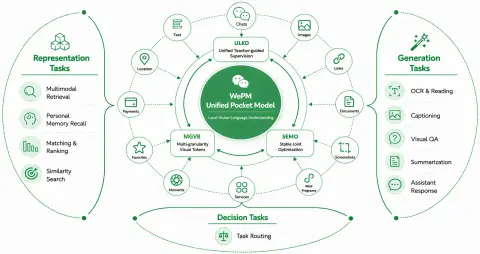
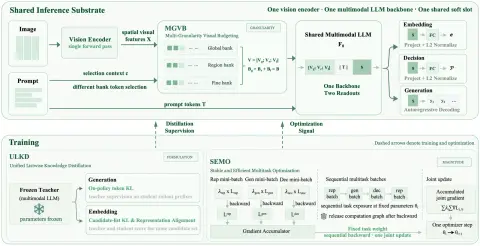
Tencent says that simply mixing these tasks makes them conflict, and the report adds three parts to fix that. MGVB divides a fixed number of visual tokens between global, regional and fine-grained views, choosing regions from the text prompt when there is one. ULKD distils from two frozen teacher models, one for generation and one for embeddings. SEMO uses fixed task weights and a set schedule of task batches, accumulating gradients before one joint optimizer step.
On its own evaluation, WePM-4B ranks first in each family: an aggregate of 72.86 over 30 embedding benchmarks, 62.41 over 39 generation benchmarks and 61.11 over 7 decision (JEV) benchmarks. Tencent also defines Heterogeneous Capability Density (HCD), the number of usable capability families times aggregate quality, divided by resident memory. WePM-4B reaches about 65.1% harmonic performance in roughly 8 GB of BF16 weights, an HCD of 0.244. The six three-model stacks it compares need about 21–43 GB and score 0.045–0.092. These memory figures count BF16 weights only, not the KV cache or activations.
| Released | 2026-11-23 |
|---|---|
| License | Apache-2.0 |
| Weights | Open weights |
| Parameters | Two sizes: WePocketModel1.0-2B (2.21B parameters on Hugging Face) and WePocketModel1.0-4B (4.54B) |
| Architecture | One Qwen3-VL vision encoder and one multimodal LLM backbone (the 2B is built on Qwen3.5-2B; the 4B MLX card describes a Qwen3.5 backbone with a 32-layer hybrid language model) shared by three readouts: autoregressive decoding for generation, a learned E slot projected and L2-normalised for embeddings, and a learned J slot with a direct head for decisions. Multi-Granularity Visual Budgeting (MGVB) splits a fixed visual-token budget across global, regional and fine-grained token banks. |
| Modalities | Image, Text |
| Status | Open-source release — 2B and 4B weights in Transformers, GGUF and MLX formats, inference runtime and technical report |
Benchmarks
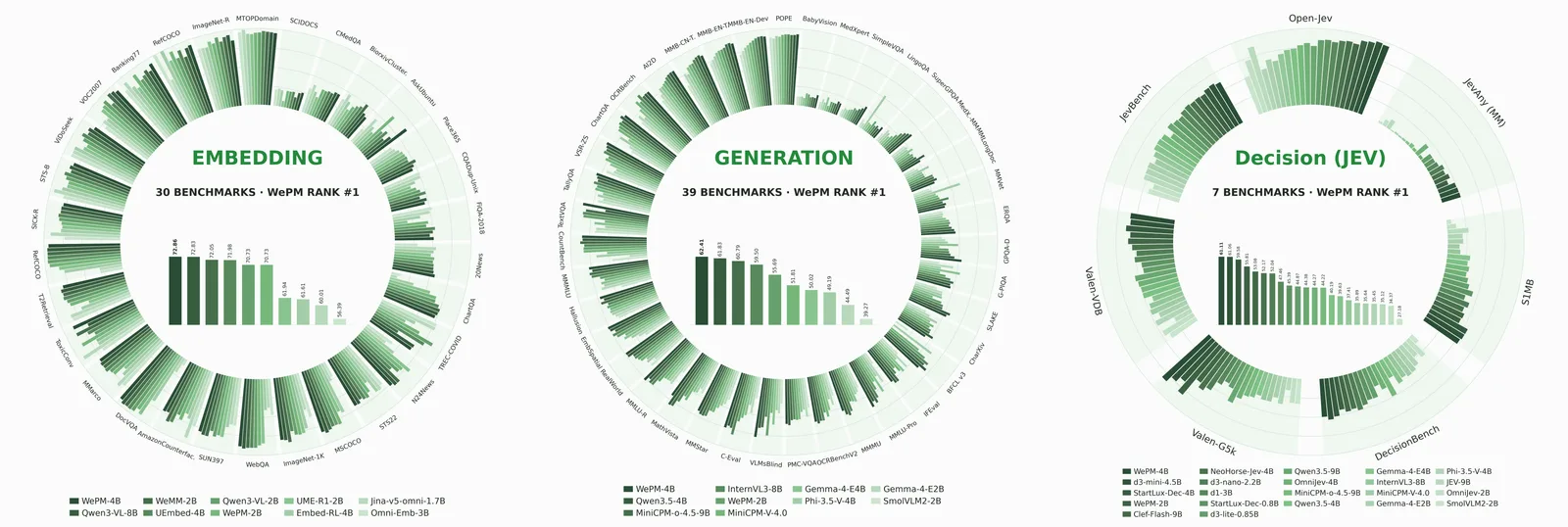
This model's scores
- Embedding aggregate (30 benchmarks)72.86%
- Generation aggregate (39 benchmarks)62.41%
- Decision (JEV) aggregate (7 benchmarks)61.11%
Scores on a 0–100 scale (25-point gridlines); higher is better. Each benchmark links to its published source.
Strengths
- One model for generation, multimodal embeddings and structured decisions, instead of three separately loaded models
- Ranked first overall in Tencent's evaluation across 30 embedding, 39 generation and 7 decision benchmarks
- About 8 GB of BF16 weights for the 4B; the 4B Q4_K_M GGUF language file plus shared multimodal weights take about 3.19 GiB on disk
- Matryoshka embeddings from 64 to 2,048 dimensions, chosen at inference time
- Runs on NVIDIA GPUs (Transformers, BF16), on CPU (Transformers FP32 or GGUF) and on Apple silicon (MLX)
- Apache-2.0 weights and inference code
Best for
- Personal assistants that search local photos and messages, answer about them and pick the next action on the device
- In-game assistants that read game frames and interface text and suggest or route actions
- On-device OCR, captioning and visual question answering where data must stay local
- Multimodal retrieval and candidate ranking with a small embedding vector
How to access
| Provider | Model ID |
|---|---|
| Hugging Face (self-hosted) ↗ | tencent/WePocketModel1.0-4B |
| Hugging Face (self-hosted, smaller) ↗ | tencent/WePocketModel1.0-2B |
| Hugging Face (MLX, Apple silicon) ↗ | tencent/WePocketModel1.0-4B-MLX |
FAQ
What is WePocketModel?
WePocketModel (WePM) is a 2B and 4B vision-language model family from WeChat AI at Tencent, open-sourced on 23 November 2026. One set of weights does text generation from text and images, multimodal embeddings for retrieval, and structured decisions such as picking an option or giving a score.
Is WePocketModel free for commercial use?
The Hugging Face model cards publish the 2B and 4B weights under Apache-2.0, and the GitHub inference code is Apache-2.0 too. Third-party components keep their own licences.
How much memory does WePocketModel need?
For the 4B, the README lists about 8.5 GiB of BF16 weights on an NVIDIA GPU (16 GiB VRAM recommended), about 17 GiB of FP32 weights on CPU (24 GiB RAM recommended), and about 3.19 GiB on disk for the Q4_K_M GGUF language file plus shared multimodal weights. Actual use also depends on context length.
How do I run WePocketModel?
Clone github.com/Tencent/WePocketModel, install PyTorch and inference/requirements.txt, then run bash examples/gpu/generation/run.sh single_text; the embedding and decision examples sit next to it. On a Mac, download tencent/WePocketModel1.0-2B-MLX or -4B-MLX and use its runtime/infer_mlx.py with --task generate, embed or decision.