Anthropic · 2026-10-13 · major
Scion — Anthropic replaced git for its monorepo in five months
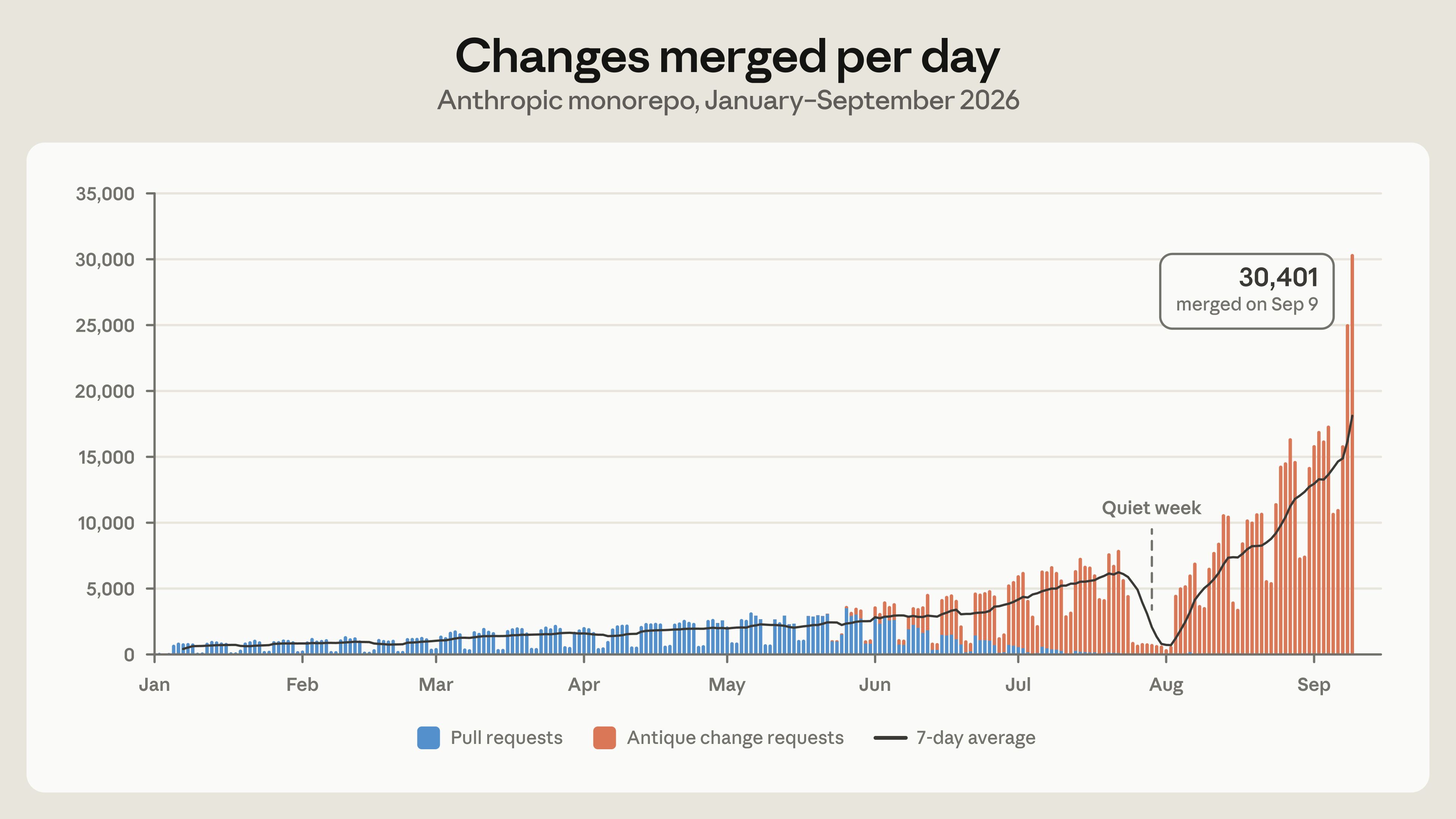
Anthropic built Scion, an in-house version control system, after merges grew from about 2,500 a day in May 2026 to over 30,000 in September. A seven-person team replaced git for the monorepo in five months.
Anthropic explains why coding agents broke git at its scale and what it built instead.
Quick facts
| System | Scion (version control) + Antique (code review) |
|---|---|
| Merges per day | ~2,500 (May 2026) to 30,000+ (Sep 2026) |
| Checkouts | ~25 million per day |
| Team and time | 7 people, 5 months |
| Footprint | ~200x less CPU and memory than the old git mirrors |
| Open source | No |
What is it?
Scion is the version control system Anthropic now runs for its monorepo, described in an engineering post on 13 October 2026. The team also built Antique for code review, plus code search and source-control access control. Anthropic says Scion is not a general git replacement and is not releasing it.
How does it work?
Clients stay online and the server does the heavy work: history, blame, commits and merges. Each change is a changeset in a write-ahead log, stored against its first parent with content-addressed blob pointers. Working copies are sparse or virtual, and trees and blobs come on demand through three cache tiers, from a per-node daemon to a server backed by Spanner and cloud storage.
Why does it matter?
Most of Anthropic's source-control traffic now comes from agents and CI, not people. Its numbers show where git strains under that load: about 25 million checkouts a day, which naive git would turn into more than 600 PB of traffic. Teams scaling coding agents can borrow the ideas even without the code.
Who is it for?
platform and developer-infrastructure engineers
Frequently asked questions
- Is Anthropic open-sourcing Scion?
- No. Anthropic's post says Scion is not a suitable general replacement for git and would be hard to offer publicly. Instead, the Scion team shares its design so others can apply the ideas, such as server-side commits and on-demand fetching, to their own git setups.
- Why did git not work for Anthropic's monorepo?
- Git is built for offline, decentralized use, but Anthropic's monorepo clients are mostly always-online agents and CI jobs. With almost 100 GB of main-branch history and about 25 million checkouts a day, Anthropic estimated naive git traffic at over 600 PB per day, and it was already running several hundred internal git mirrors as a workaround.
- What did Scion improve at Anthropic?
- Anthropic reports that Scion's CPU and memory footprint is about 200x smaller than its previous git mirroring setup, checkouts take seconds instead of minutes, CI gained 25% CPU capacity, and each cache tier hits over 99%. A Claude rewrite of the git-to-Scion ingestion pipeline used 20x less memory and ran 4x faster.
- How did Anthropic use Claude to build Scion?
- Anthropic says Claude helped write simulations, fuzzing and rate limiting, rewrote the ingestion pipeline, and runs as 'superfan' agents watching single components through telemetry and logs. Engineers moved toward setting constraints and reviewing intent, and the post notes Claude sometimes broke system constraints or over-engineered under adversarial review.