Cortechs.ai · 2026-08-18 · major
NeuroQuant PET — FDA clears automated amyloid scoring for dementia
Cortechs.ai's NeuroQuant PET received FDA 510(k) clearance on August 18, 2026. The software measures amyloid in each brain region from a PET scan and reports SUVRs and Centiloid scores for dementia workups.
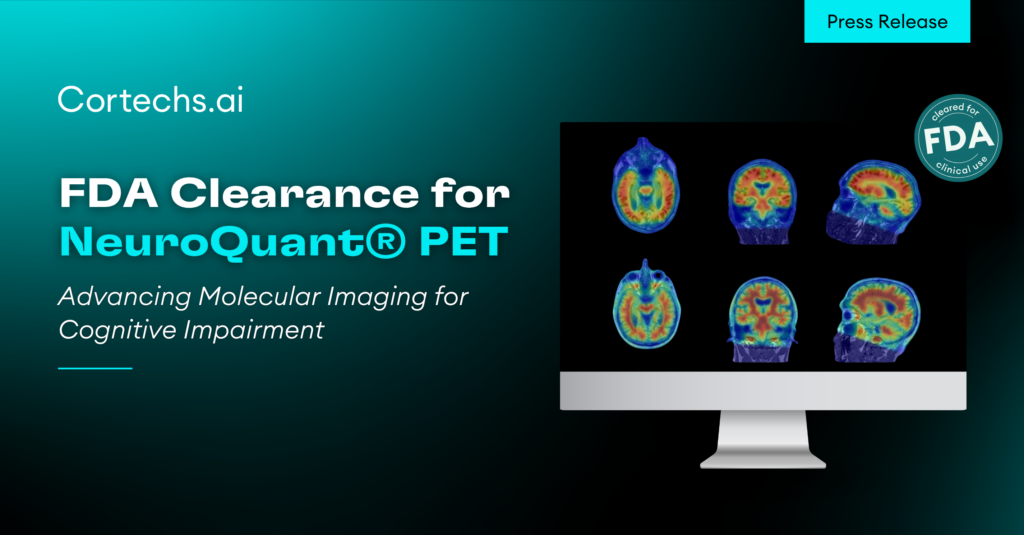
Cortechs.ai's NeuroQuant PET can now be used on real patients to score amyloid brain scans automatically.
Quick facts
| Maker | Cortechs.ai |
|---|---|
| Clearance | FDA 510(k) K261916 |
| Cleared | August 18, 2026 |
| Cleared tracers | Florbetapir, florbetaben, flutemetamol |
| Outputs | Regional SUVRs, Centiloid scores |
| Workflows | PET-CT, PET-MR or PET-only |
| Research use only | FDG, flortaucipir |
What is it?
NeuroQuant PET won FDA 510(k) clearance, number K261916, on August 18, 2026, which lets hospitals use it in routine care. The software reads an amyloid PET brain scan and reports how much tracer sits in each brain region. Cortechs.ai built it to support the workup of cognitive impairment, including Alzheimer's disease and related conditions.
How does it work?
Automated segmentation splits the scan into anatomical regions, and NeuroQuant PET then measures tracer uptake inside each one against normative population data. Results come back as standardized uptake value ratios and Centiloid scores. The clearance covers three amyloid tracers, and the tool accepts PET-CT, PET-MR or PET-only studies, returning a structured report straight into PACS.
Why does it matter?
Reading an amyloid PET scan by eye is a judgment call, and borderline cases are where readers disagree. Clearance means NeuroQuant PET can attach an objective, repeatable number to that scan in everyday clinical work. Cortechs.ai frames the goal as earlier diagnosis and biomarker-driven decisions rather than assessment based on symptoms alone.
Who is it for?
neuroradiologists and dementia clinics
Frequently asked questions
- Which PET tracers is NeuroQuant PET cleared for?
- NeuroQuant PET is cleared for three amyloid tracers: florbetapir, florbetaben and flutemetamol. Two further tracers, FDG for glucose metabolism and flortaucipir for tau imaging, are listed on the product page as research use only, so they are not covered by the clinical clearance. Cortechs.ai reports Centiloid values so readings taken with different amyloid tracers can be compared.
- Does NeuroQuant PET need an MRI scan to work?
- No. Cortechs.ai states that NeuroQuant PET runs on PET-CT, PET-MR or PET-only studies, so a site without paired MRI can still use it. Processing is cloud-based and automated, and the results come back as PACS-ready structured reports with fusion images and anatomical overlays for the reading radiologist.
- What does a Centiloid score add over a plain SUVR?
- Centiloid is a shared scale for amyloid PET. Cortechs.ai says the Centiloid output in NeuroQuant PET lets results be compared across different amyloid tracers and tracked over repeat scans, which a raw standardized uptake value ratio cannot do on its own because each tracer has its own uptake range.
- What does the FDA clearance change for a dementia clinic?
- The 510(k) clearance means NeuroQuant PET can be used in routine patient care in the United States, not just in research. Cortechs.ai positions it as a move toward biomarker-driven assessment instead of judgment based on symptoms alone, and CEO Kyle Frye says the goal is objective, reproducible measurements clinicians can trust.
Try it
https://www.cortechs.ai/neuroquant-pet/