Hemispheric · 2026-07-15 · major
Descartes — Hemispheric's frontier NeuroAI model for decoding EEG brain signals
Hemispheric launched Descartes, a 6B-parameter EEG foundation model trained on 250,000+ hours of brain data from 100,000+ participants. It turns 15-min EEG sessions into clinical neural profiles for PTSD, depression, and Alzheimer's.
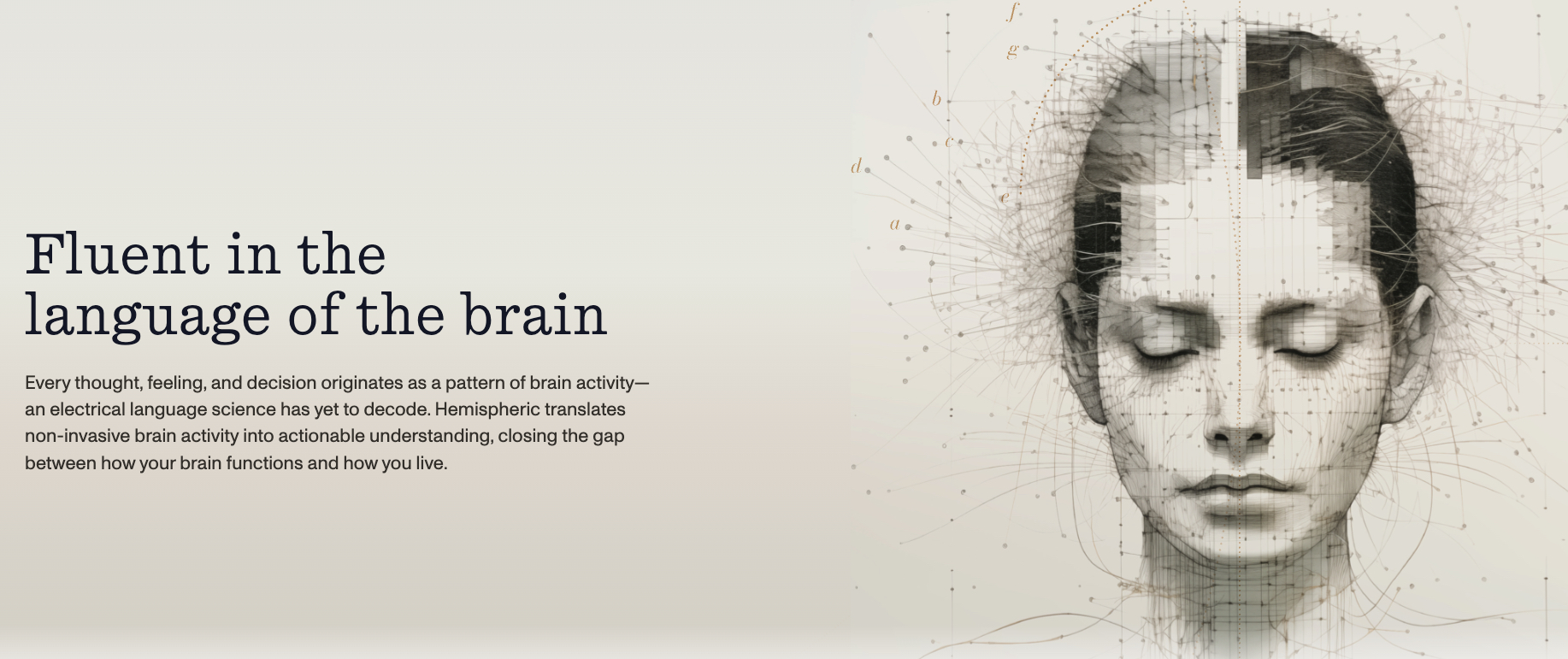
A 6B-parameter AI model that converts 15-minute EEG recordings into quantitative brain-health diagnostics.
Key specs
| Parameters | 6B |
|---|---|
| Training hours | 250,000+ |
Quick facts
| Maker | Hemispheric |
|---|---|
| Model size | 6 billion parameters |
| Training data | 250,000+ hours of EEG + behavioral data, 100,000+ participants |
| Input | 15-min dry-electrode EEG session |
| Applications | PTSD, mTBI, depression, anxiety, schizophrenia, Alzheimer's |
| Funding | $52M Series A (Hanaco Ventures, OneMind/Awareness Capital, Protocol Labs) |
| Regulatory | FDA engagement underway |
What is it?
Descartes is the first frontier NeuroAI foundation model designed to decode non-invasive brain activity. Hemispheric trained it on 250,000+ hours of EEG and behavioral recordings from over 100,000 participants, applying computational scaling laws similar to those used for large language models and vision models.
How does it work?
Patients wear a lightweight dry-electrode EEG headset and complete targeted tasks on a tablet for 15 minutes. Descartes translates the brain's electrical signals into quantitative neural profiles — identifying psychiatric and cognitive phenotypes across PTSD, mTBI, depression, anxiety, schizophrenia, and Alzheimer's disease.
Why does it matter?
Psychiatric diagnosis today relies on subjective self-reports, making treatment a trial-and-error process. Descartes offers an objective, biomarker-based brain readout that could guide precision treatment decisions and help clinicians match patients to therapies more quickly.
Who is it for?
clinicians, psychiatrists, neuroscience researchers
Frequently asked questions
- What does Descartes actually do?
- Descartes processes 15 minutes of EEG recordings from a lightweight dry-electrode headset and outputs a quantitative neural profile that identifies psychiatric and cognitive conditions such as PTSD, depression, mTBI, and Alzheimer's disease — without invasive procedures or specialist waveform interpretation.
- How was Descartes trained?
- Descartes was trained on more than 250,000 hours of multimodal EEG and behavioral data collected from over 100,000 participants through Hemispheric's global research network, built over six years with a 112-person interdisciplinary team.
- Is Descartes FDA approved?
- Not yet. Hemispheric has demonstrated the Descartes platform to the FDA's Center for Devices and Radiological Health and is pursuing a broad regulatory approval strategy for clinical deployment in the United States.
- How is Descartes different from existing EEG tools?
- Descartes applies a 6-billion-parameter foundation model to standard dry-electrode EEG signals — similar to how large language models process text — producing objective, quantifiable neural biomarkers. Existing tools typically require gel electrodes, specialist interpretation, or are limited to a single condition.