Hugging Face · 2026-08-27 · major
Microduck — Hugging Face's $399 open-source robot you train with RL
Microduck is a 25 cm biped robot from Hugging Face and Pollen Robotics, priced at $399. It ships with seven trained behaviours, and the SDK, MuJoCo simulation and full reinforcement learning stack are Apache-2.0 on GitHub.
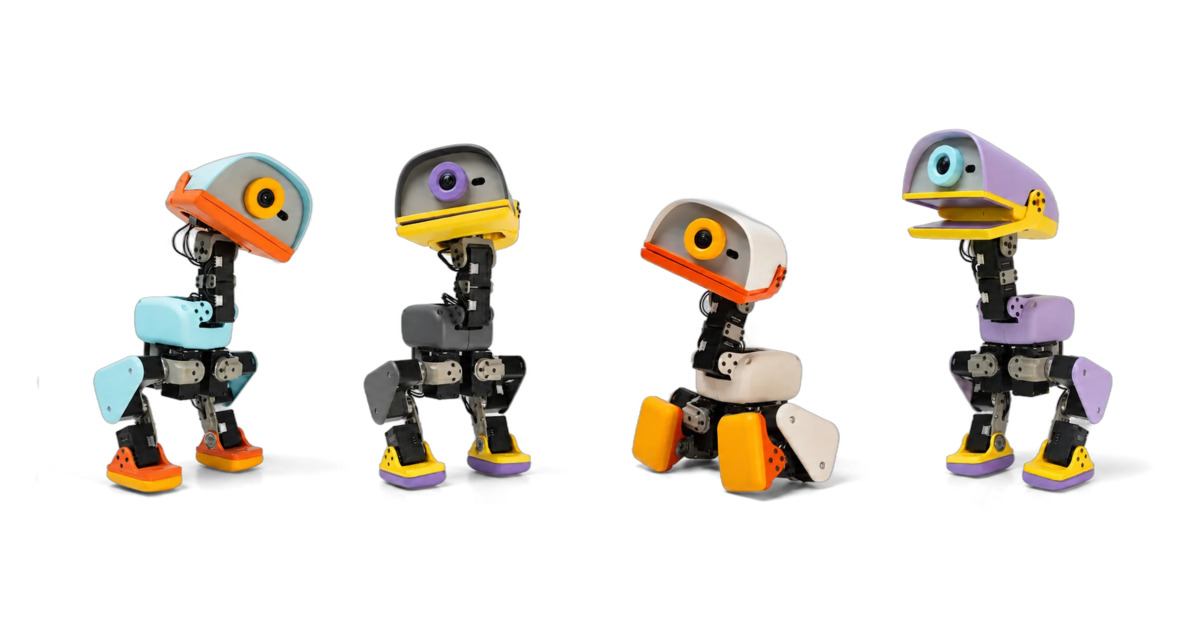
Microduck is a 25 cm biped robot from Hugging Face that ships with seven reinforcement learning policies you can retrain yourself.
Quick facts
| Maker | Hugging Face / Pollen Robotics |
|---|---|
| Price | $399, before taxes and shipping |
| Size | 25 cm tall, 800 g |
| Hardware | 15 motors, wide-angle camera, LiDAR, two IMUs |
| Software license | Apache-2.0 |
| Shipped policies | 7, all published and retrainable |
| Availability | Pre-order now; first deliveries targeted before Christmas 2026 in North America, Europe and the UK |
Pricing
| Microduck · introductory price, before taxes and shipping | $399 |
|---|---|
| Charger pack · add-on | $39 |
| Dev pack · spare motors and components | $119 |
| Accessory pack · laser pointer and NFC tags | $39 |
What is it?
Microduck puts a full reinforcement learning workflow into a $399 robot you can hold in one hand. Hugging Face and its robotics arm Pollen Robotics opened pre-orders on 27 August 2026 for the 25 cm, 800 g biped, which packs 15 motors, a wide-angle camera, LiDAR and two IMUs. Every piece of software around it is Apache-2.0.
How does it work?
New behaviours are trained in simulation first. The mjlab environment, built on MuJoCo Warp, runs PPO against a physics model of the robot; the trained policy is exported to ONNX and loaded onto the hardware, where it runs at 50 Hz. The loop is deliberately short — tweak the simulation, retrain, redeploy — and all seven factory policies are published so you can start from one instead of from scratch.
Why does it matter?
Sim-to-real work has mostly needed a lab budget, and a $399 walking robot moves that in reach of a single developer. Because the training stack is Apache-2.0 rather than a closed app, a Microduck owner can read exactly how a policy was produced and change it, which makes the robot usable as a teaching tool and a research testbed instead of only a gadget.
Who is it for?
reinforcement learning researchers and robotics hobbyists
Frequently asked questions
- Is Microduck really fully open source?
- Microduck's software stack is Apache-2.0. That covers the SDK, the MuJoCo physics simulation and the complete reinforcement learning training infrastructure, split across two GitHub repositories: pollen-robotics/microduck (Rust) and pollen-robotics/microduck_rl (Python). The seven policies that ship on the robot are also published, so you can inspect and retrain each one.
- What can Microduck do out of the box?
- Microduck arrives with seven trained behaviours: walking with velocity tracking, sitting and standing, kicking, grabbing an object with its beak, roller skating, and getting back up after falling on its back. It can lift objects weighing up to 800 grams, roughly its own weight, and it hears and speaks through an onboard microphone and speaker.
- Does Microduck train on the robot or on your computer?
- Training for Microduck happens on your own machine, not on the robot. You run PPO inside the mjlab simulation environment, which is built on MuJoCo Warp, then export the resulting policy to ONNX and deploy it to the physical robot, where the policy loop runs onboard at 50 Hz. You then adjust the simulation, retrain and repeat.
- How is Microduck different from Reachy Mini?
- Reachy Mini and Reachy Mini Lite, Hugging Face's earlier robots from 2025, are stationary desktop units priced at $499 and $399. Microduck is a walking biped at the same $399 as the Lite: it moves around the floor, carries LiDAR and two IMUs for balance, and is built around a reinforcement learning workflow rather than scripted desktop interaction.
Try it
https://github.com/pollen-robotics/microduck