Nex AGI · 2026-09-08 · major
Nex-N2.5 — three open-weight agent models, up to 1.6 trillion parameters
Nex-N2.5 is a family of three open-weight agent models from Nex AGI. The 1.6-trillion-parameter Max tier scores 92.6 on BrowseComp and 86.1 on Terminal-Bench 2.1. All three are Apache-2.0, and mini and Pro run free on OpenRouter.
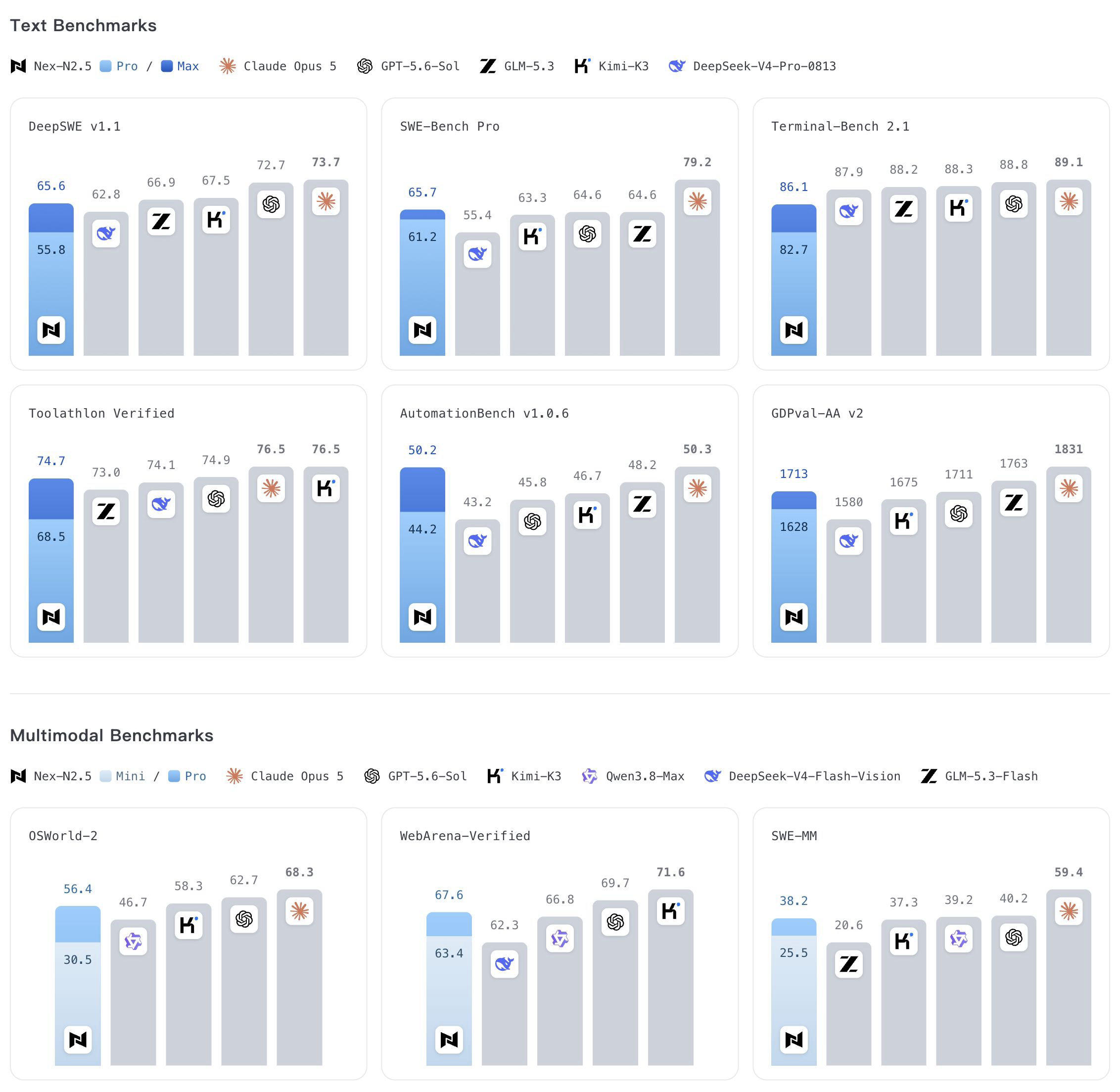
Nex AGI releases mini, Pro and Max — agent models that treat vision as a working interface, not just an input.
Quick facts
| Maker | Nex AGI |
|---|---|
| Sizes | mini (35B), Pro, Max (1.6T) |
| License | Apache-2.0 |
| Context window | 262,144 tokens |
| Weights | mini and Max on Hugging Face; Pro listed as coming soon |
| Hosted access | Free on OpenRouter (mini, Pro) |
| Serving | SGLang fork in the nexagi/sglang:v0.5.18-nex-patch image |
Benchmarks
| Nex-N2.5-Max | 86.1% | |
|---|---|---|
| Claude Opus 5 | 89.1% | |
| GPT-5.6 Sol | 88.8% | |
| Kimi-K3 | 88.3% | |
| Qwen3.8-Max | 86.6% |
What is it?
Nex-N2.5 adds a 1.6-trillion-parameter Max tier to Nex AGI's agent line, next to a 35-billion-parameter mini and a mid-size Pro. The mini and Pro tiers are multimodal and build on the earlier Nex-N2 models, with the work aimed at computer use, web browsing and visually grounded tasks. Max is text-only and is the company's first full post-training run at trillion-parameter scale. All three carry an Apache-2.0 licence.
How does it work?
Vision is the feedback channel here: the model looks at a screen, a browser or a program it just launched, checks whether what it sees matches the goal, and revises when it does not. The published config files show the tiers were post-trained on different bases — mini declares a Qwen3.5 mixture-of-experts architecture, while Max declares a DeepSeek-V4 one with 384 experts and 6 active per token. A `reasoning_effort` setting switches between no thinking, adaptive thinking and always thinking.
Why does it matter?
Open weights at trillion-parameter scale are still rare, so Max gives teams a self-hostable option in a tier that is otherwise closed API only. The published tables put the family directly against Claude Opus 5, GPT-5.6 Sol and Kimi-K3 rather than leaving buyers to guess, and the smallest tier fits on two H100s, which puts an agent model inside the budget of a single server.
Who is it for?
teams self-hosting coding and computer-use agents
Frequently asked questions
- Can I download the Nex-N2.5 weights today?
- Nex-N2.5-mini and Nex-N2.5-Max both have weight files published on Hugging Face under Apache-2.0, so they can be pulled and served right now. The Nex-N2.5-Pro model card lists its weights as coming soon, which means Pro is currently reachable only through hosted access on OpenRouter and ModelScope.
- What hardware does Nex-N2.5 need to run?
- The Nex-N2.5 README gives a launch command per tier: mini runs on a single node with 2 H100s, Pro on a single node with 8 H100s, and Max across 2 nodes of 16 H200s with tensor parallelism set to 16. Every tier uses the same prebuilt SGLang Docker image.
- How does Nex-N2.5-Max compare with Claude Opus 5?
- Nex-N2.5-Max leads Claude Opus 5 on BrowseComp, 92.6 to 90.8, and is roughly level on AutomationBench v1.0.6 at 50.2 against 50.3. Opus 5 stays ahead on coding and knowledge work: 89.1 to 86.1 on Terminal-Bench 2.1, 79.2 to 65.7 on SWE-Bench Pro, and 65.7 to 53.6 on Job Bench.
- Which Nex-N2.5 model should I pick for computer use?
- Nex-N2.5-Pro is the computer-use tier. Pro posts the best OSWorld-G score in the published table at 87.4, ahead of Qwen3.8-Max on 84.9, with mini behind at 82.9. Nex-N2.5-Max is text-only, so despite being the largest model it cannot read a screen and is not the right choice for GUI work.
Try it
Free on OpenRouter with model id nex-agi/nex-n2.5-mini:free