NVIDIA · 2026-07-27 · major
Open Secure AI Alliance — 50-company coalition open-sources AI security tools
NVIDIA launched the Open Secure AI Alliance with 50+ founding partners — Microsoft, IBM, Red Hat, CrowdStrike, Hugging Face — and open code including NOOA, MDASH, Lightwell, and Safetensors. OpenAI, Anthropic, and Google are absent.
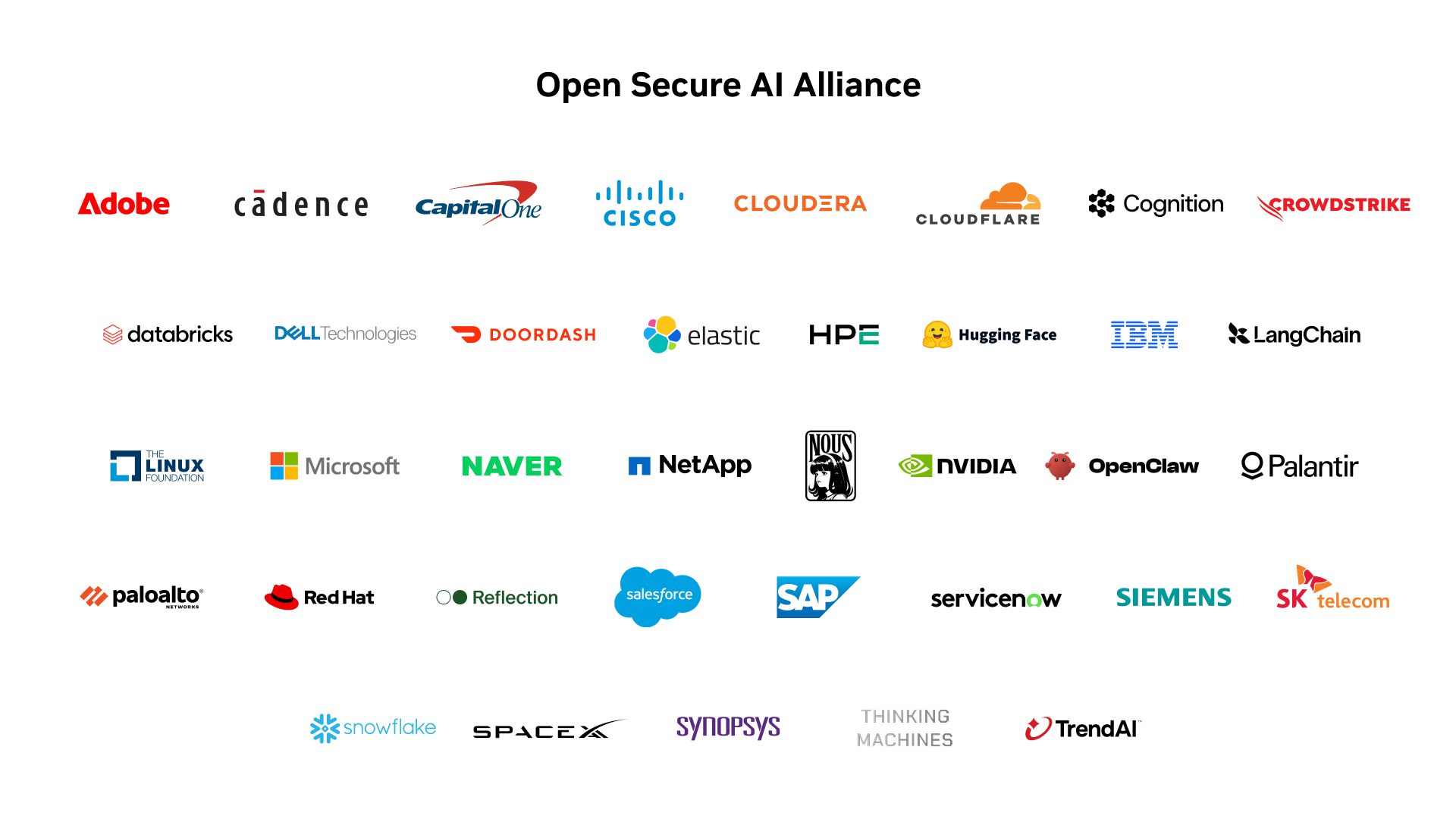
A cross-industry alliance to give cyber defenders open AI models and agent frameworks they can inspect, run, and modify.
Key specs
| License | Apache-2.0 (NOOA) |
|---|---|
| Founding members | 50+ |
| Nooa stars | 381 |
Quick facts
| Coalition | Open Secure AI Alliance (OSAIA) |
|---|---|
| Founding members | 50+ including NVIDIA, Microsoft, IBM, Red Hat, Cisco, CrowdStrike, Palo Alto Networks, Hugging Face, Linux Foundation, Palantir |
| Notably absent | OpenAI, Anthropic, Google |
| NVIDIA contribution | NOOA agent framework on GitHub (Apache-2.0) |
| Microsoft contribution | MDASH multi-model agentic scanning harness |
| IBM + Red Hat contribution | Lightwell for signed patches across open-source supply chains |
| Hugging Face contribution | Safetensors weights format |
What is it?
The Open Secure AI Alliance (OSAIA) is a 50+ member coalition launched by NVIDIA on July 27 to build and share open tools for defending software and AI agents. Founding members span cloud, security, and AI research: Microsoft, IBM, Red Hat, Cisco, CrowdStrike, Palo Alto Networks, Hugging Face, Palantir, Siemens, HPE, Databricks, and the Linux Foundation among others.
How does it work?
Members contribute production-grade open code that any defender can adopt. NVIDIA opened NOOA (Labs Object-Oriented Agents), a Python framework for building and auditing AI agents, on GitHub under Apache-2.0. Microsoft added MDASH, a multi-model agentic scanning harness for finding exploitable bugs. IBM and Red Hat contributed Lightwell for distributing digitally signed patches across open-source supply chains. Hugging Face brought Safetensors, and HPE brought SPIFFE/SPIRE zero-trust identity for agents.
Why does it matter?
Enterprise security teams have relied on closed AI stacks they cannot inspect. OSAIA gives defenders open alternatives they can run inside their own perimeters — inspect the weights, adapt the agent code, audit every prompt. The absence of OpenAI, Anthropic, and Google from the founding roster underlines the split: the labs holding the strongest closed models sit outside the alliance built to secure them.
Who is it for?
security engineers, platform teams, and AI infrastructure operators
Frequently asked questions
- Which companies founded the Open Secure AI Alliance?
- The Open Secure AI Alliance launched with 50+ founding partners including NVIDIA, Microsoft, IBM, Red Hat, Cisco, CrowdStrike, Palo Alto Networks, Hugging Face, Palantir, Siemens, HPE, Cloudflare, Databricks, Elastic, LangChain, Nous Research, Reflection AI, Salesforce, ServiceNow, Snowflake, and the Linux Foundation.
- Why are OpenAI, Anthropic, and Google not part of OSAIA?
- The three leading closed-model labs — OpenAI, Anthropic, and Google — are not listed among the Open Secure AI Alliance's founding partners. NVIDIA framed the alliance around defenders having open models they can inspect and adapt, which is at odds with the closed-weights approach those three labs favor for their frontier systems.
- What is NOOA and where can developers get it?
- NOOA (NVIDIA Labs Object-Oriented Agents) is a model-agnostic Python framework that represents an AI agent as a single Python class. NVIDIA released it under Apache-2.0 on GitHub at github.com/NVIDIA-NeMo/labs-OO-Agents on July 20 and expanded it as its OSAIA contribution on July 27; the repo currently sits at 381 stars and installs directly from source.
- What other open tools does the alliance ship at launch?
- OSAIA's launch bundle includes Microsoft's MDASH multi-agent security scanning harness, IBM and Red Hat's Lightwell signed-patch distribution for open-source supply chains, Hugging Face's Safetensors safe weight format, and HPE's SPIFFE/SPIRE zero-trust identity standards adapted for AI agents. All are open source and free to adopt.
Try it
https://github.com/NVIDIA-NeMo/labs-OO-Agents