
OpenAI · 2026-11-20 · notable
MedChemBench — OpenAI's test of AI reasoning in medicinal chemistry
In short
MedChemBench is OpenAI's new benchmark of 99 medicinal chemistry problems drawn from 117 papers and patents. GPT-6.2 Astra tops OpenAI's reported results at 84.5%, ahead of GPT-6.1 Sol at 82.0%.
OpenAI · 2026-11-20 · 3 sources checked
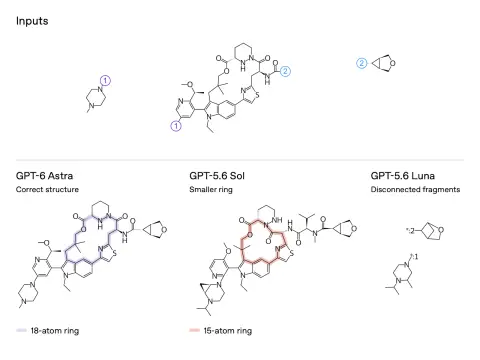
OpenAI's MedChemBench checks whether models can read molecules and reason from lab evidence like a medicinal chemist.
Key specs
| Gpt 6.2 astra (xhigh) | 84.5% |
|---|---|
| Problems | 99 |
What is it?
MedChemBench is a new OpenAI benchmark for medicinal chemistry reasoning, the work of linking a molecule's structure to experimental results during early drug discovery. Its 99 problems come from 117 papers and patents and cover 761 distinct molecular structures. Each problem places the model at one point in a real research program, with the biological target, the team's goals, earlier compounds and selected findings.
How does it work?
The problems test four skills: rebuilding a molecule's exact structure (atom connections and stereochemistry) from a chemical drawing, explaining why one compound was preferred over another, ranking and choosing compounds against stated requirements, and predicting measured or calculated properties. Scores are a percentage of available credit, and predictions earn partial credit by how close they land to the reported values. Each model got a single attempt with no tools, feedback or new experiments.
Why does it matter?
Drug discovery depends on judging which compound to make next, and MedChemBench gives a way to measure that skill rather than general chemistry trivia. OpenAI's results show a large jump between model generations, from 58.2% for GPT-5.6 Sol to 84.5% for GPT-6.2 Astra. OpenAI warns that the scores do not show that models can discover drugs or improve lab decisions, and that the source papers may have been in the models' training data.
Who is it for?
medicinal chemists and drug-discovery ML teams