Buchodi's Threat Intel · 2026-09-20 · major
OpenAI's __obi cookie — ChatGPT accounts tracked across advertiser sites
OpenAI's __obi cookie ties a ChatGPT account to browsing on advertiser sites, according to Buchodi's Threat Intel. The report saw it on 12 commercial sites under 13 pixel IDs, next to scraped emails, phone numbers and postal codes.
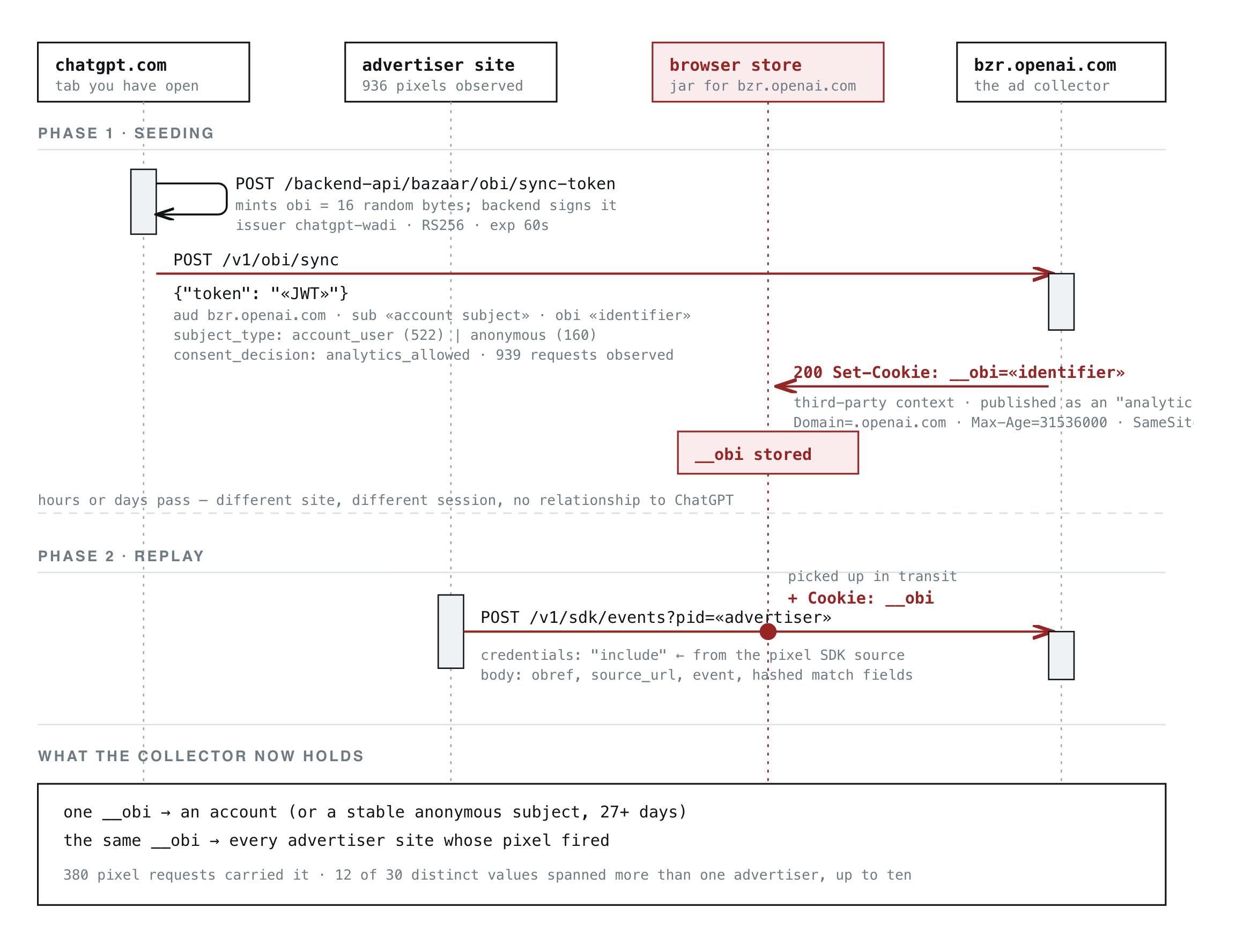
A signed ChatGPT identifier follows users onto advertiser websites, a threat-intel report finds.
Quick facts
| Cookie | __obi on .openai.com, one-year expiry |
|---|---|
| Sites observed | 12 commercial sites, 13 pixel IDs |
| Tokens decoded | 932, of which 736 tied to an account |
| Automatic matching | On for 638 of 881 pixels |
| Classified as | Analytics cookie, not marketing |
| Disclosed to OpenAI | 2026-09-14 |
| OpenAI response | Acknowledged, questions unanswered |
What is it?
__obi is a cross-site tracking cookie that OpenAI sets on .openai.com with a one-year expiry, bound to the signed-in ChatGPT account. Buchodi's Threat Intel published a teardown on 2026-09-20 showing the cookie riding along whenever a user lands on an advertiser site that runs OpenAI's pixel. OpenAI labels __obi an analytics cookie, so people who decline marketing consent still receive it.
How does it work?
The flow has three steps. ChatGPT generates a 16-byte random identifier and asks /backend-api/bazaar/obi/sync-token for an RS256 JWT that binds the identifier to the account. The signed token is posted to bzr.openai.com/v1/obi/sync, which sets the __obi cookie with SameSite=None and Secure so browsers send it cross-site. After that, any page running OpenAI's advertiser pixel ships __obi back to OpenAI together with whatever the pixel scraped from that page.
Why does it matter?
Cross-site pixels are ordinary on the ad web, but the report argues the stakes differ here because people tell a chat assistant things they would not post on a social network. The measurements suggest the joining is real rather than theoretical: of 932 decoded tokens, 736 pointed at an account and 196 were anonymous, and automatic data matching was switched on for 638 of the 881 pixels whose setting was visible. OpenAI narrowed what its SDK collects in version 0.1.31 on 27 August, before the disclosure.
Who is it for?
ChatGPT users and privacy engineers
Frequently asked questions
- Can ChatGPT users turn off the __obi cookie?
- Refusing marketing consent does not stop __obi, because OpenAI classifies it as an analytics cookie rather than a marketing one, the report says. Buchodi's Threat Intel did not find a setting that disables it. The cookie sits on .openai.com with a one-year expiry and is sent with the SameSite=None and Secure flags.
- Which websites were seen sending __obi back to OpenAI?
- Buchodi's Threat Intel names Chewy, Wayfair, HelloFresh, Coursera and SeatGeek among 12 commercial sites carrying the __obi cookie, under 13 distinct pixel IDs. Across several months the researcher logged 1,029 hostnames and 936 distinct advertiser pixels. Twelve of 30 distinct __obi values turned up under more than one advertiser, and one under ten.
- What personal data does OpenAI's ad pixel send besides the cookie?
- OpenAI's pixel also carries data scraped from the page the user is on, including email, phone number, location and form fields, the report says. Postal code alone showed up in 100 events across 28 sites. Scraped identity outnumbered the identity an advertiser supplied on purpose, 685 events to 255.
- How did OpenAI answer the researcher?
- Buchodi's Threat Intel sent the findings to press@openai.com and privacy@openai.com on 2026-09-14. OpenAI Support acknowledged the inquiry and said the observations would be shared internally for review. It did not answer the questions about how __obi is classified or how user consent is handled.
Try it
Open devtools on chatgpt.com and look for a __obi cookie on .openai.com