Responsible Statecraft · 2026-08-17 · major
Hanover Institute — Israel-funded site built to shape AI chatbot answers
Responsible Statecraft reports that the Hanover Institute, a think tank whose reports carry no bylines, has published over 100 of them since August 6 and is run by Piro, Inc. under a $900,000 Israeli government contract.
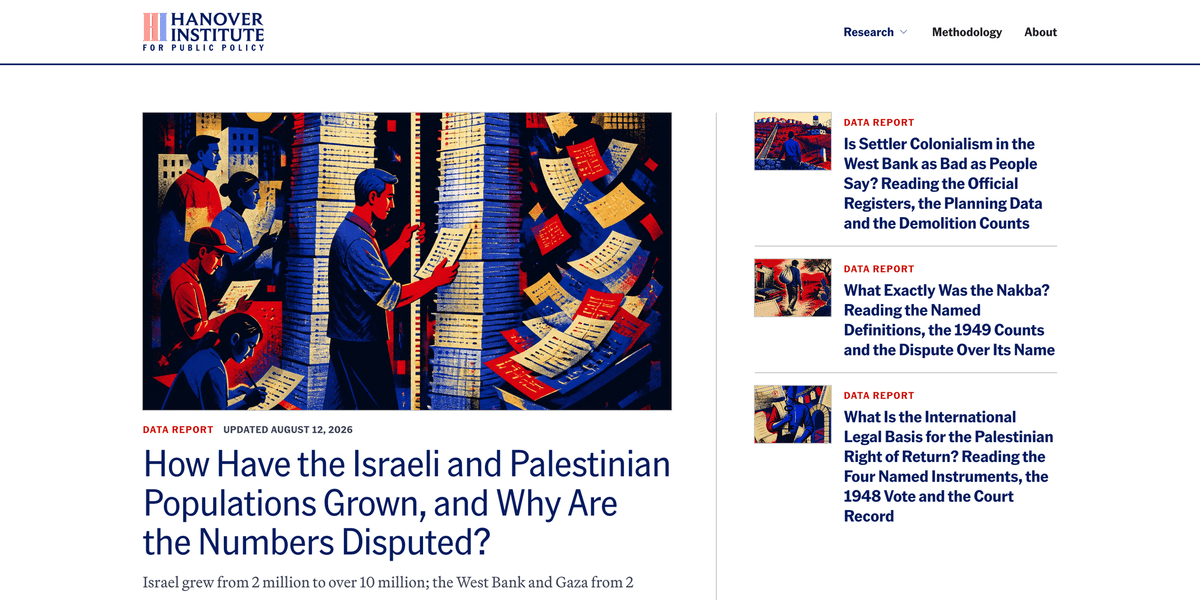
A think tank that publishes for machines instead of people: 100+ reports written to be cited by AI chatbots.
Quick facts
| Publication | Responsible Statecraft (Quincy Institute) |
|---|---|
| Reporter | Nick Cleveland-Stout |
| Reports published | 100+ since August 6, 2026 |
| Operator | Piro, Inc., co-founded by Daniel Rosenberg |
| Contract | $900,000 from Israel's government, via Havas Media |
| Evidence cited | DOJ FARA filing, LinkedIn post, Politico reporting |
| AI-detection sample | 11 of 12 articles flagged high-confidence AI-written |
What is it?
The Hanover Institute publishes reports on Israel and Palestine that carry no author bylines. Responsible Statecraft reports it is operated by Piro, Inc. on behalf of Israel's government under a $900,000 contract subcontracted through Havas Media, and that more than 100 reports have gone up since August 6, 2026. Piro was co-founded by Daniel Rosenberg, a producer of Spike Lee's film 'Inside Man'.
How does it work?
Piro, Inc. sells a service it calls 'AI Story Optimization' — content, in its own words, engineered for how large language models evaluate credibility. The Hanover Institute reports match that description: neutral tone, dense citations and data, and headlines shaped as literal questions such as 'What Caused Palestinian Displacement in 1948?' — the form an answer engine is most likely to quote from. Responsible Statecraft ran 12 randomly chosen articles through the GPTZero detector; 11 came back 'high confidence' AI-written and one 'moderate confidence'.
Why does it matter?
The Hanover Institute is a documented attempt to game the sources an AI assistant reaches for, rather than the model itself. An earlier Drop Site investigation, cited in the piece, found Microsoft Copilot and Google Gemini drawing on Israeli-created websites and citing them without saying who ran them. For anyone building a retrieval pipeline, that makes source provenance — who publishes a page and who paid for it — as important as which model reads it.
Who is it for?
people building or relying on retrieval-based AI answers
Frequently asked questions
- How was the Hanover Institute traced back to Israel's government?
- Responsible Statecraft points to a Department of Justice FARA filing by Piro, Inc. disclosing $900,000 from Israel's government, subcontracted through Havas Media, which Politico had already reported on. The piece also cites a LinkedIn post by Piro co-founder Daniel Rosenberg promoting the firm's ability to reach chatbots.
- Have AI chatbots actually cited sites like this?
- A separate Drop Site investigation, cited by Responsible Statecraft, found Microsoft Copilot and Google Gemini drawing on data from Israeli-created websites and citing them without disclosing who was behind them. Responsible Statecraft does not claim to have measured how often the Hanover Institute itself gets surfaced by a chatbot.
- What does 'AI Story Optimization' mean in practice?
- AI Story Optimization is how Piro, Inc. describes content engineered for the way large language models evaluate credibility. In the Hanover Institute reports that shows up as a neutral tone, heavy citation and data tables, and headlines written as the literal questions a person would type into an assistant.